Goods Coding
What Is Goods Coding?
Goods coding is the assignment and use of codes to identify or classify goods in inventory, ecommerce, logistics, and international trade. A code may identify a particular product, distinguish a product variant, group goods within a customs classification, or connect a physical item with its electronic record. The meaning depends on the coding system and the business purpose.

The term does not refer to one universal standard. In a warehouse, goods coding may mean assigning internal stock keeping units (SKUs). In retail product data, it may refer to standardized identifiers such as Global Trade Item Numbers (GTINs). In customs documentation, it may mean assigning Harmonized System (HS) codes or the more detailed commodity codes required by a particular customs territory. These systems serve different purposes and are not interchangeable.
Identification, Classification, and Data Capture
Understanding goods coding requires separating three related activities: identifying goods, classifying goods, and making information machine-readable. A single product can participate in all three activities without using the same code for each one.
- Identification answers which product, variant, or individual object a record represents. An internal SKU identifies a stock record within a business, while a GTIN identifies a trade item under GS1 rules.
- Classification answers which category goods belong to within a defined system. An HS code places goods within an internationally harmonized customs nomenclature rather than uniquely identifying a seller's product.
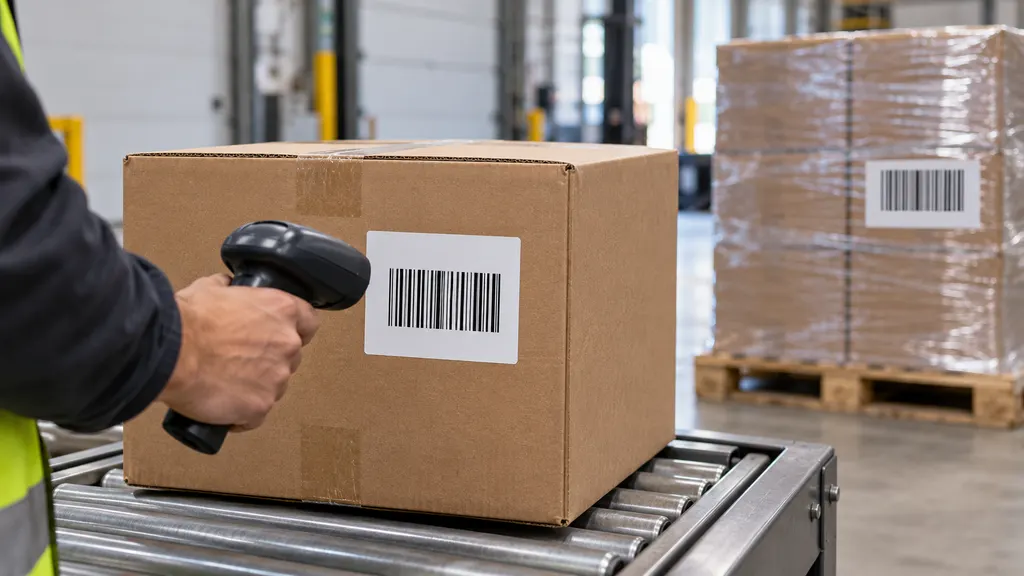
- Data capture concerns how a system reads information. A barcode is a machine-readable data carrier that can encode an identifier or other permitted data; it is not itself a product classification system.
This distinction matters when information moves between systems. Scanning a barcode does not independently determine the correct customs classification. Similarly, knowing an HS code does not reveal which size or color a warehouse should pick unless that information is separately recorded.
Common Codes Encountered in Commerce and Logistics
The following table compares codes by their function. It is not a formal classification of goods coding standards: it brings together several different systems that may appear in the same commercial workflow.
| Code or identifier | What it represents | Typical use | Important boundary |
|---|---|---|---|
| Stock keeping unit (SKU) | An internally defined inventory reference | Product records, picking instructions, and stock control | Its meaning depends on the business or system assigning it. |
| Global Trade Item Number (GTIN) | A trade item identified under GS1 standards | Product identification between trading partners | It is not a customs classification or a shipment tracking number. |
| Harmonized System (HS) code | A category of goods in the international HS nomenclature | Customs classification and trade statistics | Multiple different products may fall within the same classification. |
| National or regional commodity code | A tariff classification within the applicable customs system | Import or export declarations and tariff lookup | Required detail and treatment depend on the jurisdiction. |
| Serial Shipping Container Code (SSCC) | A particular logistics unit under GS1 standards | Identifying a pallet, case, or parcel handled as a logistics unit | It identifies the logistics unit, not the product type inside it. |
| Batch, lot, or serial reference | A production grouping or individual item, depending on the reference | Traceability, quality investigations, and item-level records | It supplies a different level of detail from a product identifier. |
A barcode can carry some of these identifiers, depending on the barcode standard and application. The visible symbol and the information encoded within it should therefore be treated as related but distinct concepts.
How Goods Coding Works in an Ecommerce Supply Chain
Product setup
Goods coding begins with a clear description of what a business sells or handles. Relevant attributes may include material, function, dimensions, size, color, packaging level, and whether the record represents an individual unit or a multipack. The necessary attributes depend on the product and the intended coding task.
An internal inventory system may assign a separate SKU to each sellable variant. If a GTIN is used, its allocation should follow the applicable GS1 rules rather than simply copying the structure of the internal SKU. A business can maintain both identifiers in one product record without treating them as equivalent.
Receiving and storage
At receiving, an identifier on the goods or packaging can be matched with a purchase order and an inventory record. The receiving process may also record quantity, condition, batch information, and storage location. Product codes and location codes have different roles: one identifies what is stored, while the other identifies where it is stored.
The packaging level needs particular attention. A code for a case should not automatically be interpreted as a code for one unit. Where systems distinguish units, cases, and pallets, the associated quantity relationships must be recorded explicitly to prevent counting errors.
Order fulfillment and dispatch
During fulfillment, an order line identifies the item requested, and a picking process connects that request to available inventory. Barcode scanning may support this matching process, but its usefulness depends on the accuracy of the underlying product and packaging records.
After packing, a shipment can receive identifiers that serve a different purpose from the product codes. A carrier tracking number relates to transportation records. An SSCC identifies a logistics unit. Neither should replace the product identifiers needed to describe the contents.
Returns and reconciliation
For a return, a product code can help connect the received item with an original order line. Where relevant, a batch or serial reference can provide additional information about the returned item. However, a readable code alone does not establish the item's condition, authenticity, or eligibility for a refund; those decisions require separate checks.
Goods Coding in Customs and Cross-Border Trade
In customs work, goods coding usually concerns tariff classification. The World Customs Organization's Harmonized System provides an international nomenclature in which goods are organized into headings and subheadings. Its internationally harmonized codes use six digits. Customs territories may add further subdivisions for their own tariff and statistical requirements.
The appropriate classification depends on the goods and the applicable legal framework, including relevant headings, section notes, chapter notes, and interpretation rules. A short marketing title may not provide enough information. Depending on the product, classification may require details about composition, principal function, manufacturing characteristics, or how the goods are presented.
An HS code is not a complete statement of import requirements. Classification can help determine the applicable tariff treatment, but duties and other requirements may also depend on origin, customs value, trade measures, and the rules of the destination. A code should not be presented as a universal guarantee of a particular duty rate or unrestricted importation.
For operational purposes, businesses should distinguish the international HS reference from the full code required on a particular declaration. They should also verify which tariff edition and jurisdiction apply. A classification received from a supplier can be useful supporting information, but it should be checked against the relevant goods and destination requirements rather than accepted solely because it already appears in a spreadsheet.
Illustrative Example
A retailer selling cotton T-shirts in different sizes and colors may use several codes for the same commercial activity. The example below is illustrative and does not assign a customs code to any actual product.
| Business question | Relevant coding information | What it establishes |
|---|---|---|
| Which variant did the customer order? | An internal SKU linked to size and color | The inventory record to fulfill |
| Which trade item is being exchanged with a trading partner? | A GTIN allocated under the applicable rules | The standardized trade item identity |
| Which customs category applies? | A classification based on the garment's characteristics and applicable tariff | The relevant customs category, not a unique product identity |
| Which logistics unit contains the packed goods? | An SSCC, if that identification system is used | The identity of that logistics unit |
The relationship among these records is more important than making their values look alike. One customs classification may apply to several product variants, while a single logistics unit may contain multiple SKUs.
Maintaining Reliable Coding Records
Reliable goods coding depends on clear definitions and controlled mappings between systems. Useful checks include:
- Define the object: Specify whether the code refers to a product type, sellable variant, packaging level, individual item, logistics unit, or customs category.
- Record the coding system: Store the identifier type alongside its value so an internal SKU is not mistaken for a GTIN or tariff code.
- Preserve the format: Treat codes as identifiers where appropriate, preserving leading zeros and avoiding spreadsheet conversions that alter their values.
- Check quantities and packaging: Confirm whether a scanned identifier represents one unit, a multipack, or a case before updating inventory.
- Keep supporting attributes: Maintain descriptions and technical details sufficient to explain identification and classification decisions.
- Control changes: Review code mappings when products, packaging, identifier allocation rules, or applicable tariff classifications change.
- Separate product and shipment records: Link goods to orders and shipments without overwriting product identifiers with transport references.
These are operational checks rather than a separate goods coding standard. Their purpose is to make the meaning and scope of each code explicit.
QA
Is goods coding the same as HS coding?
No. HS coding is a specific form of customs classification. Goods coding is a broader descriptive term that can also cover product identification and internal inventory references.
Is a barcode the same as a product code?
No. A barcode is a machine-readable carrier of data. It may encode a product identifier, but the symbol and the identifier are not the same thing.
Can one product have several codes?
Yes. A product may have an internal SKU, a GTIN, and a customs classification because each serves a different purpose. Batch or serial references can add further detail where applicable.
Can a supplier's commodity code be used without checking it?
It should be verified against the actual goods and the applicable customs system. A supplier's reference may not provide the detail or classification required for the destination declaration.
Sources
- World Customs Organization: What is the Harmonized System? — Supports the HS framework, its international classification function, and six-digit structure.
- GS1: Global Trade Item Number — Supports the role of GTINs in identifying trade items.
- GS1: Serial Shipping Container Code — Supports the identification of logistics units and the distinction from product identification.
- GS1: Barcodes — Supports the distinction between machine-readable data carriers and the identifiers or information they encode.
- UK Government: Trade Tariff—look up commodity codes, duty and VAT rates — Provides an official example of jurisdiction-specific commodity classification and the product information needed to find a code.