Bar Code
What Is a Bar Code?
A bar code, commonly written as barcode, is an optically readable symbol that represents data using a defined arrangement of bars, spaces, or other graphical elements. In logistics and ecommerce, barcodes help identify products, inventory locations, parcels, and logistics units so that scanning equipment can capture their identifiers for use in business systems. The encoded information may be an identification number, additional product data, or a link to an online resource.
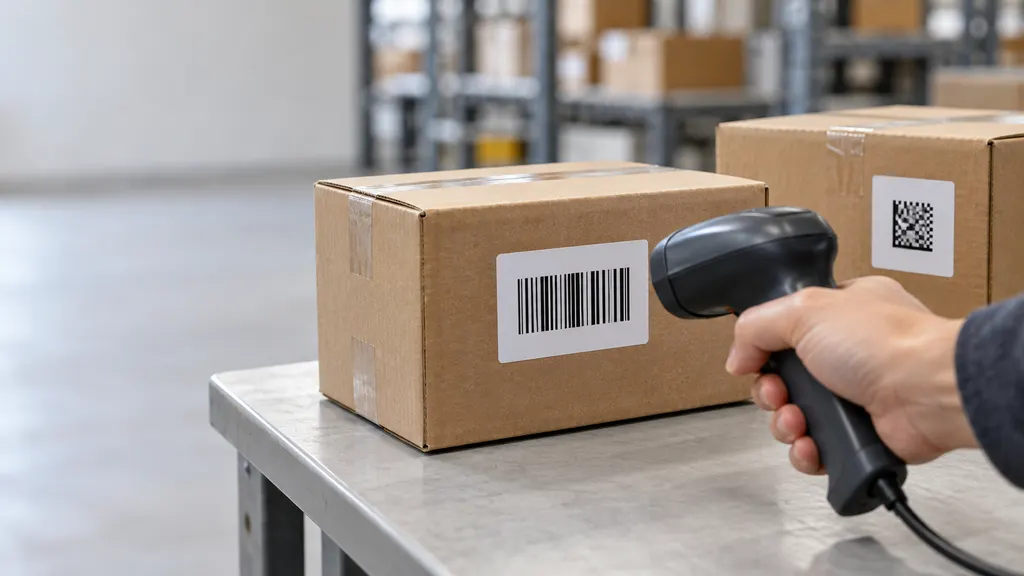
Traditional one-dimensional barcodes represent information through bars and spaces arranged along a line. Two-dimensional barcodes, such as QR Code and Data Matrix, encode information across a two-dimensional pattern. Although their appearances differ, both are forms of automatic identification and data capture. A barcode is a data carrier: its meaning depends on the encoding rules, the identifier it carries, and the system that interprets it.
How a Barcode Works
A barcode connects a physical object with information that software can process. Understanding this connection requires distinguishing the printed symbol from the data represented by that symbol and the records associated with that data.
- Data is assigned or selected. A business identifies the relevant product, storage location, shipment, or logistics unit. It may use an internal identifier or an identifier governed by an external standard.
- The data is encoded. Barcode-generation software converts the data into a symbol according to a particular symbology. A symbology defines rules for representing characters, arranging the symbol, and checking its structure.
- The symbol is displayed or printed. The barcode may appear on product packaging, a warehouse label, a shipping label, or another suitable surface.
- A reader captures and decodes it. Compatible scanning equipment interprets the graphical pattern and outputs the encoded data. Not every reader supports every barcode type.
- An application uses the result. A warehouse, retail, or shipping system may retrieve a record, validate an expected item, or record an operational event.
The barcode does not necessarily contain the information shown after scanning. For example, a product identifier can be used to retrieve a description from a product database. Similarly, a parcel identifier can connect a scan to a shipment record without encoding the parcel's complete route or delivery history.
Main Barcode Types
Barcodes can be grouped by their graphical structure into one-dimensional and two-dimensional forms. Within those groups, individual symbologies have different character sets, capacity limits, reading requirements, and application rules. Selecting a barcode therefore involves more than choosing its appearance.
| Type or symbology | Structure | Relevant commercial use | Important distinction |
|---|---|---|---|
| EAN/UPC | One-dimensional | Product identification, especially at retail checkout | Encodes a product identifier rather than a complete product record. |
| Code 128 | One-dimensional | Alphanumeric identification in business and logistics applications | The symbology alone does not define the business meaning of its data. |
| GS1-128 | One-dimensional, based on Code 128 | Structured supply-chain data on labels | Uses GS1 rules and Application Identifiers to identify data elements. |
| ITF-14 | One-dimensional | Identification of trade-item groupings, including cases | Carries a GTIN and is suited to applications that include printing on corrugated material. |
| GS1 DataMatrix | Two-dimensional | Product identification and associated structured data | Uses Data Matrix with GS1 data-formatting rules. |
| QR Code | Two-dimensional | Web links and other encoded information | A QR Code is not automatically a standardized product or shipment identifier. |
Two-dimensional symbols can accommodate more information within a compact area than many linear symbols, but that does not make them interchangeable with existing labels. Reader capability, software support, trading-partner requirements, and the applicable identification standard determine whether a particular symbol is appropriate.
Use in Logistics and Ecommerce
Receiving and inventory control
At warehouse receiving, a worker may scan a product or case barcode and compare the result with an expected receipt. The warehouse application can then associate the received quantity with an inventory record. A separate location barcode may identify the shelf, bin, or storage area where the goods are placed.
These identifiers serve different purposes. A product barcode identifies the product or relevant trade item; a location barcode identifies where goods are stored. A scan supports inventory accuracy only when the software correctly interprets the identifier and records the intended operation. Scanning a product without confirming quantity, location, or workflow context does not by itself establish an accurate stock balance.
Picking, packing, and dispatch
During picking, scanning may help compare a selected item with an order requirement. At packing, a business may scan the item again to check its association with the order. These are possible workflow controls rather than capabilities guaranteed by the barcode itself.
Dispatch introduces a different identification layer. A shipping label may contain a barcode representing a parcel identifier or another reference required by the carrier. A logistics label may identify a pallet or other logistics unit using a Serial Shipping Container Code, or SSCC. Product identification and logistics-unit identification should not be treated as equivalent: a pallet can contain multiple products, while identical products can travel in separate parcels.
Delivery and returns
In parcel networks, scanning an identifier can contribute to a tracking event when the carrier's system associates the scan with a location, time, and operational status. The symbol itself does not continuously report the parcel's position. Tracking visibility depends on the events captured and made available by the relevant systems.
For a return, a barcode may identify a return authorization, a return shipment, or the product being returned. These references answer different questions. A return-shipment identifier connects the parcel to its transport record, while a product identifier helps establish what item has arrived. Neither alone proves that a refund has been approved.
Cross-border shipments
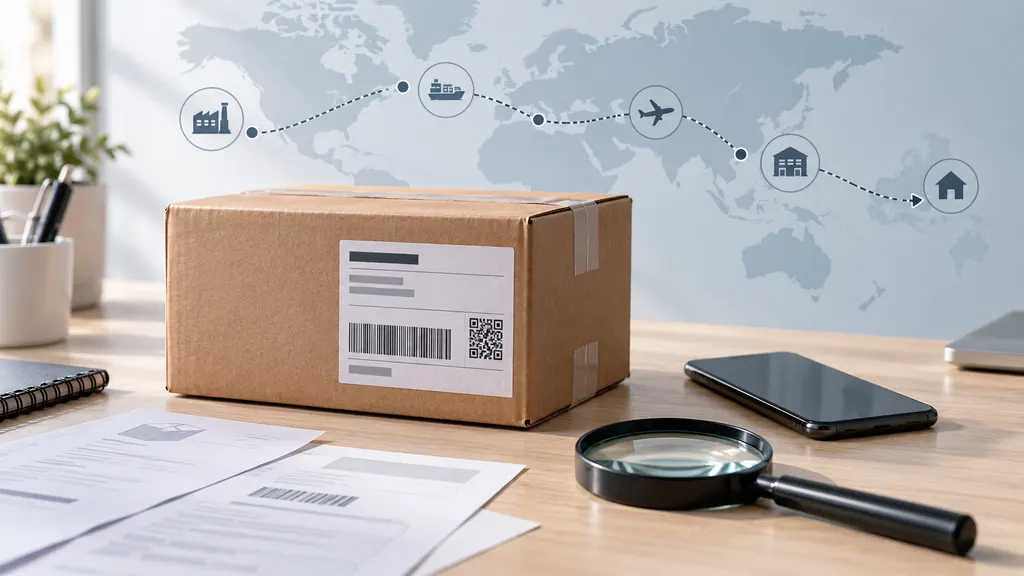
In cross-border ecommerce, barcodes can help connect physical goods and parcels with records exchanged among sellers, warehouses, and transport operators. Standardized identifiers can support data exchange, but interoperability still requires compatible data definitions and systems.
A product barcode should not be assumed to establish customs classification, country of origin, declared value, or import eligibility. Those are separate trade-data and compliance questions. A barcode may provide access to supporting records, but scanning it does not replace the information or documents required for a particular shipment.
Barcode, Identifier, SKU, and Tracking Number
Several terms appear together on packaging and labels but describe different things. The distinction is between the graphical carrier, the identifier carried, and the business object identified.
| Term | Meaning | Relationship to a barcode |
|---|---|---|
| Barcode | A machine-readable graphical representation of data | Carries an identifier or other encoded information. |
| GTIN | Global Trade Item Number, a GS1 identifier for trade items | Can be represented in an appropriate barcode. |
| SKU | Stock keeping unit, used by a business to identify an inventory item | May be encoded in a barcode; it is not automatically a globally standardized identifier. |
| Tracking number | An identifier used to retrieve shipment or parcel tracking information | May appear as both readable text and encoded data on a shipping label. |
| SSCC | A GS1 identifier for a logistics unit, such as a pallet, case, or parcel | Can be encoded on a logistics label, including in GS1-128. |
| Serial number | An identifier distinguishing an individual instance within its identification context | Can be encoded with other data when the format and application support it. |
A product-level identifier does not necessarily identify an individual physical item. Multiple units of the same trade item may carry the same GTIN. Distinguishing individual units requires additional identification, such as serialization, where supported by the relevant system.
Reading Quality and Operational Checks
Successful scanning depends on both symbol quality and correct application. A readable barcode carrying the wrong identifier can still produce an operational error. Conversely, correctly assigned data may be unusable if the printed symbol cannot be decoded reliably.
- Check the required format. Confirm the symbology, data structure, and label requirements with the receiving system or trading partner before producing labels.
- Check identifier assignment. Ensure that the encoded value refers to the intended product, parcel, location, or logistics unit.
- Preserve symbol geometry. Avoid stretching, clipping, or resizing that changes required proportions or makes the symbol unsuitable for its application.
- Maintain clear space. Keep the required quiet zones around the symbol free of text, borders, and other graphics.
- Consider the physical surface. Wrinkles, damage, poor contrast, reflective packaging, and placement across edges can interfere with reading.
- Test the complete workflow. Confirm not only that a reader decodes the symbol, but also that the destination application interprets and records the data correctly.
Barcode verification is more specific than a successful test scan. Verification evaluates symbol quality against applicable criteria using appropriate equipment and methods. A symbol that reads on one device is not thereby proven to meet all relevant quality or application requirements. GS1 guidance distinguishes verification from ordinary scanning and addresses both print quality and data integrity.
Common Misunderstandings
A barcode is not a complete database. Some symbols carry additional attributes, but many contain an identifier used to look up information elsewhere. Product descriptions, prices, and shipment histories may be stored outside the symbol.
A barcode is not proof of authenticity. A visible symbol can be copied. Authentication requires suitable controls beyond the mere presence of a readable code.
A barcode is not an RFID tag. Barcodes are read optically, whereas radio-frequency identification uses radio communication. Both can support automatic identification, but their reading methods and infrastructure differ.
A scan is not necessarily a location update. Its meaning depends on the application and workflow. A warehouse inventory scan, for example, is not automatically a carrier tracking event.
QA
Are “bar code” and “barcode” different terms?
No. They are alternative spellings of the same term. “Barcode” is widely used as a single word in standards and technical documentation.
Is a QR Code a barcode?
Yes. A QR Code is a two-dimensional barcode. Its encoded content may be a web address or other data; it does not necessarily identify a product or shipment.
Is a barcode the same as a tracking number?
No. A tracking number is an identifier, while a barcode is a graphical way to represent data. A shipping label may encode a tracking number in a barcode.
Does scanning a barcode automatically update inventory?
No. Inventory changes occur only when the connected application interprets the scan as part of a configured transaction, such as receiving, picking, or stock adjustment.
Sources
- GS1: Barcodes — Barcode functions, linear and two-dimensional symbologies, and supply-chain applications.
- GS1: Global Trade Item Number (GTIN) — Trade-item identification and the distinction between identifiers and data carriers.
- GS1: Serial Shipping Container Code (SSCC) — Identification of logistics units.
- GS1: Barcode Verification — Barcode quality assessment and the distinction between verification and scanning.
- GS1: EPC/RFID — Radio-frequency identification as a distinct automatic-identification technology.