Logistics Label
What Is a Logistics Label?
A logistics label is a label attached to a physical unit, such as a carton, pallet, or parcel, to identify it and communicate information needed for handling, storage, transport, or delivery. It connects the physical unit with information in warehouse, transport, and trading-partner systems. Depending on its purpose, it may contain human-readable text, barcodes, destination details, and references to associated records.
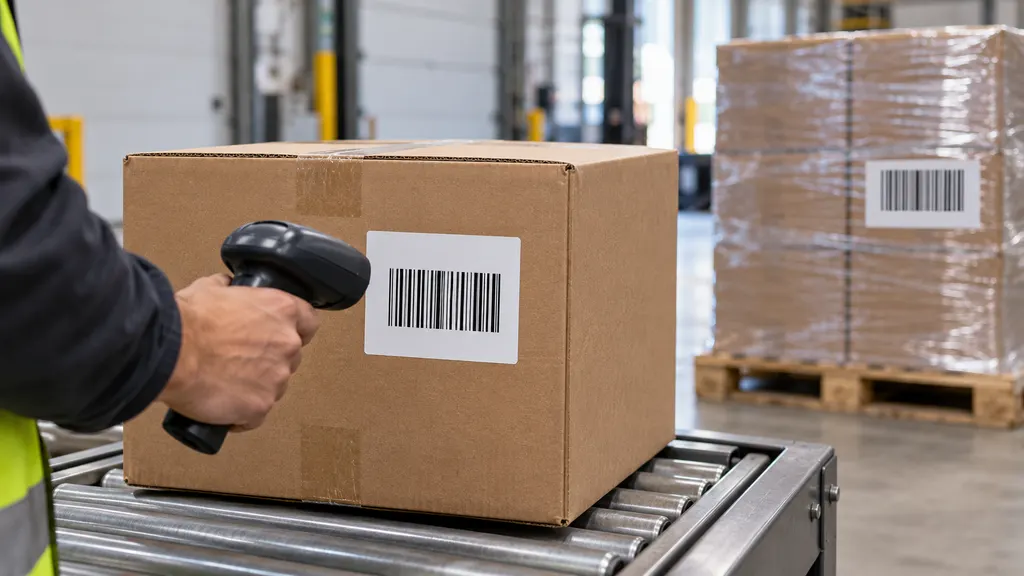
The term has both a broad operational meaning and a more specific standards-based meaning. In everyday logistics, it may describe several labels used to move and identify goods. In the GS1 system, a GS1 Logistic Label identifies a logistic unit using a Serial Shipping Container Code, or SSCC. This distinction matters because a carrier shipping label is not automatically a GS1 Logistic Label, even when both contain barcodes.
What a Logistics Label Identifies
A logistics label usually identifies a unit being handled or transported rather than simply describing a product. That unit may contain one item, multiple identical items, or an assortment of different products. Its identity allows a warehouse or transport operator to associate a scan with information about the unit.
For example, a retailer may receive a pallet containing several cartons of merchandise. A pallet label can identify the pallet as one logistic unit, while separate carton labels identify units handled individually. Product identifiers on the contents serve a different purpose: they identify the trade items rather than necessarily identifying each physical pallet or carton.
The distinction also applies to ecommerce orders. An order is a commercial record, whereas a parcel is a physical unit. One order may be fulfilled through several parcels, and each parcel may need its own transport identification. An order number alone therefore does not necessarily identify the package being scanned.
The GS1 Logistic Label
The GS1 Logistic Label provides a standardized way to identify logistic units and present related information. Its central identifier is the SSCC, an 18-digit identification key. The SSCC identifies the logistic unit; it does not, by itself, describe every product inside it.
Information about contents, shipment relationships, or commercial transactions can be associated with the SSCC in electronic records. This allows a receiving system to use a scanned identifier to find the corresponding information rather than requiring every detail to appear on the label.
GS1-128 barcodes are used on GS1 Logistic Labels to encode the SSCC and, where applicable, additional standardized data. GS1 Application Identifiers specify the meaning and format of the encoded fields. The Application Identifier (00) identifies an SSCC. The parentheses shown in human-readable text are not encoded as part of the barcode data.
These requirements belong to the GS1 system. They should not be generalized into a claim that every logistics label must carry an SSCC or use GS1-128. Carrier labels and other operational labels may follow different specifications.
Information Found on Logistics Labels
Label content depends on the identification system, transport service, trading-partner agreement, and operational purpose. The following are common information categories, not a universal list of mandatory fields.
| Information category | Purpose | Important distinction |
|---|---|---|
| Unit identifier | Identifies the physical unit being handled. | An SSCC identifies a logistic unit within the GS1 system; other systems may use different identifiers. |
| Destination information | Indicates where the unit should be sent. | An address or receiving location does not uniquely identify the unit. |
| Routing or service information | Supports transport sorting and service execution. | Its format and interpretation can depend on the carrier or network. |
| Order or shipment references | Connects the unit with commercial or transport records. | One reference may relate to multiple physical units. |
| Contents information | Describes associated products, quantities, or other permitted attributes. | The label may contain only selected details; fuller information can remain in electronic records. |
| Machine-readable symbols | Allow scanning equipment to capture encoded information. | A barcode is a data carrier, not the identifier itself. |
Human-readable information supports visual checking and exception handling. Machine-readable information supports automated capture. Both must correspond to the intended unit, but their presence does not guarantee that the associated electronic record is complete or correct.
How Logistics Labels Are Used
- Define the unit. The sender determines what will be identified, such as an individual parcel or a pallet assembled for transport. This prevents confusion between the contents and the handling unit.
- Assign the appropriate identifier. The identifier is created or obtained under the applicable carrier, warehouse, or standards-based system. Where an SSCC is used, its allocation follows GS1 rules rather than an arbitrary internal numbering convention.
- Associate the identifier with records. Relevant information is linked to the unit in operational systems. Depending on the process, this may include contents, destination, shipment references, or receiving instructions.
- Print and apply the label. The label is attached to the intended unit in a location suitable for the applicable handling process. Placement and print requirements depend on the specification being followed.
- Capture events through scanning. Scans can support receiving, sorting, loading, dispatch, and delivery processes. Their meaning depends on the system and the operation in which they occur.
- Manage changes and exceptions. If the unit is repacked, divided, combined, or redirected, the operator determines whether its existing identity remains valid and which labels or electronic records need updating.
A printed label is therefore one part of a larger information process. It does not independently create a transport event, confirm that a carrier has possession, or prove that the recorded contents match the actual contents.
Related Labels and Documents
Several labels and documents may accompany the same goods. Their functions can overlap, but they are not interchangeable.
| Term | Main function | Relationship to a logistics label |
|---|---|---|
| Shipping label | Provides information used to transport a parcel or shipment through a delivery network. | Often described as a logistics label in broad usage, but not necessarily a GS1 Logistic Label. |
| Product label | Identifies or describes a trade item. | Identifies the product rather than necessarily identifying the individual transport unit. |
| Packing list | Lists the contents associated with a shipment or package. | Provides documentary detail rather than serving solely as a scannable unit identifier. |
| Customs declaration | Provides information required for customs processing. | A logistics label does not automatically replace the required customs information or documentation. |
| Handling label | Communicates a handling instruction or warning. | May accompany an identification label but performs a different function. |
| Return shipping label | Supports transport of goods back to a designated destination. | Serves the return movement rather than automatically reusing the outbound transport identity. |
Use in Ecommerce and Cross-Border Logistics
In ecommerce fulfillment, labels connect packed goods with the records used to dispatch and receive them. A warehouse may use internal identifiers during picking and packing, then apply a carrier shipping label before dispatch. For palletized deliveries, a standards-based logistic unit identifier can support information exchange between trading partners.
Cross-border movements add documentary and data requirements, but the basic identification function remains the same. A logistics label identifies or routes a physical unit; customs information describes matters relevant to border processing. Some shipping workflows combine these functions on a document or label set, while others keep them separate. Required information depends on the route, goods, service, and applicable customs procedures.
For example, a seller may place several individually labeled parcels inside an outer transport container. The outer container and the parcels represent different handling levels. A label identifying the outer unit should not be assumed to identify each enclosed parcel for final delivery. Each identifier needs a clear relationship to the unit and process it serves.
Operational Checks and Common Misunderstandings
Label checks should address both physical readability and data accuracy. A perfectly readable barcode can still produce the wrong operational result if it belongs to another unit or points to an incorrect record.
- Confirm the unit: Check that the label belongs to the actual parcel, carton, or pallet being dispatched.
- Confirm the specification: Use the requirements applicable to the carrier, receiving partner, or identification standard rather than assuming one format suits every network.
- Check print and placement: Keep symbols readable and avoid placement that obscures them through folds, damage, or overlapping labels. Follow applicable requirements for dimensions and positioning.
- Control obsolete labels: Remove, cover, or otherwise manage superseded labels when required so that an unintended symbol is not captured.
- Check data alignment: Ensure the identifier, destination, and associated electronic records describe the same intended movement.
- Review repacking: When the physical unit changes, determine whether a new identity is required under the system being used.
Another common misunderstanding is that every barcode on a package is a tracking number. A package may display product identifiers, warehouse references, and transport identifiers. Their appearance alone does not establish their meaning. Similarly, a label marked with an SSCC is not necessarily a customer-facing parcel tracking label: the SSCC and a carrier tracking identifier serve different identification contexts.
QA
Is a logistics label the same as a shipping label?
They can overlap in everyday usage. A shipping label supports transport through a delivery network, while logistics label is a broader term. A GS1 Logistic Label has a specific standards-based meaning centered on the SSCC.
Does every logistics label need an SSCC?
No. The SSCC is central to the GS1 Logistic Label, but other operational and carrier labels may use different identifiers and specifications.
Does an SSCC describe the contents of a pallet?
Not by itself. It identifies the logistic unit. Information about the contents can be associated with that identifier in electronic records, and selected additional information may appear on the label.
Can a logistics label replace customs documentation?
Not automatically. Identification and routing information do not by themselves satisfy all customs requirements. The documentation and data needed depend on the particular cross-border movement.
Sources
- GS1 — GS1 Logistic Label Guideline: Standards-based label structure, logistic unit identification, label information, and operational application.
- GS1 — Serial Shipping Container Code (SSCC): Identification of logistic units and the relationship between identifiers and associated information.
- GS1 — GS1-128: Barcode use in logistics and standardized data encoding through GS1 Application Identifiers.
- U.S. Customs and Border Protection — Internet Purchases: An official jurisdiction-specific example of customs documentation and import considerations for cross-border purchases; not a universal label specification.