Global Returnable Asset Identifier(Grai)
What Is a Global Returnable Asset Identifier (GRAI)?
A Global Returnable Asset Identifier (GRAI) is a GS1 identification key used to identify reusable transport assets, such as pallets, crates, roll cages, and other returnable containers. It can identify an asset type and, when an optional serial component is included, an individual asset. In logistics, a GRAI helps organizations identify the equipment that carries goods through repeated distribution and return cycles, rather than identifying the goods themselves.
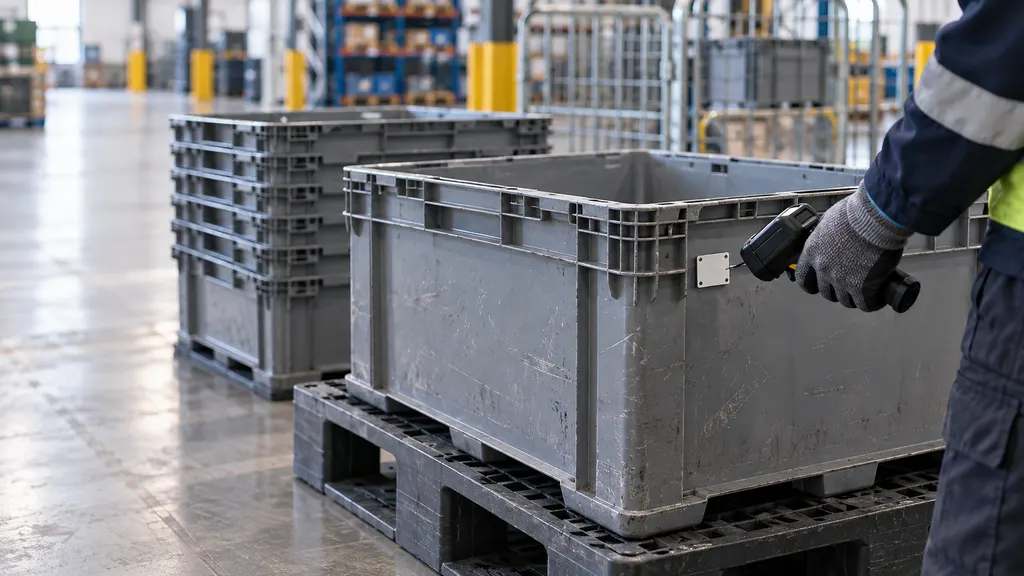
The distinction matters because a reusable container may carry different products on successive journeys. Its asset identity can remain unchanged even when its contents, destination, shipment reference, or custodian changes. A GRAI provides the reference that information systems can use to associate those separate journeys with the same asset or asset type.
What a GRAI Identifies
GS1 defines the GRAI specifically for returnable assets. These include reusable transport items that circulate between supply-chain participants instead of being discarded after one delivery. Depending on the operation, an asset may move between a manufacturer, distribution center, retailer, logistics provider, and an organization responsible for collecting or managing reusable equipment.
A GRAI supports two identification levels:
- Asset-type identification: the identifier distinguishes a category of returnable assets defined by the assigning organization.
- Individual asset identification: adding a serial component distinguishes one physical asset from others of the same type.
The level chosen determines what records can reliably describe. A type-level identifier can support identification of a container category, but it does not by itself distinguish two otherwise identical containers. Recording the repair history or last observed location of a specific container requires individual identification.
Here, returnable describes reusable equipment intended to circulate through a return process. It does not mean that a customer has requested a product return, refund, or exchange.
Structure and Data Representation
A GRAI contains a GS1 Company Prefix, an asset type reference, a check digit, and an optional serial component. The company prefix and asset type reference together occupy a defined numeric structure; their individual lengths depend on the company prefix allocated under the GS1 system.
| Component | Purpose | Interpretation |
|---|---|---|
| GS1 Company Prefix | Provides the allocation namespace | Allows the organization assigning the identifier to create asset references within its GS1 allocation. |
| Asset type reference | Identifies a returnable asset type | Its meaning is established through the assigning organization's asset records. |
| Check digit | Checks numeric integrity | Helps detect certain entry errors; it does not authenticate an asset. |
| Optional serial component | Identifies an individual asset | Distinguishes one physical item within the asset type. |
The numeric portion of a GRAI has 13 digits, including its check digit. The optional serial component can contain up to 16 alphanumeric characters. When represented in a GS1 element string, a GRAI uses Application Identifier (8003), and a leading zero precedes the 13-digit numeric portion. That representation rule should not be confused with the underlying identification key's component structure.
The identifier and its data carrier are separate concepts. A GRAI can be represented in an appropriate GS1 barcode or encoded using a suitable GS1 EPC/RFID representation. The applicable encoding rules depend on the carrier. Implementers should therefore consult the GS1 General Specifications and, where relevant, the associated EPC standards rather than assume that every representation uses identical character restrictions or formatting.
How a GRAI Is Used in Logistics
A GRAI connects a physical reusable asset with records about its use. It does not contain a complete movement history, maintenance record, or ownership agreement. Those details reside in systems that reference the identifier.
- Define the identification requirement. The organization decides whether it needs to distinguish asset types, individual assets, or both.
- Allocate the identifier. The responsible organization creates the GRAI under the applicable GS1 allocation rules and records its associated asset information.
- Mark or tag the asset. An appropriate label, direct marking, or RFID tag makes the identifier readable during operations. The marking method must suit the asset's handling and reuse conditions.
- Capture operational events. Readers or scanning devices collect the identifier at relevant points, such as dispatch, receipt, collection, inspection, or repair.
- Associate business context. Software links the observation to a time, location, business step, shipment, or trading partner, as required by the process.
- Reconcile and reuse. Asset records can support return reconciliation and preparation for another cycle without assigning a new identity for every journey.
GS1 EPCIS provides a standard for sharing visibility event data between applications and organizations. It can support records concerning identified assets, but adopting a GRAI does not automatically mean that an organization uses EPCIS. Identification and event-data exchange are related but separate implementation decisions.
Illustrative Distribution Example
A retailer may receive goods in reusable crates from a distribution center. If each crate carries a serialized GRAI, the receiving system can record which individual crates arrived. After unloading, the retailer can scan the empty crates when returning them. The distribution center can then compare the recorded outgoing and incoming assets.
In this example, the product identifiers describe the goods, shipment records describe the delivery, and the GRAIs describe the crates. If a crate requires repair, its individual identifier can also link it to an inspection record. This is an illustrative workflow, not evidence that every retailer implements these steps.
Relationship to Other Supply-Chain Identifiers
Several identifiers may appear in the same warehouse transaction because they identify different objects. The correct choice depends on whether the record concerns a product, a logistics unit, or a reusable asset.
| Identifier or Reference | Primary Identification Purpose | Difference from GRAI |
|---|---|---|
| Global Trade Item Number (GTIN) | Identifies a trade item that may be priced, ordered, or invoiced. | Describes the trade item rather than serving as the returnable asset's circulation identity. |
| Serial Shipping Container Code (SSCC) | Identifies a logistics unit assembled for transport or storage. | Identifies the logistics unit, not the reusable equipment independently of its load. |
| Global Individual Asset Identifier (GIAI) | Identifies an individual asset. | Uses a different GS1 key structure; GRAI specifically supports returnable asset types and optional individual serialization. |
| Carrier tracking number | References a consignment, parcel, or movement within a carrier's system. | Supports shipment tracking rather than persistent identification of reusable equipment. |
For example, a reusable pallet can retain its serialized GRAI while supporting different logistics units over its working life. A particular palletized load can have an SSCC, while the products on that pallet have their own trade item identifiers. These identifiers are complementary rather than interchangeable.
Use in Ecommerce and Cross-Border Operations
In ecommerce fulfillment, a GRAI is relevant when reusable equipment circulates through warehouses, sorting facilities, stores, or delivery operations. It may identify a reusable tote used to move orders internally or a returnable container exchanged between business partners. It is not a replacement for an order number or a consumer parcel's shipping label.
For cross-border movements, consistent asset identification can help partners refer to the same equipment even when their internal asset codes differ. However, a GRAI is not a customs declaration, tariff classification, proof of origin, or authorization for temporary admission. Any customs treatment of reusable equipment depends on the applicable rules and transaction circumstances, not simply on the presence of a GS1 identifier.
Similarly, an asset identifier does not establish ownership, a deposit amount, or liability for loss. Those matters require supporting master data, contracts, transaction records, or other relevant evidence.
Implementation Checks and Limitations
The practical value of a GRAI depends on the surrounding process. Before deployment, organizations should check the following points:
- Identification granularity: use serialization when the process needs individual custody, maintenance, or movement records.
- Data validation: distinguish the identification key from its barcode or RFID representation, and validate formatting against the relevant GS1 rules.
- Master data: maintain a reliable association between the identifier, the physical asset, and the asset type description.
- Physical readability: select marking and tag placement appropriate to cleaning, stacking, abrasion, and handling conditions.
- Event coverage: define which handovers and processing steps require capture. An unrecorded movement cannot be reconstructed from the identifier alone.
- Partner interpretation: agree on data exchange, event meanings, and reconciliation responsibilities before relying on shared records.
A scan proves that a reader captured a particular identifier at a recorded event; interpreting that event still requires context. A GRAI is not a GPS device and does not independently report a live location. Likewise, a valid check digit does not prove that a label is genuine or attached to the correct asset.
QA
Does every returnable asset need a serialized GRAI?
No. A GRAI can identify an asset type without a serial component. Serialization is needed when the application must distinguish individual assets, such as for item-specific return reconciliation or maintenance records.
Is a GRAI the same as a shipment tracking number?
No. A GRAI identifies returnable equipment, while a carrier tracking number references a shipment or movement within the carrier's system. The equipment may retain its identity across multiple shipments.
Can a reusable pallet have both a GRAI and an SSCC?
Yes. The GRAI can identify the reusable pallet, while an SSCC identifies a logistics unit formed using that pallet. They refer to different identification purposes.
Does a GRAI show an asset's current location?
Not by itself. Location information comes from observations or other records linked to the identifier. Without those records, the identifier alone does not reveal where the asset is.
Sources
- GS1: Global Returnable Asset Identifier (GRAI) — Official definition, returnable asset applications, and individual identification through serialization.
- GS1 General Specifications — Identification key structures, Application Identifier (8003), data representation rules, and distinctions among GS1 identification keys.
- GS1: EPCIS — Standardized sharing of visibility event data across applications and organizations.