Scissor Lift Table
What Is a Scissor Lift Table?
A scissor lift table is a material-handling device that raises and lowers a load-supporting platform using linked, crossing arms arranged in a scissor-like mechanism. In warehouses, fulfillment centers, and production facilities, it positions goods at a suitable height for loading, unloading, packing, inspection, or transfer. Its main purpose is to adjust the working height of materials, rather than to transport them over long distances.
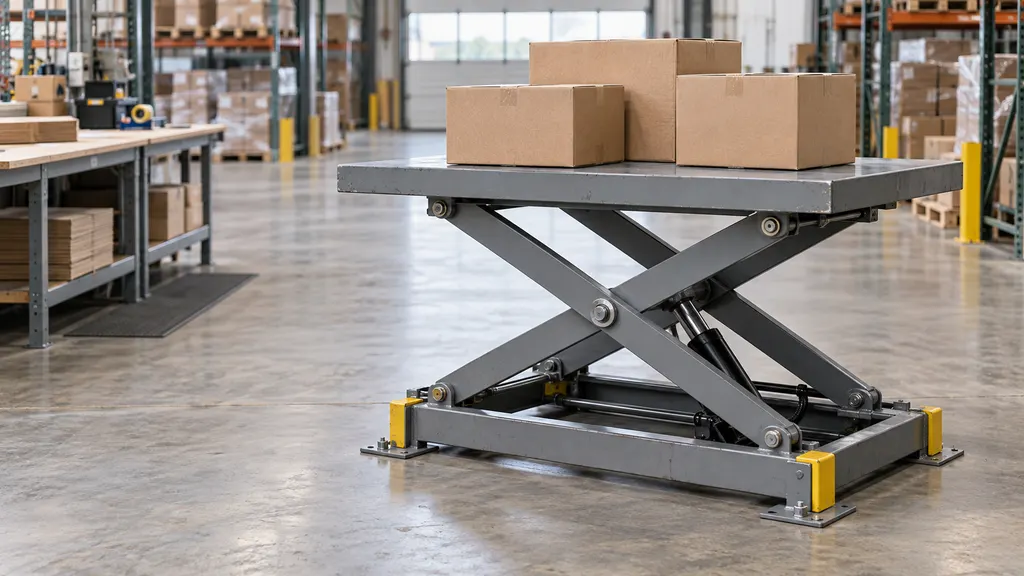
The term describes both the lifting mechanism and the platform it supports. A scissor lift table may be installed in a fixed location or mounted on a mobile base. It is a type of lift table, but not every lift table uses a scissor mechanism. Equipment designed to lift goods must also be distinguished from a scissor lift intended to elevate people.
How a Scissor Lift Table Works
The platform rests above one or more sets of pivoting arms. As the mechanism opens, the platform rises; as it closes, the platform descends. The arms guide the platform through its vertical movement, while a base supports the assembly. The design must accommodate movement at the arm ends as the angle of the mechanism changes.
Hydraulic designs use a cylinder to move the mechanism. A pump supplies hydraulic pressure, and controlled fluid release allows the platform to lower. Depending on the model, the pump may be operated manually or by an electric motor. Other designs use mechanical drives or pneumatic arrangements. The power source and control method should therefore be confirmed from the equipment specification rather than inferred from its appearance.
Some load-positioning tables use springs or other balancing arrangements to change platform height as goods are added or removed. These differ operationally from tables that remain at a selected height until an operator activates a control. Automatic height adjustment is a model-specific feature, not an inherent property of every scissor lift table.
Role in Warehousing and Ecommerce Fulfillment
A scissor lift table operates at the physical handling stage of a supply chain. It supports goods while workers or connected equipment transfer, process, or inspect them. It does not identify inventory, allocate orders, generate shipping labels, or provide shipment tracking, although it may form part of a workstation where those activities occur.
Its relevance to ecommerce lies primarily in the handling of cartons, containers, pallets, and returned merchandise. Adjusting the platform height can reduce the need to reach down to floor level or work with materials at an unsuitable height. However, the ergonomic result depends on the entire task, including reach distance, load weight, handling frequency, and workstation layout. A lift table alone does not eliminate manual-handling risk.
| Activity | Illustrative use | Important condition |
|---|---|---|
| Receiving | A worker raises a container of incoming goods for inspection or sorting. | The load must remain stable as items are removed. |
| Pallet loading and unloading | A pallet is raised or lowered to position the active layer closer to working height. | The table must accommodate the pallet dimensions and loading method. |
| Packing | A heavy carton is supported beside a packing surface. | The transfer gap and height difference require assessment. |
| Returns processing | A container of returned items is positioned for examination and repacking. | Uneven or shifting contents must not create an unstable load. |
| Production supply | Components are presented beside an assembly station. | Platform movement must not create trapping points against adjacent equipment. |
These are possible applications, not evidence that every facility needs this equipment. In a cross-border fulfillment operation, its function remains physical material handling; it does not change customs status, tariff classification, or import documentation requirements.
Configurations and Features
Scissor lift tables vary along several independent design dimensions. Mounting arrangement, lifting mechanism, platform surface, and control system should not be treated as a single classification. For example, a stationary table can have either a plain platform or a roller surface, while both stationary and mobile models may use hydraulic lifting.
- Stationary installation: The table operates at a designated workstation. Installation may require anchoring or other arrangements specified by the manufacturer.
- Mobile base: Wheels or casters allow relocation within the conditions specified for that model. Mobility does not automatically permit travel with an elevated load.
- Low-profile or pit-mounted arrangement: A reduced loading height or recessed installation can help accommodate certain loading methods. Floor conditions, access, and surrounding edges require separate consideration.
- Multiple scissor stages: Stacked mechanisms can provide additional vertical travel. Side-by-side mechanisms may support a different platform geometry. Neither arrangement alone establishes load capacity.
- Special platform features: Turntables, rollers, tilting sections, or fixtures may support a particular handling task. Each introduces additional operating conditions and potential hazards.
Features such as perimeter safety bars, bellows, travel limits, and maintenance supports vary by model. Their presence, function, and limitations should be checked in the manufacturer's documentation rather than assumed from the equipment category.
Selection and Operating Conditions
Selecting a scissor lift table involves more than comparing the load weight with a rated capacity. The intended load, its position, the method of transfer, and the operating environment all affect suitability. The following checks help define the application without replacing an engineering assessment or the manufacturer's instructions.
- Establish the complete supported load. Consider the goods together with pallets, containers, fixtures, and other items carried on the platform. Confirm how accessories affect the available capacity.
- Check load distribution. A centrally distributed load is not equivalent to a concentrated, offset, or rolling load. Consult the specified loading conditions and any restrictions on the load center.
- Match platform dimensions to the task. Assess the load footprint, permitted overhang, stability, and access needed by the operator. A larger platform does not necessarily mean a higher capacity.
- Confirm the required height range. Compare the lowered and raised platform positions with the actual loading surface, unloading surface, and working task. Lift travel alone does not describe every relevant height.
- Evaluate the transfer method. Forklift placement, pallet-truck access, conveyor transfer, and manual loading impose different requirements. Check clearances and compatibility before use.
- Review operating frequency. Confirm that the drive, hydraulic system, and controls are suitable for the intended duty cycle. Rated capacity does not establish suitability for continuous operation.
- Assess the installation environment. Consider floor strength and levelness, available space, power supply, moisture, contamination, and any special environmental requirements.
- Plan inspection and maintenance access. The equipment must be accessible for the checks and servicing required by its instructions and applicable local rules.
Safety and Equipment Boundaries
The moving scissor mechanism creates potential crushing and shearing hazards. Additional trapping points can occur between the platform and a wall, conveyor, workbench, or other fixed object. A task assessment should therefore consider the surrounding installation as well as the table itself.
Operators should follow the equipment instructions, keep people clear of moving components, and avoid exceeding specified loading conditions. Loads should be positioned and secured as required for the application. A mobile table should not be moved with a raised load unless the manufacturer expressly permits that operating condition.
Work beneath a raised platform requires the prescribed maintenance support and isolation procedure. Hydraulic pressure alone should not be treated as a maintenance support. Unexpected movement can occur if components fail or controls are activated. Maintenance arrangements must address stored energy and unintended operation.
Legal duties depend on the jurisdiction, equipment design, and use. In Great Britain, the Health and Safety Executive distinguishes general work-equipment duties under PUWER from lifting-equipment duties under LOLER. Whether particular requirements apply to a specific installation should be established from the relevant guidance and a competent assessment, rather than assumed from the name “scissor lift table.”
Related Equipment and Common Confusions
| Term | Relationship or distinction |
|---|---|
| Lift table | The broader equipment term. A scissor lift table is one design within this category. |
| Personnel scissor lift | A work platform designed to elevate people. A goods-handling table is not a substitute for personnel-lifting equipment. |
| Pallet positioner | Equipment intended to present a pallet load at a useful working position. Some pallet positioners use a scissor mechanism, so the terms can overlap. |
| Pallet truck | Equipment primarily used to move palletized loads. Some high-lift models also provide positioning functions, but transport capability and working-height capability must be checked separately. |
| Dock leveler | Equipment that bridges the loading interface between a dock and a vehicle. It is not interchangeable with a lift table simply because both adjust a load-handling surface. |
| Conveyor | Equipment that moves goods along a handling path. A lift table may connect surfaces at different heights, but it does not necessarily provide horizontal movement. |
Another common misunderstanding is that the rated capacity describes every permissible loading situation. Capacity must be read together with the manufacturer's conditions for load placement, platform use, attachments, and movement. Likewise, a table's ability to raise a load does not establish that the load is stable or that the surrounding workstation is safe.
QA
What is a scissor lift table used for in a warehouse?
It raises or lowers goods to support tasks such as pallet loading, packing, inspection, and returns processing. Its principal role is load positioning rather than long-distance transport.
Can a scissor lift table lift people?
A material-handling table must not be treated as personnel-lifting equipment. Carrying people requires equipment specifically designed and authorized for that purpose.
Is a scissor lift table the same as a pallet positioner?
Not necessarily. “Scissor lift table” describes a mechanism and platform arrangement, while “pallet positioner” describes an application. A piece of equipment can fit both descriptions.
What should be checked before selecting one?
Check the complete load, load distribution, platform dimensions, required heights, transfer method, duty cycle, installation conditions, and maintenance requirements. Rated capacity alone is insufficient.
Sources
- Wikipedia: Lift table — General reference for the equipment definition, scissor mechanism, configurations, and material-handling applications.
- Canadian Centre for Occupational Health and Safety: Manual Materials Handling — Mechanical Aids — Ergonomic context for using mechanical aids to position and handle materials.
- Health and Safety Executive: Provision and Use of Work Equipment Regulations — Great Britain work-equipment guidance covering suitability, maintenance, inspection, and safe use.
- Health and Safety Executive: Lifting Operations and Lifting Equipment Regulations — Great Britain guidance on lifting-equipment responsibilities and the need to determine applicable requirements.