Automatic Identification and Data Capture(Aidc)
What Is Automatic Identification and Data Capture?
Automatic identification and data capture (AIDC) is the use of technologies to identify objects or other entities and enter information about them into computer systems with limited manual data entry. In logistics and ecommerce, AIDC connects physical items, cartons, pallets, and parcels to digital records through technologies such as barcode scanning and radio-frequency identification (RFID). It supports activities including receiving goods, recording inventory movements, checking orders, and processing shipments.

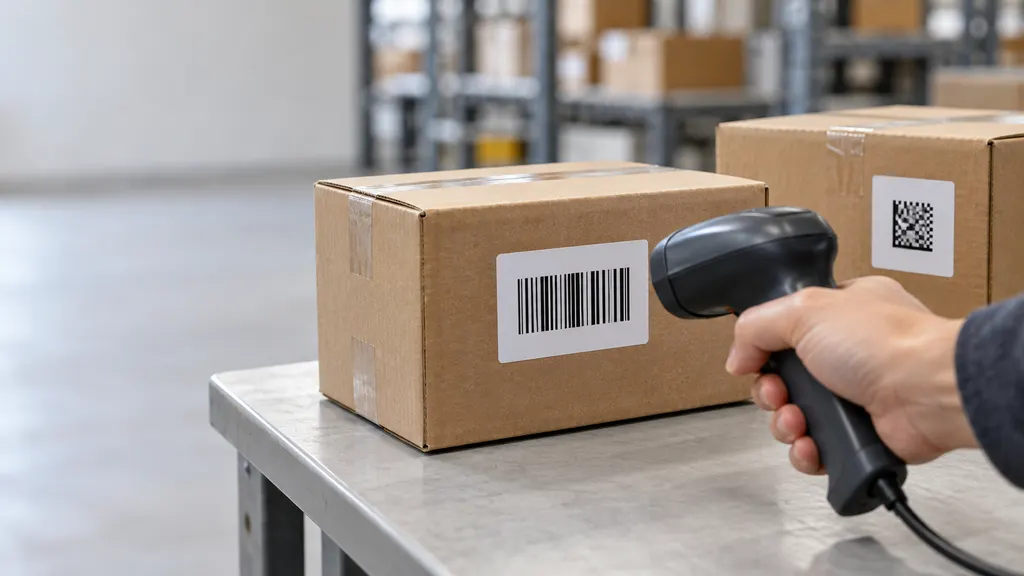
AIDC describes a group of technologies and processes, not a single device or software application. A warehouse worker scanning a product barcode is using AIDC even though a person initiates the scan. The automatic element is the machine reading and transferring the encoded information rather than requiring the worker to type it. Other applications include optical character recognition (OCR), which converts printed or handwritten text into machine-readable data.
How AIDC Works
An AIDC workflow links a physical object to an identifier, captures that identifier, and passes the resulting information to an application. The application then interprets the capture in its operational context. Reading an identifier alone does not explain whether goods have arrived, been picked, or been dispatched; the surrounding workflow supplies that meaning.
- Assign an identity. An organization determines what needs to be identified, such as a product type, an individual item, a logistics unit, or a storage location. Different identification levels serve different purposes.
- Represent the information. An identifier and, where appropriate, additional data are encoded in a barcode or RFID tag. In an OCR workflow, the source may instead be human-readable text.
- Capture the data. A scanner, camera, or RFID reader reads the information. The equipment must support the relevant symbol, tag technology, or document format.
- Validate and interpret it. Software checks whether the captured value is usable and matches an expected record. It may also assess the location, operator, order, or process step associated with the read.
- Update the business system. A warehouse management system, inventory application, or shipping system records the event or requests further action. For example, it may confirm a pick or flag an unexpected item.
Successful capture and successful processing are separate outcomes. A scanner may read a barcode correctly while the application rejects the value because the item is unknown, the shipment is closed, or the goods are being scanned at the wrong stage.
Common AIDC Technologies
The following technologies capture information in different ways. They are not interchangeable, and the appropriate choice depends on the object, operating environment, data requirements, and receiving systems.
| Technology | How It Captures Information | Logistics or Ecommerce Application | Important Constraint |
|---|---|---|---|
| Linear barcodes | An optical reader decodes a pattern of bars and spaces. | Identifying products, warehouse locations, or parcels. | The symbol must be visible and sufficiently clear for the reader. |
| Two-dimensional barcodes | An imaging reader decodes a two-dimensional pattern, such as a Data Matrix or QR Code. | Capturing identifiers and additional information, depending on the encoding scheme. | Both the reader and the application must support the symbol and its data structure. |
| RFID | A reader exchanges radio signals with a tag attached to or embedded in an object. | Identifying tagged items or logistics units at a workstation or read zone. | Performance depends on tag placement, materials, reader configuration, and the environment. |
| Optical character recognition | Software recognizes characters in an image and converts them into digital text. | Extracting references or other fields from labels and commercial documents. | Image quality, layout, and character ambiguity can require validation or human review. |
Barcodes require an optical view of the symbol. RFID does not require the same direct optical visibility and can support reading multiple tags within a configured read zone. However, that does not mean every tag will always be detected or that every detected tag belongs to the intended transaction. Physical layout and software filtering remain important.
Identification Levels and Data Standards
A central design question is what an identifier actually identifies. A product identifier may refer to a trade item shared by many identical units. A serialized identifier distinguishes an individual instance. A logistics-unit identifier refers to a unit assembled for transport or storage, which may contain several different products.
GS1 provides identification keys and data-carrier standards used in supply chains. For example, the Global Trade Item Number (GTIN) identifies trade items, while the Serial Shipping Container Code (SSCC) identifies logistics units. These identifiers have different purposes: scanning a pallet's SSCC does not, by itself, reveal its contents unless the relevant content information is encoded or associated with that identifier in a system.
The identifier, its data carrier, and the related business record should therefore be treated separately. A barcode is a representation of data, not necessarily a complete product or shipment record. Similarly, an RFID tag can carry an identifier without containing every attribute that a warehouse or trading partner needs.
Shared standards help organizations interpret captured information consistently. Nevertheless, using a recognized barcode symbol alone does not establish interoperability. Partners also need compatible identification rules, data formats, and business processes.
Use in Logistics and Ecommerce
AIDC is encountered at points where physical goods must be matched to digital instructions or records. The following examples illustrate possible workflows rather than requirements that apply to every operation.
| Process | Illustrative AIDC Activity | What the Application Checks or Records |
|---|---|---|
| Receiving | An operator scans an arriving carton or pallet. | Whether the identifier matches an expected inbound delivery and whether discrepancies need review. |
| Putaway | The operator scans the goods and a storage-location label. | The association between the inventory and its recorded warehouse location. |
| Picking and packing | A worker scans a product before placing it into an order container. | Whether the product matches the order line; quantity confirmation depends on the workflow. |
| Dispatch and parcel handling | A parcel label is scanned at a shipping station or handling point. | The parcel's identity and the event associated with that station. |
| Returns processing | A returns reference or item identifier is scanned. | The associated return record and the next inspection or disposition step. |
For example, an ecommerce retailer may scan an item during packing and compare its identifier with the order being fulfilled. If the values do not match, the application can request correction. This check depends on accurate product master data and a correctly configured order association; the scanner does not independently know which product the customer ordered.
Cross-Border Applications
In cross-border commerce, AIDC can help link goods and logistics units to records used by warehouses, carriers, and trading partners. An identifier captured at dispatch may be associated with shipment information that another organization later uses at receiving.
AIDC does not replace customs declarations, determine tariff classification, or establish the accuracy of declared value and origin. A scanned identifier may retrieve information relevant to those tasks, but the information must still be complete, correct, and suitable for the applicable procedure. Commercial document capture through OCR likewise extracts information; it does not validate its legal or factual correctness.
AIDC, Tracking, and Traceability
AIDC supplies observations that can support tracking and traceability, but the terms describe different functions.
| Term | Meaning in This Context | Relationship to AIDC |
|---|---|---|
| Identification | Establishing which object or entity a record refers to. | AIDC reads the identifier used to make that association. |
| Data capture | Collecting information for processing by a system. | AIDC automates parts of this collection. |
| Tracking | Following the recorded progress or status of an item or shipment. | Capture events can provide inputs to the tracking record. |
| Traceability | Being able to reconstruct relevant history, movement, or relationships from records. | AIDC helps collect evidence, while retained records and data links make reconstruction possible. |
A parcel scan is an observation at a particular point, not necessarily a continuous position measurement. Its usefulness depends on the accompanying event information and how quickly the receiving system processes it. A lack of a new scan does not, by itself, establish that a parcel has stopped moving.
GS1's Electronic Product Code Information Services (EPCIS) standard addresses the sharing of visibility event data between applications and organizations. It complements identification and capture by providing a framework for communicating events; it is not itself a barcode or RFID reader.
Operational Limitations and Checks
AIDC can reduce manual transcription and support process checks, but it does not eliminate errors. A readable label can be attached to the wrong carton. An accurate capture can update the wrong transaction if the application context is incorrect. Duplicate events can also produce misleading records unless the system handles them appropriately.
When assessing an AIDC workflow, useful checks include:
- Identification scope: Confirm whether the process needs a product type, a serialized item, a logistics unit, or a shipment reference.
- Physical readability: Test label placement, print condition, packaging surfaces, lighting, or RFID behavior under actual operating conditions.
- Data compatibility: Check that readers, software, and partners interpret the same identifiers and additional data fields consistently.
- Event context: Establish which location and process step a capture represents, rather than assuming every read means receipt or dispatch.
- Exception handling: Define what happens when an identifier is missing, unreadable, unexpected, or captured more than once.
- Record integrity: Verify that captured events reach the intended system and remain associated with the correct object and transaction.
These checks distinguish equipment performance from business-process accuracy. A high rate of successful reads is useful, but it does not alone demonstrate accurate inventory, correct order fulfillment, or complete shipment visibility.
QA
Does AIDC require a fully automated warehouse?
No. A worker using a handheld barcode scanner is using AIDC. Human involvement in moving goods or initiating a scan does not make the captured data manually entered.
What is the difference between AIDC and RFID?
AIDC is the broader group of identification and data-capture technologies. RFID is one technology within that group, alongside barcode scanning and other capture methods.
Does a barcode contain all the information about a shipment?
Not necessarily. It may contain only an identifier that a system uses to retrieve a shipment record. What is encoded depends on the label design and the relevant data standard.
Does an AIDC scan prove delivery or customs clearance?
Not by itself. The scan identifies captured data within a workflow. Whether it supports a delivery or clearance status depends on the associated event, supporting records, and applicable process.
Sources
- ISO/IEC JTC 1/SC 31 — Automatic identification and data capture techniques: Standards context for AIDC, including data carriers, capture, and related identification technologies.
- GS1 — Barcodes: Barcode technologies, encoded information, and supply-chain identification applications.
- GS1 — EPC/RFID: RFID identification, radio-based capture, and its relationship to GS1 standards.
- GS1 — Global Trade Item Number: Identification of trade items and the distinction between product identification and other identification levels.
- GS1 — Serial Shipping Container Code: Identification of logistics units used in storage and transport.
- GS1 — EPCIS: Sharing visibility event data across applications and organizations.