Robot Palletizer
What Is a Robot Palletizer?
A robot palletizer is an automated system that uses a programmable industrial robot to pick up goods and arrange them on a pallet in a planned stacking pattern. Also called a robotic palletizer, it is used in manufacturing, warehousing, and distribution to prepare cartons, bags, trays, or other suitable loads for storage and transport.
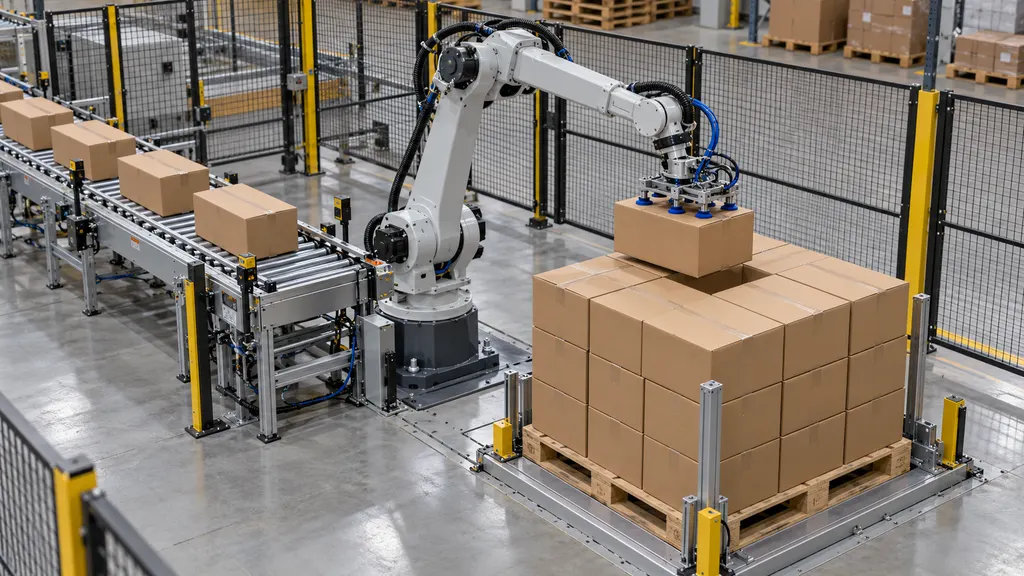
The term can refer to the robot and its gripping tool or, more broadly, to the complete palletizing installation. A complete installation may include product conveyors, pallet positioning equipment, sensors, controls, and protective measures. This distinction matters when interpreting equipment specifications: a robot's lifting capacity alone does not describe the capabilities of an entire palletizing system.
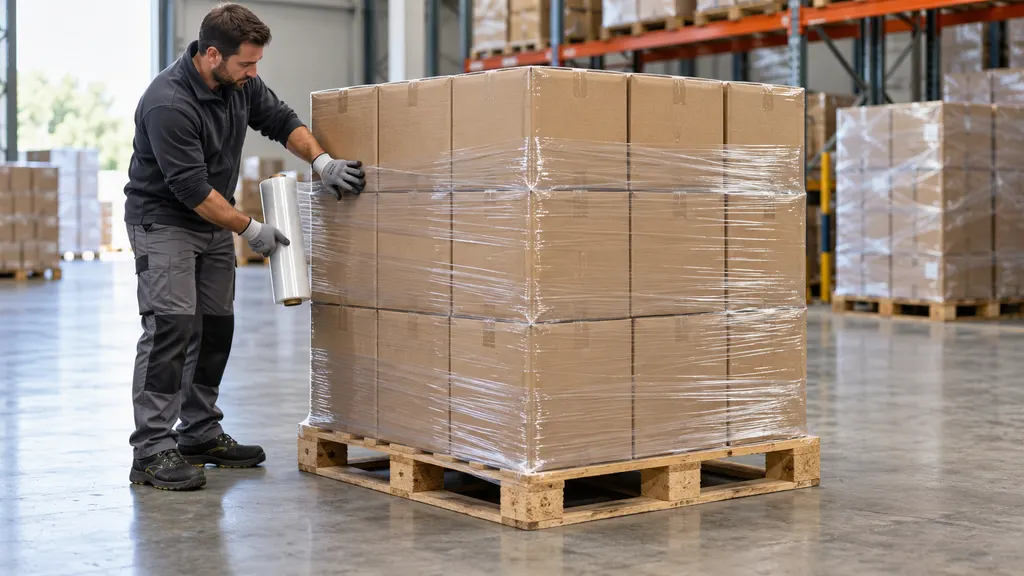
Palletizing creates a unit load, allowing multiple items to be handled together using equipment such as a forklift or pallet truck. It does not necessarily include securing that load. Stretch wrapping, strapping, labeling, and final inspection may take place in separate equipment or integrated downstream stations.
Role in Logistics and Ecommerce
A robot palletizer operates at the point where individual packages or other handling units are assembled into a pallet load. In a factory, this may be near the end of a packaging line. In a distribution center, it may support outbound freight preparation, store replenishment, or the consolidation of goods for another facility.
In ecommerce, palletizing is particularly relevant to bulk inventory movements rather than individual doorstep deliveries. For example, a retailer may receive products in cartons, store them in a fulfillment center, and later use robotic palletizing to prepare replenishment loads for another warehouse. A separate process may subsequently break down those pallets for individual order picking.
For cross-border shipments, a palletizer helps form the physical load but does not perform customs clearance or establish regulatory compliance. Pallet dimensions, package markings, pallet material, and load-securing arrangements still need to be checked against the shipment's applicable requirements. A robot completing its programmed stacking pattern does not by itself demonstrate that a load is suitable for international transport.
How a Robot Palletizer Works
The exact sequence depends on the installation, but a palletizing cycle can be understood through the following stages:
- Product presentation: A conveyor or other feeding arrangement brings items into a known picking area. Items may need spacing, alignment, or orientation before the robot can handle them reliably.
- Product identification: The controller uses a selected production recipe, sensor input, or information from connected equipment to determine what is being handled. Vision systems can be included where identification or position detection is needed, but they are not essential to every installation.
- Picking: The robot's end effector grips one item or a group of items. The gripping method must suit the packaging, weight, surface, and intended movement.
- Movement and placement: The robot moves the load to a calculated position on the pallet, applying the required orientation and placement sequence.
- Layer building: The system repeats the process to build successive layers. Some installations also handle layer pads or slip sheets where the load design requires them.
- Pallet completion and transfer: When the planned load is complete, it is removed or conveyed onward. An empty pallet must then be positioned before the next load can begin.
The controller coordinates these actions with surrounding equipment. For example, it may prevent a placement when the pallet is absent or stop upstream flow when the picking area is full. The actual functions depend on the system's design and integration.
Main Components
| Component | Function | Important consideration |
|---|---|---|
| Industrial robot | Moves products between the picking area and pallet positions. | Payload, reach, motion, and available working space must match the task. |
| End effector | Grips, supports, or releases the product. | Packaging strength and surface characteristics affect gripping suitability. |
| Product feeding equipment | Presents products for picking. | Inconsistent spacing or orientation can interrupt the cycle. |
| Pallet handling equipment | Positions empty pallets and transfers completed loads. | Pallet condition and positioning accuracy affect placement. |
| Controller and programming interface | Coordinates motion, stacking recipes, and equipment signals. | Product changes require appropriate configuration and validation. |
| Safeguarding system | Controls exposure to hazardous movement and related hazards. | Protective measures must address the complete application. |
Gripping Methods and Product Compatibility
The end effector, also called end-of-arm tooling, is central to product compatibility. A robot capable of lifting a load may still be unsuitable if its tool cannot hold that load securely without damaging it.
- Vacuum gripping uses suction cups or vacuum-based gripping surfaces. Suitability depends on factors such as surface porosity, sealing conditions, carton integrity, and the available gripping area.
- Mechanical gripping uses fingers, clamps, or similar mechanisms. The product must tolerate the applied contact forces, and the tool needs sufficient access around it.
- Supporting or fork-style tooling carries the product from underneath where the package and feeding arrangement allow it.
- Combined tooling uses more than one gripping principle or includes additional functions, such as handling sheets between layers.
These are descriptions of handling approaches, not a universal classification of complete palletizers. Tool selection must consider the actual package, including weak cartons, loose closures, irregular bags, or contents that shift during movement. A change in packaging can therefore require a new handling assessment even when the product's nominal weight remains unchanged.
Robot Palletizer and Related Terms
| Term | Meaning | Relationship to a robot palletizer |
|---|---|---|
| Palletizer | Equipment that arranges goods on pallets. | A broader category that includes robotic and non-robotic equipment. |
| Conventional palletizer | A system that uses dedicated conveying, positioning, and layer-forming mechanisms to build pallet loads. | It performs the same overall task through a different equipment arrangement; hybrid designs also exist. |
| Depalletizer | Equipment that removes goods from pallets. | It performs the reverse handling task. A palletizing installation is not automatically configured for depalletizing. |
| Pallet wrapper | Equipment that applies stretch film around a load. | It helps secure the load rather than creating the stacking pattern. |
| Palletizing cell | The robot together with associated equipment, controls, and protective measures. | It describes the integrated installation rather than only the robot. |
A collaborative robot can also be used in a palletizing application, but the word collaborative does not mean that every task can operate without protective measures. The tool, payload, movement, surrounding equipment, and potential contact hazards all affect the safety assessment.
Stacking Patterns and Load Stability
A stacking pattern specifies where packages are placed, how they are oriented, and how successive layers relate to one another. It must account for both pallet space and package behavior. Filling the largest possible area is not the only objective: the finished load also needs appropriate support, stability, and compatibility with subsequent handling.
Column stacking places packages in vertically aligned positions. Interlocking arrangements change the relationship between adjacent layers. Neither arrangement is automatically best for every product. Carton compression strength, package dimensions, friction, load height, and securing methods can influence the appropriate choice.
Load design should also consider overhang, gaps, uneven weight distribution, and the condition of the pallet. A pattern that is geometrically possible may still be unsuitable for storage or transport. Placement accuracy cannot compensate for damaged packaging or an inadequately supported load.
For example, a distributor may program separate recipes for two carton sizes shipped on the same pallet format. Each recipe would need suitable placement coordinates, layer arrangements, and gripping settings. If the distributor introduces mixed-product pallets, additional planning may be necessary to manage package strength, weight distribution, and the order in which products become available.
Operating Constraints and Evaluation
A robot palletizer's useful output depends on the complete handling process, not just the robot's advertised motion capability. Product arrival, picking reliability, travel distance, pallet exchange, and downstream congestion can all constrain operation. Comparisons between systems therefore require equivalent products, layouts, load patterns, and operating conditions.
Practical evaluation should address the following questions:
- What is the complete handled weight? Robot selection must account for the tool and other carried equipment as well as the product, using the manufacturer's applicable load limits.
- Can every required position be reached? Check the picking area, pallet corners, upper layers, and clearance around surrounding equipment.
- Can the packaging withstand handling? Evaluate gripping, acceleration, placement, and repeated contact using representative packages.
- How are exceptions managed? Consider missing products, failed picks, damaged cartons, misaligned pallets, and interrupted cycles.
- How are product changes controlled? Recipes, tooling adjustments, and validation procedures should reflect the permitted product range.
- How will people access the installation? Operation, cleaning, maintenance, and recovery require appropriate access and safety procedures.
Connections to warehouse or production software may support recipe selection and operational reporting, but such connections are not inherent in every robot palletizer. Physical pallet handling should also be distinguished from inventory recording: moving a carton does not automatically update a warehouse management system unless the required identification and data exchange are implemented.
Safety Considerations
Robot palletizing introduces hazards associated with moving machinery, carried loads, gripping tools, conveyors, and pallet transfer. OSHA's robotics guidance emphasizes evaluating robotic applications and addressing hazards during activities such as programming, maintenance, and other human interaction with equipment.
Protective measures may include perimeter guarding, interlocked access points, presence-sensing devices, and safety-related control functions, depending on the risk assessment. Emergency stopping is not a substitute for appropriate safeguarding or hazardous-energy control. Maintenance and recovery procedures must address the relevant energy sources and the possibility of unexpected movement.
Safety assessment should cover the integrated cell rather than treating the robot as an isolated component. A robot's individual safety features do not establish that the complete installation is safe for its intended use.
QA
Is a robot palletizer the same as a palletizer?
A robot palletizer is one type of palletizer. The broader term also includes equipment that builds pallet loads using dedicated conveying and layer-forming mechanisms rather than a robotic picking system.
Can a robot palletizer handle different carton sizes?
It can, if its reach, payload, tooling, feeding arrangement, and programming support those cartons. Programmability alone does not guarantee compatibility with every package.
Does a robot palletizer wrap the finished pallet?
Not necessarily. Palletizing arranges goods on the pallet; wrapping secures the load with film. The processes may be integrated, but they remain separate functions.
Can a robot palletizer build mixed-product pallets?
Some installations can, provided they have suitable product information, handling capabilities, and load-planning arrangements. Mixed-product palletizing should not be assumed to be a standard capability of every system.
Sources
- International Federation of Robotics: Industrial Robots — Background on industrial robot definitions and application categories, including handling operations.
- ABB Robotics: Palletizing — Manufacturer documentation illustrating robotic palletizing applications, product handling, and integrated equipment.
- Occupational Safety and Health Administration: Robotics — Guidance and reference resources on robotic-system hazards, risk assessment, and safeguarding.