Palletizing
What Is Palletizing?
Palletizing is the process of arranging goods on a pallet and securing them so that they can be stored, handled, and transported as a single load. In logistics and warehousing, it turns individual cartons, bags, or other packages into a unit that suitable equipment, such as a forklift or pallet truck, can move together.
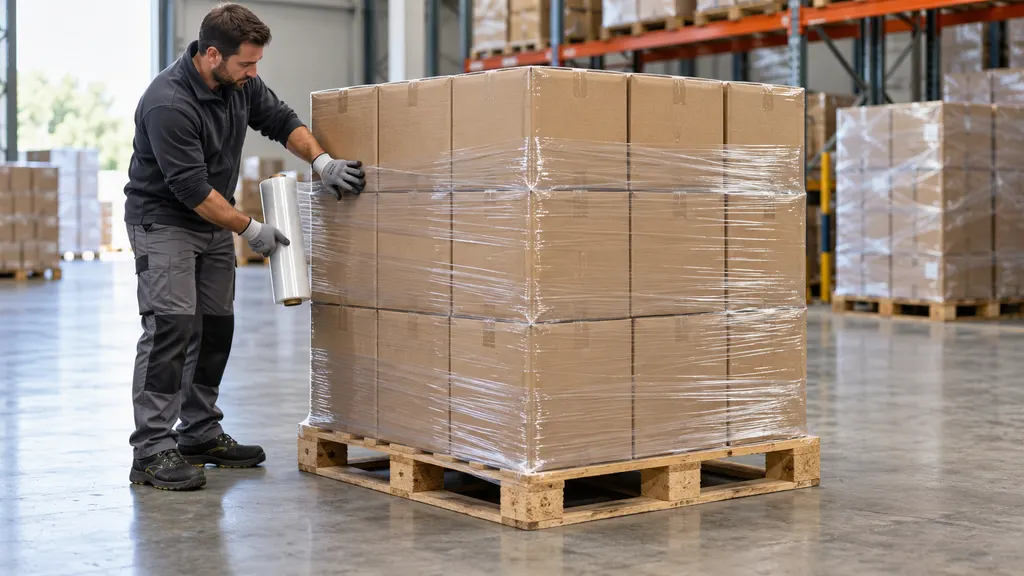
The resulting assembly is often called a palletized load or unit load. Palletizing involves more than placing packages on a platform: the pallet, packaging, stacking arrangement, and load restraints must work together. A load that remains stable on a warehouse floor may still need additional restraint for lifting, vehicle movement, or storage in a rack.
The spelling palletising is also used, particularly in British English. It describes the same process.
Role in Logistics and Ecommerce
Palletizing connects packaging, warehouse operations, and freight transport. It may take place after manufacturing, during consolidation at a distribution center, or before goods leave a fulfillment facility. At the receiving location, workers may store the complete palletized load or separate it into smaller quantities for inventory replenishment and order fulfillment.
In ecommerce, palletizing is particularly relevant to inbound inventory rather than individual consumer deliveries. For example, a retailer may receive cartons of products on pallets, check the shipment against receiving records, and move the goods into storage. Those products may later leave the warehouse as individual parcels. Returned goods may also be consolidated onto pallets for transfer to another facility, inspection, or processing.
A palletized load does not necessarily correspond to one customer order or one product. It may contain a single stock-keeping unit, several products for one destination, or packages allocated to different orders. The physical handling unit and the commercial order are separate concepts.
How Palletizing Works
- Confirm the handling requirements. Establish the destination's pallet requirements, handling equipment, storage conditions, and applicable carrier instructions. Check whether the load will be floor-stacked, placed in racking, or transferred between facilities.
- Select and inspect the pallet. Choose a pallet with suitable dimensions, construction, and load capacity for its intended use. Remove damaged or unsuitable pallets from service. Compatibility with lifting equipment and storage systems matters as much as the pallet's footprint.
- Assess the packages. Check carton strength, package condition, weight distribution, and orientation instructions. Packages that are crushed, wet, leaking, or poorly closed may not provide a dependable base for a stacked load.
- Build the load. Arrange packages according to a suitable stacking pattern. Keep the center of gravity low where practicable, support the packages adequately, and avoid allowing fragile goods to carry loads beyond their packaging capability.
- Secure and protect the goods. Apply appropriate stretch film, strapping, corner protection, sheets, or other stabilizing materials. The choice depends on the goods, packaging, pallet, and expected handling conditions.
- Identify and measure the completed load. Apply required labels where they can be read and record the final dimensions and gross weight, including the pallet and securing materials.
- Inspect before release. Check stability, package damage, loose restraints, label visibility, and access for lifting equipment before moving the load to storage or dispatch.
These steps describe a practical workflow, not a universal operating standard. Product-specific hazards, equipment instructions, workplace safety rules, and destination requirements may require additional controls.
Manual and Automated Palletizing
Palletizing methods can be distinguished by how packages are positioned. The following comparison concerns the handling method rather than the type of goods being shipped.
| Method | How it works | Operational considerations |
|---|---|---|
| Manual palletizing | Workers position packages on the pallet, sometimes using lifting aids. | Workstation layout, lifting demands, package weight, and safe working practices require attention. |
| Conventional automated palletizing | Mechanical equipment arranges packages into rows or layers and transfers them onto a pallet. | Package consistency, equipment settings, guarding, and line integration affect suitability. |
| Robotic palletizing | A programmed robot uses an appropriate gripping tool to position packages. | Gripper compatibility, package variability, programming, and safeguarded access require assessment. |
A facility may combine these methods. Automated placement does not by itself establish that a load is safe for transport: the stacking pattern, packaging strength, pallet condition, and restraint still need to be suitable.
Stacking Patterns and Load Stability
The stacking pattern affects both package support and resistance to movement. Two arrangements are column stacking and interlocking. Neither is universally preferable; the appropriate choice depends on carton design, load geometry, and the conditions the load will encounter.
| Arrangement | Description | Main consideration |
|---|---|---|
| Column stacking | Packages are aligned vertically, with packages in successive layers occupying corresponding positions. | For suitable corrugated cartons, alignment can support compression performance, but the load may need additional measures against sideways movement. |
| Interlocking | The orientation or position of packages changes between layers so that packages overlap those below. | Overlapping layers can help tie the load together, but may reduce carton compression performance compared with properly aligned columns. |
Overhang occurs when goods extend beyond the pallet's edges. It can leave packaging unsupported and expose goods to contact damage. Excessive gaps or an uneven top surface may also complicate load restraint and stacking. Where goods cannot fit within the intended footprint, changing the pallet or packaging arrangement may be more appropriate than accepting an unstable load.
Stretch film helps hold packages together, but it cannot restore the strength of damaged cartons or correct an unsuitable pallet. Similarly, strapping must be applied with suitable tension and protection: excessive pressure can damage packages. A load should be evaluated as a complete system rather than as a stack made safe by one securing material.
Pallet Capacity, Dimensions, and Storage Conditions
A pallet's capacity depends on how it is supported and used. A load resting on a level floor places different demands on a pallet from a load being lifted or supported across rack beams. Where suppliers specify static, dynamic, or racking capacities, those ratings should be interpreted according to the stated test conditions and intended use. They are not interchangeable guarantees.
The usable capacity of a palletized load may also be limited by the cartons, storage rack, lifting equipment, or receiving facility. A strong pallet does not make weak packaging suitable for high stacking. Likewise, a stable load on the floor may not be suitable for racking without a separate assessment.
There is no single pallet size or maximum load height that applies to every supply chain. Requirements can differ between facilities, transport services, and storage systems. Shipment measurements should describe the completed load, including wrapping, protective materials, and any projection beyond the pallet.
Cross-Border Shipping and Wood Packaging
Cross-border palletizing requires attention to both physical handling and packaging compliance. A pallet that fits the dispatch warehouse may not meet the receiving facility's requirements. Shippers should confirm the acceptable pallet format, load dimensions, identification requirements, and unloading arrangements before dispatch.
Wood packaging can introduce an additional phytosanitary requirement. ISPM 15, developed under the International Plant Protection Convention framework, addresses regulated wood packaging material used in international trade, including relevant wooden pallets. It provides requirements concerning approved treatments and marking to reduce the risk of spreading plant pests.
ISPM 15 does not mean that every pallet material requires treatment. Packaging made wholly from certain processed wood materials, such as plywood, is outside its scope, as are non-wood materials such as plastic or metal. The importing country's requirements and the actual packaging construction must still be checked.
An ISPM 15 mark is not a load-capacity rating, a product-quality certificate, or proof that a shipment has completed customs clearance. Pest-risk controls, structural suitability, and customs formalities address different questions.
Related Terms and Important Distinctions
| Term | Meaning | Relationship to palletizing |
|---|---|---|
| Pallet | A platform designed to support goods during handling, storage, or transport. | It is the physical base, not the loading process. |
| Unitization | Combining separate items into a load that can be handled as one unit. | Palletizing is one form of unitization; not every unit load uses a pallet. |
| Depalletizing | Removing goods from a pallet. | It reverses the loading stage and may precede picking, replenishment, or further processing. |
| Stretch wrapping | Applying stretchable film around a load to help contain and stabilize it. | It can be part of palletizing, but is not the entire process. |
| Container loading | Placing goods inside a freight container. | A container may carry palletized loads or goods loaded without pallets. |
Practical Inspection Points
Before accepting a palletized load for movement, an operational check should address the following questions:
- Is the pallet undamaged and suitable for the intended support and handling conditions?
- Are the packages adequately supported, without avoidable overhang or unstable projections?
- Can the lower packages withstand the weight placed above them?
- Are restraints secure without crushing or cutting the packaging?
- Are lifting entry points accessible and free from loose material?
- Are the completed load's dimensions, gross weight, and identifying labels accurate?
- Have applicable destination and wood-packaging requirements been addressed?
These checks support load preparation but do not replace a workplace risk assessment or a validated packaging design. The UK Health and Safety Executive's pallet guidance addresses pallet suitability and safe use, while US OSHA material-storage rules require stacked materials to remain stable and secure against sliding or collapse.
QA
Is palletizing the same as wrapping a pallet?
No. Palletizing includes selecting the pallet, arranging the goods, and securing the resulting load. Wrapping is one possible securing step.
Does every ecommerce shipment need palletizing?
No. Palletizing is relevant when goods need to move as a pallet-sized handling unit, such as inbound inventory or consolidated freight. Individual consumer orders may be dispatched as parcels instead.
What is the difference between palletizing and depalletizing?
Palletizing assembles goods onto a pallet. Depalletizing removes them, for example when a warehouse separates received inventory for storage or order picking.
Do wooden pallets always need ISPM 15 treatment?
No. The answer depends on whether the packaging falls within the standard's scope and on applicable import requirements. ISPM 15 concerns regulated wood packaging in international trade, not every pallet in every setting.
Sources
- Health and Safety Executive: Pallet safety, Guidance Note PM15 — pallet selection, loading, handling, storage, and inspection considerations.
- US Occupational Safety and Health Administration: 29 CFR 1910.176, Handling materials—general — requirements for stable, secure material storage and safe handling arrangements.
- International Plant Protection Convention: Adopted International Standards for Phytosanitary Measures — ISPM 15, Regulation of wood packaging material in international trade, including its scope, treatment, marking, and exemptions.