Live Pallet Rack
What Is a Live Pallet Rack?
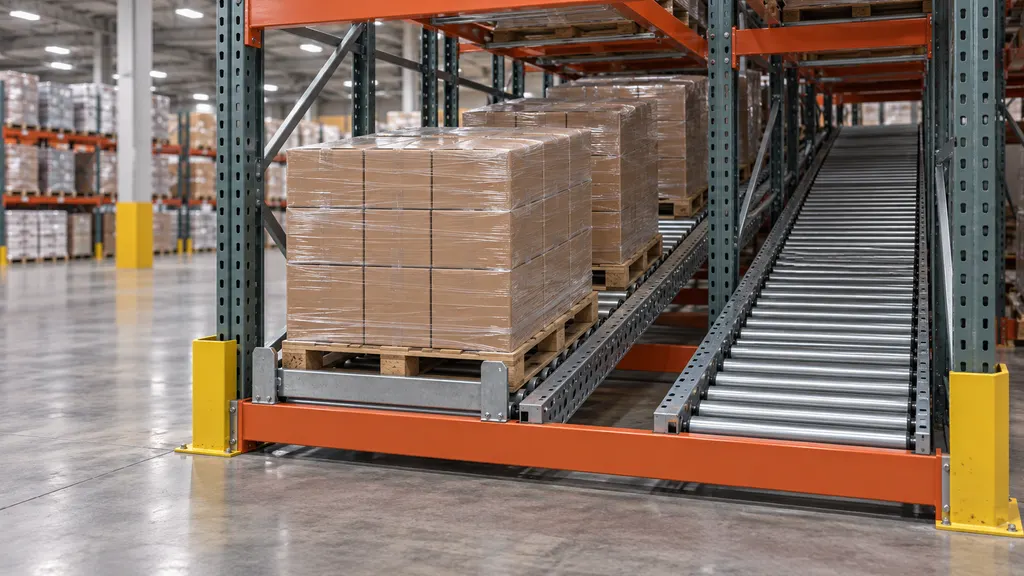
A live pallet rack is a warehouse storage system in which palletized goods move along inclined lanes, usually on rollers, from a loading position toward a retrieval position under gravity. In its common configuration, pallets enter at one end and leave at the opposite end, supporting first-in, first-out (FIFO) stock rotation. The system is also called pallet flow racking or gravity flow pallet racking.
The word live refers to the movement of stored loads within the rack. It does not mean that the rack tracks inventory electronically, updates stock records automatically, or requires powered conveyors. Although individual installations can incorporate powered equipment or sensors, gravity-driven movement is the defining operating principle of conventional pallet flow storage.
How Live Pallet Racking Works
A live pallet rack combines a structural rack framework with flow lanes designed for specified pallet and load characteristics. Each lane slopes toward the unloading face. When the front pallet is removed, the pallets behind it advance toward the retrieval position.
- Loading: A forklift or other suitable handling device places a pallet at the higher end of an assigned lane.
- Movement: The pallet travels along the rollers under gravity. Its movement depends on the lane design, pallet condition, load weight, and rolling resistance.
- Speed control: Braking devices regulate travel where incorporated into the system. End stops retain loads at the discharge position.
- Separation: Where fitted, a pallet separator holds following pallets back so that the front pallet can be removed without the full pressure of the queue acting on it.
- Retrieval: An operator removes the pallet at the unloading face. The next pallet advances into the available position.
- Replenishment: New pallets enter from the loading face, maintaining the physical sequence within the lane.
These components must work together as an engineered system. Lane slope, roller arrangement, braking, and retention cannot be selected independently of the pallets and loads being handled. A configuration suitable for one pallet specification may not work safely with another.
Role in Warehousing and Ecommerce Fulfillment
Live pallet racks provide storage between receiving and downstream activities such as replenishment, production supply, order picking, or outbound dispatch. They are particularly relevant when a business needs multiple pallets of the same stock-keeping unit (SKU) available in a defined sequence.
In an ecommerce fulfillment center, pallet flow storage may hold reserve inventory that replenishes separate picking locations. Workers do not necessarily pick individual customer orders directly from the flow lane. In another layout, the discharge face may serve as a pallet-based picking position, provided that the installation is designed for that activity.
For cross-border ecommerce, the rack performs the same physical storage function as it does in domestic distribution. It does not determine customs status, calculate duties, or establish product eligibility for sale. Where stock must remain separated by ownership, customs status, batch, or sales market, those distinctions require inventory controls and appropriate location assignments.
For example, a retailer may receive several pallets of one packaged product and assign them to a flow lane in arrival order. The front pallet can supply a replenishment operation while later receipts remain behind it. This is an illustrative operating arrangement, not a requirement for every warehouse.
Main Operating Characteristics
- Storage depth: Multiple pallets can occupy a lane behind one another, reducing the need for an access aisle beside every pallet position.
- Separate loading and retrieval faces: The common through-flow arrangement allows replenishment and retrieval to occur from opposite sides.
- Sequence-dependent access: The front pallet is accessible, but pallets behind it cannot normally be selected independently without moving intervening stock.
- Pallet sensitivity: Pallet construction, underside geometry, damage, and load distribution affect how a pallet moves.
- Defined operating limits: The installation must be used within its specified load capacities and approved pallet and load parameters.
These characteristics create trade-offs rather than universal advantages. Greater storage depth can reduce aisle requirements, but it also limits direct access to individual pallets. The effective use of capacity depends on how well lane depth matches the quantity and turnover of the stock assigned to it.
Live Pallet Rack and Related Storage Systems
Several rack types store pallets in depth, but they differ in movement, access, and stock rotation. The following comparison describes their common operating arrangements rather than every possible engineered variation.
| System | How pallets are handled | Usual rotation pattern | Main distinction |
|---|---|---|---|
| Live pallet rack | Pallets move along inclined flow lanes from loading to retrieval. | FIFO within each correctly operated lane | Gravity advances stock toward the unloading face. |
| Selective pallet rack | Handling equipment places and retrieves pallets directly from individual positions. | Determined by operating procedures | Provides direct access to pallet positions rather than automatic lane advancement. |
| Drive-in rack | A forklift enters the storage lane to place or retrieve pallets. | Commonly last-in, first-out | Storage depth is accessed by the truck rather than a gravity flow mechanism. |
| Push-back rack | Incoming pallets push earlier pallets backward on carts or rollers; retrieval takes place from the same face. | Commonly last-in, first-out | Loading and unloading share one face. |
| Carton flow rack | Cartons or smaller containers move along inclined lanes. | FIFO within each correctly operated lane | Handles smaller picking units rather than full pallet loads. |
Pallet flow and carton flow therefore describe related movement principles, but they are not interchangeable equipment specifications. A rack designed to support and control full pallets should not be treated as equivalent to a shelf-level carton flow installation.
FIFO Does Not Automatically Mean FEFO
FIFO means that the first stock entering a sequence is the first stock removed. First-expired, first-out (FEFO) means that stock with the earliest expiry date is selected first. These rules can produce different retrieval priorities.
A live pallet rack supports FIFO mechanically within a lane, but it does not inspect expiry dates or compare batches across different lanes. If a later receipt has an earlier expiry date, loading it behind existing stock may conflict with a FEFO policy.
Warehouses handling dated goods therefore need receiving checks, batch identification, and lane allocation rules in addition to suitable racking. A warehouse management system can guide those decisions, but the physical lane sequence must still match the intended retrieval sequence.
Suitability and Design Considerations
Assessing a live pallet rack requires more than comparing nominal pallet capacity. The proposed stock profile, handling equipment, building layout, and maintenance arrangements all affect whether the system is appropriate.
Pallet and load compatibility
The supplier or responsible designer should establish acceptable pallet dimensions, construction, condition, and load characteristics. Damaged boards, unsuitable underside geometry, projecting wrapping, or unstable loads can interfere with movement. Both lighter and heavier loads need consideration because rolling behavior and braking performance depend on the operating range.
Lane allocation and stock variety
A lane normally needs a clear product and sequence assignment. Combining unrelated products in one lane can make required stock inaccessible behind other pallets. If a warehouse holds many SKUs in small quantities, deep lanes may leave substantial usable positions empty while still preventing those positions from serving other products conveniently.
Access and traffic layout
Separate loading and retrieval faces can help organize different activities, but they do not automatically eliminate vehicle conflicts. Aisle widths, turning space, pedestrian separation, visibility, and emergency access still need to be considered in the warehouse layout.
Commissioning and operating checks
Before routine use, movement and retention should be checked using representative approved pallets and loads under a competent commissioning process. Operators need instructions covering loading orientation, permitted loads, retrieval, fault reporting, and the response to a pallet that does not advance correctly. Published capacity information alone is not a substitute for these checks.
Inspection, Maintenance, and Blocked Lanes
A live pallet rack contains both load-bearing structures and moving components. Inspection therefore needs to address the rack framework as well as rollers, brakes, separators, end stops, and other installed flow equipment. The inspection arrangements should follow applicable local requirements and the equipment supplier's instructions.
Warehouse safety guidance emphasizes reporting rack damage, observing load limits, and arranging competent inspection. Impact damage, displaced components, and deteriorated pallets should not be dismissed simply because the rack remains standing or some pallets continue to move.
A blocked lane requires a controlled response. Staff should stop using the affected area as necessary, report the problem, and follow an approved recovery procedure. Climbing into the rack, standing in a pallet's travel path, or improvising a release can expose workers to crushing and falling-load hazards. Repairs or changes affecting structural or flow performance require appropriate technical assessment.
Common Misunderstandings
- “Live” means electronically connected: The term describes physical stock movement, not inventory visibility or tracking software.
- Every pallet can be accessed immediately: Access is constrained by its position within the lane.
- FIFO is guaranteed across the warehouse: The rack supports a physical sequence within a lane; warehouse-wide rotation also depends on allocation and retrieval decisions.
- Gravity operation means no maintenance: Moving and structural components still require inspection and maintenance.
- Any pallet of the right size will work: Dimensions alone do not establish compatibility; construction, condition, weight, and load stability also matter.
QA
Is a live pallet rack the same as pallet flow racking?
Yes. In warehouse terminology, live pallet rack commonly refers to pallet flow racking, where palletized loads move along inclined lanes under gravity.
Does a live pallet rack require electricity?
Conventional gravity flow lanes do not need electrical power to move pallets. A particular installation may nevertheless include powered handling equipment, sensors, or other electrical components.
Can live pallet racking guarantee expiry-date rotation?
No. It supports FIFO within a lane, but FEFO also requires expiry-date information and suitable stock allocation. Arrival order and expiry order are not necessarily the same.
Can live pallet racks be used for ecommerce inventory?
Yes. They can hold palletized reserve stock or support suitable pallet-based picking arrangements. Their suitability depends on pallet compatibility, stock quantities, retrieval requirements, and warehouse design rather than the sales channel alone.
Sources
- Wikipedia: Pallet racking — Reference overview of pallet flow, push-back, drive-in, and other pallet storage arrangements.
- Health and Safety Executive: Warehousing and storage—A guide to health and safety (HSG76) — Guidance supporting discussion of storage-system safety, pallet suitability, rack loading, damage reporting, inspection, and maintenance.
- MHI: Rack Manufacturers Institute — Industry reference for engineered industrial storage racks and rack safety resources.