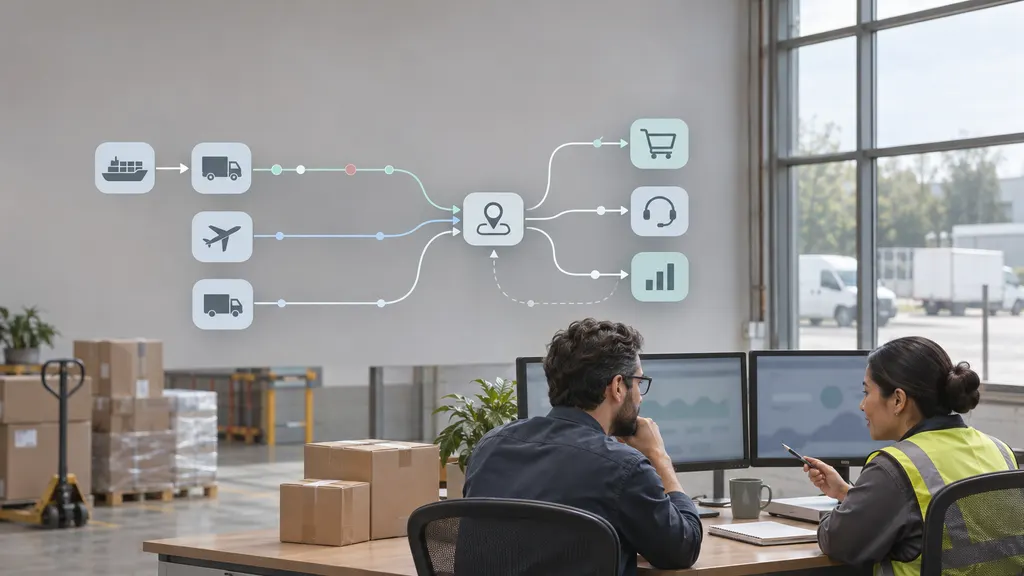
Bar Code Automatic Identification Technology
What Is Bar Code Automatic Identification Technology?
Bar code automatic identification technology is the use of machine-readable optical symbols, scanners, and software to capture encoded data and identify products, packages, logistics units, or other objects. In logistics and ecommerce, it connects physical goods with digital records used for receiving, inventory control, order fulfillment, shipping, and returns. The technology is commonly called barcode identification and forms part of automatic identification and data capture, or AIDC.
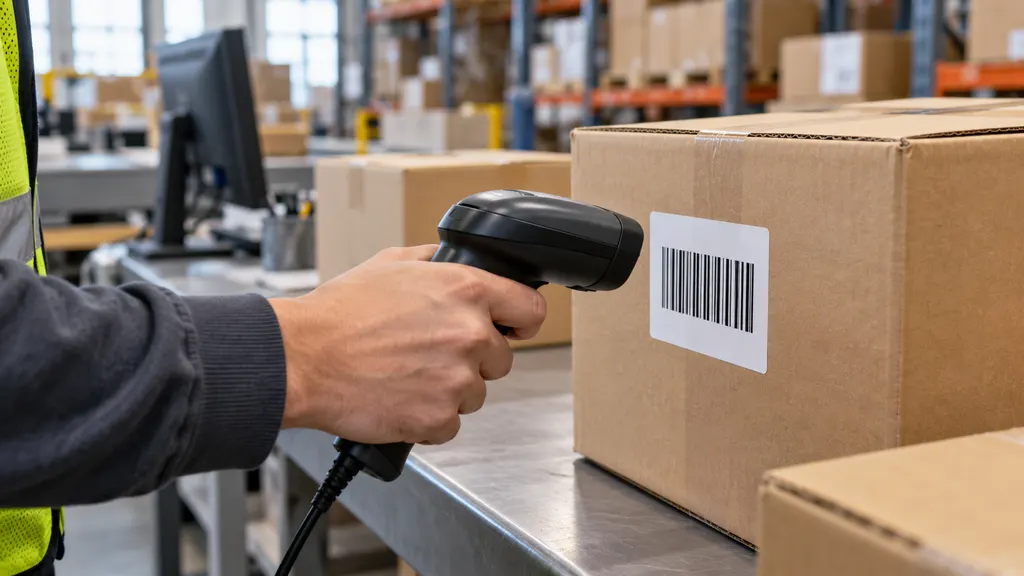
A barcode is the data carrier, not the complete identification system. It may encode an identifier that software uses to retrieve a record, or it may contain additional information such as a batch number or expiration date. Useful identification therefore depends on both a readable symbol and the correct relationship between its data and the object being scanned.
How Barcode Identification Works
A barcode identification system combines several functions: assigning identifiers, encoding data, producing symbols, reading them, interpreting their contents, and connecting the result to a business process. These functions are related, but an error in one cannot necessarily be corrected by the others.
- Assign an identifier. An organization establishes which product, individual item, carton, pallet, shipment, or other entity the identifier represents. The intended scope matters: a product identifier and a logistics-unit identifier answer different questions.
- Encode the data. Software converts the identifier and any permitted supplementary information into a barcode symbology. A symbology defines how data is represented by bars, spaces, or two-dimensional patterns.
- Produce and attach the symbol. The barcode is printed on packaging, applied as a label, or otherwise marked on the object. Its dimensions, contrast, placement, and surrounding clear space affect readability.
- Capture and decode it. A compatible reader captures the optical pattern and converts it into data. Laser scanners are associated with linear barcodes, while imaging readers can support linear and two-dimensional symbols, depending on their capabilities and configuration.
- Interpret and validate the data. Software checks the decoded content against the expected format and business context. A readable barcode may still contain an unexpected identifier or refer to the wrong object.
- Record the business event. An application associates the identifier with an action, such as receiving goods, confirming a pick, or recording a parcel handover.
The final step is particularly important in logistics. Scanning a label does not inherently mean that an item has been shipped, delivered, or accepted into inventory. The meaning depends on the application, operator action, location, and workflow associated with that scan.
Barcode Formats and Identification Standards
Barcode formats and identification standards address different parts of the system. A barcode format determines how information is represented optically; an identification standard determines what an identifier means and how it is assigned. GS1 standards provide established examples of both.
| Barcode family | How it represents data | Examples | Operational consideration |
|---|---|---|---|
| Linear, or one-dimensional, barcodes | Data is represented through a sequence of bars and spaces. | EAN/UPC, Code 128, and ITF-14 | The reader must support the specific symbology, and the symbol needs suitable dimensions and clear space. |
| Two-dimensional barcodes | Data is represented in patterns distributed across two dimensions. | Data Matrix and QR Code | A compatible imaging reader and appropriate software interpretation are needed. |
These families describe symbol structures, not separate categories of goods or shipments. Choosing a format requires considering the data to be carried, available printing area, scanning environment, and requirements of receiving systems. A format suitable for one workflow is not automatically suitable for another.
Identifiers, Data Carriers, and Internal References
| Term | Meaning | Important distinction |
|---|---|---|
| GTIN | A Global Trade Item Number identifies a trade item under the GS1 system. | It identifies a trade item, not necessarily an individually serialized physical unit. |
| SSCC | A Serial Shipping Container Code identifies an individual logistics unit, such as a pallet or parcel. | It identifies the logistics unit rather than each product contained within it. |
| SKU | A stock keeping unit is an internal reference used to manage a product or product variant. | Its meaning depends on the organization assigning it; it is not automatically a globally standardized identifier. |
| Barcode | A machine-readable optical representation of data. | It carries information but is not synonymous with the identifier it encodes. |
| Symbology | The rules for representing data in a particular barcode format. | It describes the encoding structure rather than the business object being identified. |
For example, GS1-128 uses the Code 128 symbology within the GS1 system. GS1 Application Identifiers indicate the meaning and format of data elements, such as an SSCC, batch number, or expiration date. Reading the characters is only one part of processing such a symbol; software must also interpret the data structure correctly.
Use in Logistics and Ecommerce
Barcode identification connects warehouse and transport activities to records in inventory applications, warehouse management systems, order management systems, and carrier systems. The following are illustrative workflows, not requirements that apply to every operation.
| Process | Possible scanning activity | Purpose |
|---|---|---|
| Receiving | Scan a product, carton, or pallet label against an expected receipt. | Associate arriving goods with the correct receiving record and identify discrepancies. |
| Putaway | Scan goods and a storage-location label. | Record where inventory has been placed. |
| Picking and packing | Scan an item and compare it with an order requirement. | Check that the selected product matches the expected item. |
| Shipping | Scan a parcel or logistics-unit label during dispatch. | Associate the physical unit with an outbound movement or handover. |
| Returns | Scan a return reference and, where relevant, a product identifier. | Connect returned goods to the appropriate return and inspection process. |
For example, an ecommerce warehouse may scan a product barcode before placing an item into a shipping carton. Its software can compare the decoded identifier with the order line. This check can support picking accuracy, but it does not establish that the item is undamaged or that the carton contains the correct quantity unless the workflow includes those checks.
Cross-Border Shipping
Cross-border movements can involve different labels and identifiers at different stages. A product barcode, a warehouse reference, and a carrier tracking barcode may all appear on related packaging while serving distinct purposes. Systems need a reliable mapping between those references when the business process requires them to be connected.
A barcode does not, by itself, establish customs classification, country of origin, declared value, or regulatory compliance. It may help retrieve records containing such information, but the validity of those records is a separate matter. Similarly, reading a parcel identifier does not prove customs release; that status requires information from the relevant clearance process.
Barcode Identification, Tracking, and Traceability
Identification answers which object or category of object a code represents. Tracking concerns recorded movement or status. Traceability concerns the ability to follow relevant history and relationships across a process or supply chain. Barcode scans can contribute to tracking and traceability, but the printed symbol alone does not provide either capability.
A tracking record requires events associated with an identifier, such as the time, location, and business step of a scan. Traceability may also require relationships between products, batches, cartons, and pallets. GS1 EPCIS provides a standard for sharing visibility event data; it is distinct from the barcode used to capture an identifier.
A product-level identifier shared by interchangeable units cannot alone distinguish one individual unit from another. Where individual-unit traceability is needed, the identification scheme and records must provide that distinction, for example through serialization. Batch-level identification serves a different purpose and should not be mistaken for individual-unit identification.
Readability, Data Quality, and Operational Limits
Barcode identification depends on both optical quality and information quality. A well-printed label with an incorrect identifier can create a data error, while a correctly assigned identifier on an unreadable label can interrupt a workflow.
- Print quality: Insufficient contrast, distorted dimensions, smudging, or missing elements can affect decoding.
- Placement and condition: Folds, abrasion, curved surfaces, reflective wrapping, and obstruction can make a symbol difficult to capture.
- Reader compatibility: A reader must support the symbology and be configured to transmit the information the application expects.
- Data interpretation: Leading zeros, separators, and structured data elements must be preserved or processed appropriately.
- Record accuracy: The decoded identifier must correspond to the correct product, logistics unit, or transaction in the receiving system.
- Workflow controls: Applications need rules for unexpected codes, duplicate scans, missing records, and unsuccessful reads.
Barcode verification is different from a successful scan. Verification assesses symbol quality against applicable specifications. A successful read by one device shows that the device decoded the symbol under those conditions; it does not establish consistent readability across other equipment or environments.
Before introducing a barcode workflow, an operator should establish what each identifier represents, which formats trading partners accept, where labels will be placed, and how exceptions will be handled. Testing should include the intended printers, packaging materials, readers, and software interfaces rather than only checking an image on a screen.
Common Misunderstandings
- A barcode contains the complete product record. Many barcodes carry an identifier used to retrieve information elsewhere. Some formats can carry additional data, but the available content depends on the encoding scheme and implementation.
- Every barcode identifies a unique physical item. Some identify a trade item shared by many identical units. Individual identification requires an appropriate unique reference and supporting records.
- Scanning automatically updates every connected system. Updates depend on application rules, integrations, connectivity, and event processing.
- A valid-looking barcode proves authenticity. A barcode can be copied. Readability alone does not establish that the labeled goods are genuine or that the label was legitimately applied.
QA
Is barcode identification the same as shipment tracking?
No. Barcode identification captures an identifier. Shipment tracking combines that identifier with recorded events and status information from the transport process.
Can a barcode identify an individual parcel?
Yes, if the encoded reference identifies that parcel or logistics unit within the relevant identification system. A product barcode alone does not necessarily identify the parcel containing the product.
Does scanning a barcode require an internet connection?
Optical decoding itself does not inherently require internet access. Retrieving remote records, validating data against an online service, or sharing events may require connectivity, depending on the implementation.
Are QR codes part of barcode automatic identification technology?
Yes. QR codes are two-dimensional barcodes. Their usefulness in a logistics workflow depends on the encoded data, reader compatibility, and software that interprets the result.
Sources
- GS1 — Barcodes: Barcode families, GS1 data carriers, and automatic data capture applications.
- GS1 — Global Trade Item Number: The identification role of GTINs for trade items.
- GS1 — Serial Shipping Container Code: Identification of individual logistics units.
- GS1 — Barcode Verification: Symbol quality assessment and the distinction between verification and ordinary scanning.
- GS1 — EPCIS: Sharing visibility event data and its relationship to supply-chain traceability.