Bar Code System
What Is a Bar Code System?
A bar code system, also written as barcode system, is a combination of machine-readable symbols, scanning equipment, software, and operating procedures used to identify objects and record information about them. In logistics and ecommerce, it connects physical goods, storage locations, parcels, and logistics units with digital records so that receiving, inventory, order fulfillment, shipping, and returns activities can be recorded and checked.
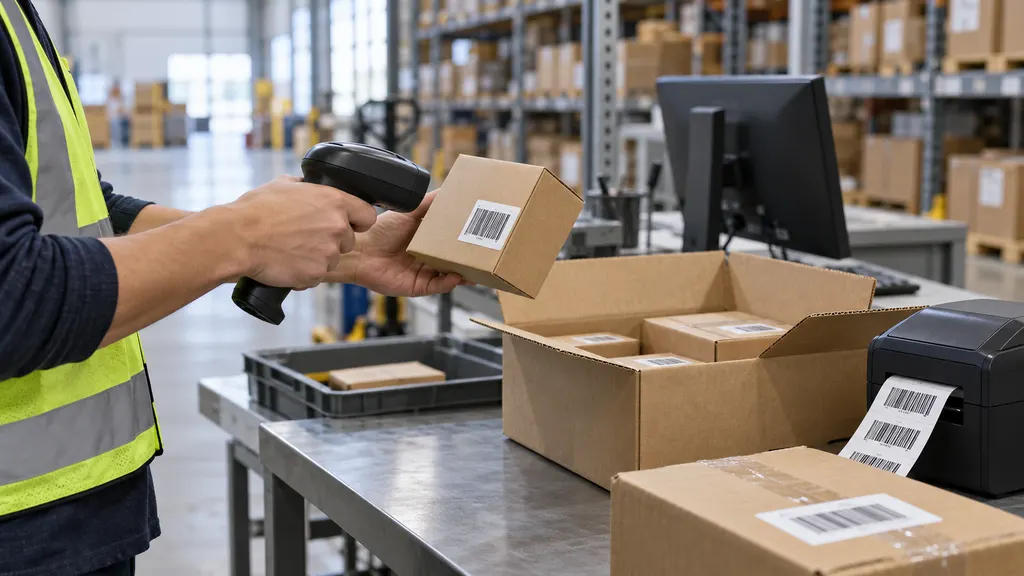
The barcode itself is only one component. A complete system must determine what an identifier represents, produce or obtain the appropriate symbol, read it correctly, and use the decoded information in a business application. For example, scanning a product during order picking may allow a warehouse management system to check whether the selected item matches the order line.
Although the term originated with symbols made of parallel bars and spaces, barcode systems can also use two-dimensional symbols, including QR Code and Data Matrix. The appropriate symbol depends on the information being encoded, applicable standards, scanning equipment, and the requirements of the receiving organization.
Components of a Bar Code System
A functioning system requires agreement between physical labels and digital records. Purchasing scanners or printing labels does not, by itself, establish that agreement.
- Identification rules: These define what is being identified, such as a product type, an individual serialized item, a warehouse bin, or a logistics unit.
- Barcode symbols: These carry identifiers or other data in a machine-readable format. A barcode symbology specifies how that information is represented.
- Label production or marking: Symbols may be printed on packaging, applied as labels, or marked directly on suitable surfaces.
- Reading equipment: Compatible scanners, cameras, or mobile devices capture and decode the symbols.
- Business software and records: Applications interpret the decoded information and connect it with products, orders, locations, shipments, or other records.
- Operating procedures: These establish when to scan, how to respond to mismatches, and how to handle damaged, duplicate, or unidentified labels.
These components are interdependent. A clearly printed symbol can still produce an incorrect transaction if its identifier is assigned to the wrong product. Conversely, an accurate database cannot compensate for a label that the available equipment cannot read.
How a Bar Code System Works
- Define the identification level. The organization determines whether the process needs to distinguish a product type, a lot or batch, an individual item, or a handling unit such as a pallet.
- Assign or obtain an identifier. The identifier is created under the relevant internal or external identification rules and associated with a business record.
- Encode the information. The chosen barcode format represents the identifier and, where supported and required, additional information such as a batch number or expiration date.
- Apply the symbol. The barcode is placed where it can be read during the intended operation without being obscured by wrapping, folds, or other labels.
- Scan at a process event. A worker or automated reader captures the barcode during receiving, putaway, picking, packing, dispatch, or another defined activity.
- Validate and record the transaction. Software checks the decoded information against the task or expected record. It may accept the transaction, request more information, or flag an exception.
Reading a barcode and completing a transaction are different actions. A successful decode means the equipment has interpreted the symbol; it does not prove that the goods are correct, that the expected quantity is present, or that the transaction has been saved. Those checks depend on application logic and operational controls.
Barcode Formats Used in Commerce and Logistics
Barcode formats are commonly grouped into linear and two-dimensional symbols. That distinction describes their physical structure, not the business meaning of every identifier they can carry. The following examples illustrate established formats rather than an exhaustive classification.
| Format | Structure | Relevant use | Important distinction |
|---|---|---|---|
| EAN/UPC | Linear | Identification of retail trade items using Global Trade Item Numbers | Identifies a trade item; it does not inherently identify a parcel or shipment. |
| Code 128 | Linear | Encoding alphanumeric information in operational applications | The symbology alone does not establish shared business meanings for the encoded data. |
| GS1-128 | Linear, based on Code 128 | Logistics labels and structured supply chain data | Uses GS1 conventions and Application Identifiers to distinguish data elements. |
| GS1 DataMatrix | Two-dimensional | Identification and additional structured data where the application requires them | Uses the GS1 data syntax; it is not simply any Data Matrix symbol. |
| QR Code | Two-dimensional | Encoding information such as web addresses or identifiers | Its business meaning depends on the encoded content and the application interpreting it. |
GS1 Application Identifiers indicate the meaning and format of associated data elements. They allow compatible applications to distinguish information such as a product identifier, batch number, or expiration date. A system handling these elements must interpret their structure correctly rather than treat every scan as an undifferentiated string of characters.
Use Across the Logistics Workflow
Receiving and Inventory
During receiving, a barcode can connect arriving goods with an expected product or logistics-unit record. Depending on the workflow, operators may also capture quantities, batches, serial numbers, and storage locations. Scanning a product does not automatically establish the number of units received; quantity must be encoded, entered, counted, or derived under a defined process.
During putaway and replenishment, scanning both the goods and the destination location can help associate stock with a warehouse bin. Inventory counts can use the same identifiers to compare physically observed stock with recorded balances. The accuracy of the result still depends on correct counting and consistent transaction recording.
Picking, Packing, and Dispatch
In order fulfillment, software can compare a scanned product identifier with the item requested by an order. At packing, a separate check may associate the selected goods with the parcel being prepared. A carrier label then provides identifiers used in the shipping workflow.
These identifiers should not be assumed to be interchangeable. A product barcode answers a different question from a parcel barcode. A parcel may contain several products, and one order may be fulfilled through several parcels. The software must maintain those relationships explicitly.
Returns
A returns workflow may use an original product barcode, a parcel identifier, or a return authorization identifier to find the relevant record. Identification is only the starting point: inspection, condition assessment, refund eligibility, and the decision to restock or dispose of an item remain separate activities.
Cross-Border Movements
In cross-border ecommerce, identifiers can help trading partners connect physical goods with information exchanged between warehouse, transportation, and commercial systems. However, a barcode does not by itself establish customs admissibility, origin, tariff classification, or duty treatment. Those matters depend on the relevant goods, documents, declarations, and legal requirements.
Where different organizations scan the same label, interoperability requires more than readable printing. The partners must agree on the identification scheme, data syntax, label requirements, and electronic records associated with the identifier.
Related Terms and Identification Boundaries
| Term | Meaning | Relationship to a bar code system |
|---|---|---|
| Barcode | A machine-readable symbol representing data | The data carrier, not the complete operational system. |
| SKU | An identifier used by a business to manage an inventory item | May be encoded in a barcode, but its meaning and uniqueness depend on the business assigning it. |
| GTIN | Global Trade Item Number, a GS1 identifier for trade items | Can be carried in supported barcode formats; it identifies the trade item rather than the entire barcode system. |
| SSCC | Serial Shipping Container Code, a GS1 identifier for a logistics unit | Can connect a physical logistics unit, such as a pallet, with associated information. |
| Tracking number | An identifier used in a shipment-tracking service | May appear in a carrier barcode, but its scope and interpretation depend on the carrier or shipping system. |
| RFID | Radio-frequency identification using tags and readers | A different data-capture technology; barcode reading normally requires optical visibility of the symbol. |
A GTIN usually identifies a trade item at a particular packaging level, not each individual physical instance. Identifying a particular instance requires an appropriate instance-level identifier or a combination such as a product identifier and serial number. Likewise, an SSCC identifies a logistics unit; it is not a substitute for describing every product contained within that unit.
Practical Checks and Limitations
Barcode systems can support consistent identification, but their effectiveness depends on data governance, equipment compatibility, label quality, and workflow design. Useful implementation checks include:
- Identifier scope: Establish whether each code represents a product type, individual item, location, parcel, or logistics unit. Avoid assigning the same identifier to unrelated active records.
- Reader compatibility: Confirm that the equipment can read the selected symbol. Equipment intended only for linear barcodes should not be assumed to read two-dimensional symbols.
- Data interpretation: Test how software handles leading zeros, variable-length fields, separators, and structured data elements.
- Print and placement quality: Check contrast, symbol dimensions, required clear space, and visibility on the actual packaging used.
- Operational durability: Assess whether labels remain readable after expected handling, abrasion, moisture exposure, or temperature changes.
- Record matching: Verify that the scan opens or updates the intended record, including the correct packaging level and unit of measure.
- Exception handling: Define what happens when a code is unknown, duplicated, unreadable, or inconsistent with the task.
- Event recording: Confirm that transactions retain the relevant context, such as the operation, location, and time, rather than merely storing a decoded identifier.
Barcode verification and ordinary scanning serve different purposes. A scanner test demonstrates that particular equipment can read a symbol under the test conditions. Formal verification assesses symbol quality against applicable criteria. Neither process, on its own, establishes that the encoded identifier is associated with the correct physical goods.
QA
Is a bar code system the same as a barcode scanner?
No. A scanner is a reading device. A bar code system also includes identification rules, labels or markings, software, business records, and procedures for acting on scanned information.
Does a barcode contain all the information about a product?
Not necessarily. It may contain only an identifier that software uses to retrieve a record. Some formats can carry additional structured data, but the available information depends on what was encoded.
Can the same product barcode be used as a parcel tracking number?
A product identifier and a tracking number serve different purposes. A product code identifies a trade item, while a tracking identifier relates to a shipment-tracking record. A system should maintain the relationship between them rather than assume they are equivalent.
Does scanning a barcode automatically update inventory?
Only when the connected application is configured to perform an inventory transaction. A scan can instead retrieve information, validate a task, or trigger an exception without changing stock balances.
Sources
- GS1: Barcodes — Barcode structures, supported formats, and their role in identification and data capture.
- GS1 General Specifications — Identification rules, barcode application requirements, data syntax, and symbol-quality considerations.
- GS1: Global Trade Item Number — The scope and purpose of trade-item identification.
- GS1: Serial Shipping Container Code — Identification of logistics units in supply chain operations.
- GS1 Application Identifiers — Meanings and formats of structured data elements used in GS1 applications.