Automatic Guided Vehicle(Agv)
What Is an Automatic Guided Vehicle (AGV)?
An automatic guided vehicle (AGV), more commonly called an automated guided vehicle, is a powered, driverless industrial vehicle that moves materials along designated routes under automatic control. In logistics, AGVs transport loads such as pallets, containers, carts, and work-in-progress between locations within warehouses, distribution centers, and manufacturing facilities. They use guidance and control systems rather than an onboard driver to follow routes and complete transport tasks.
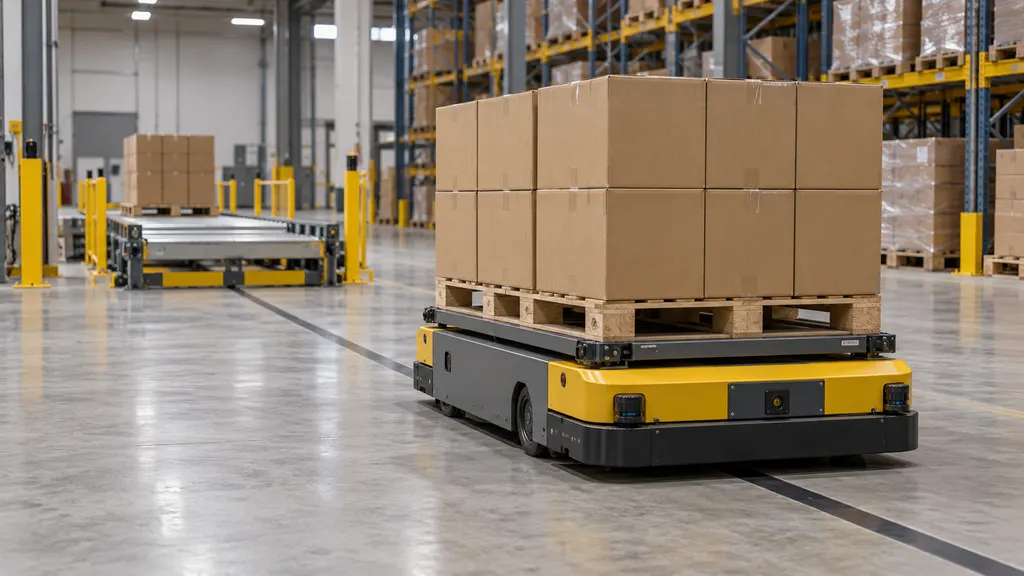
An AGV is part of a material-handling system, not a parcel delivery service or shipment-tracking platform. Its immediate function is to move physical goods between operating locations. Depending on its design, it may carry a load on a platform, tow carts, travel underneath a load carrier, or lift and place pallets using forks.
The abbreviation AGV may refer to an individual vehicle. A complete installation also includes supporting elements such as fleet-control software, guidance infrastructure where required, charging equipment, load-transfer stations, and interfaces with other warehouse systems.
Role in Warehousing and Ecommerce Fulfillment
AGVs operate within the internal movement stage of a supply chain. They can connect receiving, storage, replenishment, production, packing, and outbound staging areas. These movements support fulfillment, but they are distinct from deciding which orders to release, determining inventory ownership, or transporting shipments between countries.
For example, an ecommerce retailer may use an AGV to move a pallet of received merchandise from an inbound transfer station to a designated storage interface. Another vehicle may deliver packaging materials to a packing area. In a returns operation, an AGV may move containers of returned goods from receiving to inspection stations. These are illustrative workflows, not functions available in every installation.
In cross-border ecommerce, the same equipment may handle imported inventory after receipt at a fulfillment center or move consolidated export loads toward dispatch areas. The vehicle does not itself clear goods through customs, determine tariff classification, or replace the records required for international trade. Its role remains physical transport within the facility.
How an AGV System Works
Task creation and assignment
A transport request identifies a pickup location, a destination, and relevant load requirements. The request may originate from an operator, a production system, a warehouse management system, or another control application. Fleet-control software can assign the task to a suitable vehicle according to configured rules, vehicle availability, location, and battery condition.
System boundaries vary. A warehouse management system may decide that inventory needs replenishment, while a warehouse control system or fleet manager translates that requirement into equipment movements. Not every AGV installation uses every software layer.
Guidance and navigation
An AGV determines how to follow an authorized route using its installed guidance technology. Methods include embedded guide wires, magnetic tape, optical markers, laser reflectors, and localization against mapped environmental features. Some methods require physical route infrastructure; others rely more heavily on maps and onboard sensors.
The important distinction is between knowing the vehicle's position and deciding where it may travel. A vehicle can localize without a painted line or embedded wire while still operating on predefined routes. Therefore, the absence of a physical guide path does not, by itself, establish that a vehicle is an autonomous mobile robot rather than an AGV.
Travel and traffic coordination
The vehicle travels toward its assigned station while its control system manages movement. In a multi-vehicle installation, fleet management may coordinate access to intersections, shared aisles, and transfer points. The system must also account for interactions with people, manually operated trucks, doors, and other equipment.
Obstacle detection does not necessarily mean independent rerouting. Depending on the vehicle and installation, detecting an obstruction may cause a slowdown or stop until the route becomes available. Any claim that an AGV can navigate around an obstacle should be checked against the actual system design.
Load transfer and completion
At the destination, the vehicle positions itself for unloading or load exchange. Transfer may involve forks, rollers, conveyors, lifting mechanisms, or an operator. A successful movement requires alignment between the vehicle, the load carrier, and the receiving equipment.
The control system can then report task completion. This confirmation should not automatically be treated as proof of product identity, quantity, or inventory accuracy: those facts depend on the identification and verification controls used in the workflow.
Common Vehicle Configurations
AGVs can be described by how they handle a load. The following configurations are practical equipment descriptions rather than an exhaustive classification. Load-handling configuration and navigation technology are separate characteristics.
| Configuration | Load-handling method | Illustrative application |
|---|---|---|
| Towing vehicle | Pulls one or more compatible trailers or carts. | Moving batches of materials between staging areas and workstations. |
| Unit-load carrier | Carries a discrete load on a platform or integrated transfer deck. | Moving palletized goods or containers between transfer stations. |
| Automated forklift | Uses forks to pick up, transport, and place compatible loads. | Moving pallets between floor positions, conveyors, or suitable storage locations. |
| Underride vehicle | Travels beneath a compatible cart or load carrier and engages or lifts it. | Transporting mobile racks or carts between operating stations. |
Suitability depends on more than nominal load capacity. Load dimensions, center of gravity, pallet condition, pickup height, turning space, floor condition, and transfer accuracy can all affect whether a particular vehicle can perform a task.
AGVs and Related Automation Terms
| Term | Meaning | Relationship to an AGV |
|---|---|---|
| Autonomous mobile robot (AMR) | A mobile robot associated with autonomous localization, navigation, and movement planning within an operating environment. | Commercial terminology overlaps. AGVs are commonly associated with predefined routes, while AMRs are commonly associated with more flexible path planning; actual capabilities must be verified. |
| Conveyor | Fixed equipment that moves goods along a defined physical path. | May serve the same transfer requirement, but does not travel through the facility as a vehicle. |
| Automated storage and retrieval system (AS/RS) | Equipment and controls that automatically place loads into storage and retrieve them. | An AGV may connect to an AS/RS interface without performing the storage and retrieval function itself. |
| Warehouse management system (WMS) | Software used to manage warehouse inventory and operational workflows. | May request or record movements performed by AGVs; it is not the vehicle's physical guidance mechanism. |
The AGV–AMR distinction should not be treated as a universal binary rule. Suppliers, technical documents, and safety frameworks may group or describe mobile equipment differently. For procurement and system design, route flexibility, obstacle response, load-handling capability, and safety functions are more informative than the product label alone.
Operating Requirements and Limitations
An AGV installation is an engineered material-handling application. Its performance depends on the interaction between vehicles, software, loads, people, and the building. Automation does not remove the need to manage these conditions.
- Route conditions: Aisle width, turning clearance, gradients, floor joints, surface condition, and access restrictions must suit the vehicle and load.
- Load consistency: Damaged pallets, unstable stacks, projecting packaging, or incompatible carts may prevent safe pickup or transport.
- Transfer readiness: A destination must be available and able to accept the load. A blocked station can delay vehicles upstream.
- Traffic interaction: Pedestrians, manually driven equipment, and other automated vehicles introduce coordination requirements.
- Energy supply: Charging locations and charging schedules must fit the operating workflow.
- System communication: Where dispatch and status exchange depend on network connections, communication interruptions require defined responses.
- Exception recovery: Operators need procedures for blocked routes, failed transfers, damaged loads, and equipment faults.
AGVs can automate repeatable transport tasks, but they do not guarantee a particular labor saving, throughput increase, or return on investment. Results depend on travel distances, demand patterns, handling time, congestion, equipment availability, and the amount of manual intervention required. A transport bottleneck may also shift to a pickup station, packing operation, or receiving process rather than disappear.
Safety and Application Assessment
Driverless movement still requires risk assessment and appropriate safeguards. Hazards can arise from collisions, trapping or crushing points, falling loads, unexpected movement, and interactions during maintenance or manual recovery. Detection devices and emergency stops are components of a safety system, not substitutes for assessing the complete application.
ISO 3691-4 addresses safety requirements and verification for driverless industrial trucks and their systems. Its relevance does not mean that citing the standard alone proves an installation is safe or legally compliant. Applicable requirements depend on the equipment, operating conditions, jurisdiction, and relevant version of the standard.
Before selecting or modifying an installation, useful assessment questions include:
- What exact loads, pickup points, and destinations must the system handle?
- Are routes and transfer interfaces suitable under both normal and peak operating conditions?
- How will people and other vehicles interact with the equipment?
- What happens when a route is blocked or a load cannot be transferred?
- Who may reset faults, recover vehicles, or enter restricted areas?
- How are task completion, load identification, and inventory updates verified?
- How will changes to layouts, packaging, software, or operating procedures be reviewed?
These checks help define the application boundary. A demonstration in an empty aisle does not establish performance or safety in a working warehouse with mixed traffic and variable loads.
QA
What does AGV stand for in logistics?
AGV stands for automated guided vehicle; automatic guided vehicle is also used. It is a driverless industrial vehicle used to move materials along designated routes.
Does an AGV need a wire or magnetic tape?
No. Some AGVs use wires or tape, while others use laser guidance or localization against mapped features. Guidance technology should be checked separately from route-planning capability.
What is the difference between an AGV and an AMR?
AGVs are commonly associated with predefined routes, while AMRs are commonly associated with more flexible autonomous navigation. Terminology overlaps, so the actual navigation, obstacle-response, and safety capabilities matter more than the label.
Can an AGV update warehouse inventory?
An AGV system can exchange movement confirmations with warehouse software. An accurate inventory update also depends on identifying the correct load, confirming its destination, and applying the appropriate system controls.
Sources
- ISO 3691-4: Industrial trucks — Safety requirements and verification — Part 4: Driverless industrial trucks and their systems — Safety framework and scope for driverless industrial truck systems.
- Occupational Safety and Health Administration: Industrial Robot Systems and Industrial Robot System Safety — General industrial robotics hazards, risk assessment, safeguarding, and operational safety context.
- Wikipedia: Automated guided vehicle — Supporting reference for terminology, guidance methods, vehicle configurations, and material-handling applications.