Radio Frequency Identification (Rfid)
What Is Radio Frequency Identification (RFID)?
Radio frequency identification (RFID) is a technology that uses radio waves to identify tagged objects and exchange data between a tag and a reader. In logistics and ecommerce, RFID is used to identify goods, cartons, pallets, reusable containers, and other assets at points such as warehouse receiving, storage, picking, and dispatch. A software system connects the identifier read from a tag to information about the associated object.
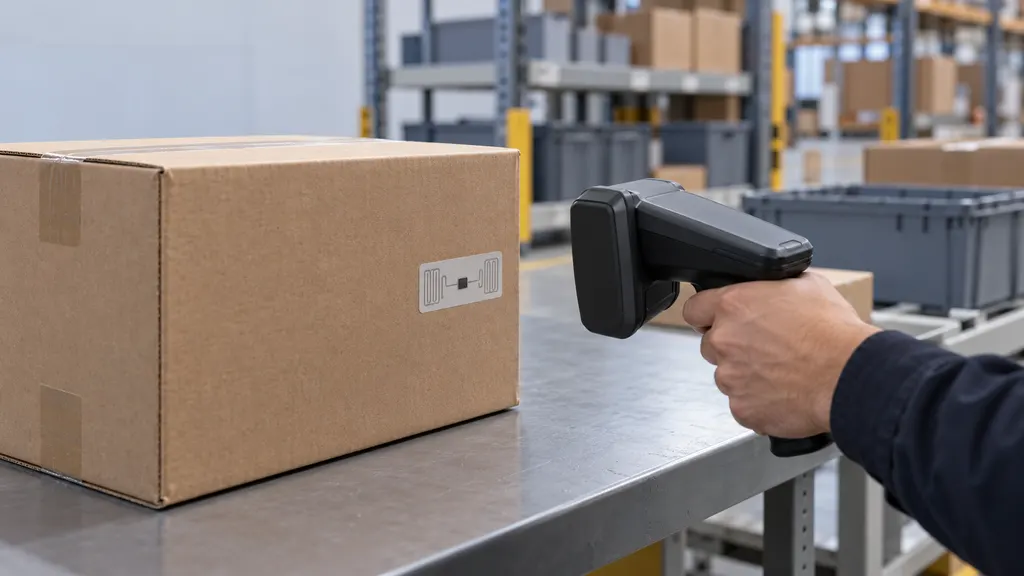
An RFID tag usually contains an electronic chip and an antenna. Unlike an optical barcode, it does not normally need to be directly visible to the reader. However, a successful read still depends on the tag, reader, distance, orientation, surrounding materials, and operating environment. RFID identifies objects within a suitable reading zone; it does not automatically provide continuous shipment tracking or geographic location.
How RFID Works
An RFID system combines physical identification equipment with software that interprets the resulting observations. Reading a tag is only one part of the process: the system must also determine what the observation means for inventory or a business transaction.
- An object is associated with a tag. A business attaches or embeds a suitable tag and links its identifier to an item, carton, pallet, or asset record. Some deployments encode additional data on the tag.
- A reader communicates with the tag. Reader antennas create a radio-frequency interrogation zone. A compatible tag responds according to the relevant air-interface protocol.
- Software processes the observations. The system may remove repeated reads, check whether an identifier is expected, and associate the observation with a particular reader or operational location.
- A business application uses the result. A warehouse management or inventory system may record receipt, flag an unexpected object, or support a stock count, depending on configured business rules.
For example, a pallet passing through a receiving portal may produce several observations of the same tag. Those observations do not represent several pallets. Software must interpret them as evidence of a business event, while accounting for whether the pallet actually entered the receiving area or merely passed nearby.
This distinction between a raw read and an accepted business event is important. RFID hardware supplies observations; application logic determines whether those observations are sufficient to update an operational record.
Main RFID Tag Types
Tags can be classified by their power source. This classification is separate from their operating frequency, memory capacity, physical construction, or attachment method.
| Tag type | Power arrangement | Operational implications |
|---|---|---|
| Passive | Uses energy supplied by the reader's radio field rather than an onboard battery. | Suitable for applications where objects pass within a configured reader zone; performance depends strongly on the tag and environment. |
| Active | Uses an onboard power source to support radio transmission. | Can support asset-monitoring applications, but introduces battery maintenance and infrastructure considerations. |
| Battery-assisted passive | Uses a battery to power circuitry while relying on reader communication and a passive-style response mechanism. | May support sensing or particular performance requirements; capabilities depend on the implementation. |
RFID systems also operate in different frequency bands, including low frequency, high frequency, and ultra-high frequency. Passive UHF RFID is used for supply-chain applications such as reading tagged items or cases at operational checkpoints. Frequency alone does not determine performance: antenna design, permitted reader power, tag placement, and object materials also matter.
Frequency allocations and operating requirements vary by jurisdiction. A cross-border deployment therefore needs compatible tags and readers, as well as equipment configured for the applicable local radio regulations. Compatibility should not be inferred solely from the word RFID on a product specification.
Uses in Logistics and Ecommerce
RFID can connect physical handling activities with digital inventory and asset records. Its usefulness depends on the identification level and the specific operational question being answered.
| Operational stage | Illustrative use | Important condition |
|---|---|---|
| Receiving | A warehouse compares observed carton identifiers with an expected inbound delivery. | Identifiers must be linked to the relevant shipment or receipt records. |
| Inventory counting | An operator uses a handheld reader to collect identifiers from tagged stock. | Read coverage and location boundaries must be checked before accepting the count. |
| Order fulfillment | A packing station checks tagged items against an order's expected contents. | Nearby stock must not be mistaken for items inside the package. |
| Dispatch | A portal records tagged goods moving through an outbound checkpoint. | The system needs a reliable basis for associating reads with the correct movement. |
| Returns | A returned item's identifier is checked against an existing product or sale record. | Identification does not establish condition, eligibility, or refund approval. |
| Reusable asset management | A business records movements of tagged totes or transport containers. | The asset identifier must remain distinguishable from identifiers for its contents. |
These are possible workflows, not claims that every warehouse uses RFID. A business may use RFID at selected checkpoints while retaining barcodes or manual checks elsewhere.
The identification level also limits what a read establishes. Reading a pallet tag identifies that pallet; it does not independently confirm every item inside it. Software may associate the pallet with recorded contents, but the association must be created and maintained as goods are packed, split, or moved.
Identifiers, Standards, and Data Exchange
RFID is the identification technology, not a single universal numbering system. A tag's stored identifier needs an agreed meaning so that software can connect it to the correct business object.
The Electronic Product Code (EPC) is a standardized identification framework used with RFID in supply chains. Depending on the identification scheme, it can distinguish individual instances of products or identify other business objects. EPC and RFID are therefore related but not interchangeable: EPC concerns identification, while RFID concerns radio-based data capture.
GS1's EPC UHF Gen2 air-interface standard addresses communication between compatible passive UHF tags and readers. Separately, GS1's Electronic Product Code Information Services (EPCIS) standard supports sharing visibility-event data between applications and organizations. EPCIS is not an RFID reader protocol, and its events can originate from data-capture methods other than RFID.
For trading partners, technical readability is only one requirement. They also need agreement on identifiers, event meanings, locations, access permissions, and data quality. A readable tag does not by itself create an interoperable supply-chain record.
RFID Compared with Related Technologies
| Technology or concept | Primary role | Difference from RFID |
|---|---|---|
| Barcode | Represents data in an optically readable symbol. | Requires the symbol to be visible to an optical reader; RFID uses radio communication. Both can identify the same business object. |
| GPS | Provides positioning using satellite signals received by suitable equipment. | An ordinary passive RFID tag does not determine its geographic coordinates. A fixed RFID reader instead supplies evidence that a tag was within its reading zone. |
| NFC | Supports short-range contactless communication within the broader radio-frequency identification field. | NFC is not synonymous with all RFID. An NFC-capable phone does not automatically read warehouse UHF tags. |
| Shipment tracking | Records and presents the progress of a shipment through operational events. | RFID can supply some underlying observations, but tracking also requires shipment associations, event processing, and reporting systems. |
Barcode and RFID systems can coexist. A printed label may carry a human-readable identifier, a barcode, and an RFID component, allowing different facilities to use the data-capture equipment available to them.
Limitations and Implementation Checks
RFID performance should be evaluated in the intended workflow rather than inferred from a nominal read-range specification. Metal can alter antenna behavior or obstruct communication, while water-containing materials can affect radio propagation. Specialized tag designs and placement may address particular conditions, but they require testing.
- Define the object and event. Specify whether the system identifies individual items, cartons, pallets, or assets, and whether a read should represent receipt, movement, counting, or dispatch.
- Test representative conditions. Include actual packaging, product materials, stacking patterns, movement speeds, and tag orientations.
- Control the read zone. Check for missed tags and unintended reads from adjacent stock, lanes, or workstations.
- Maintain identifier associations. Verify how tags are commissioned, linked to records, replaced, and handled when goods are repacked.
- Define exception handling. Establish what happens when a tag cannot be read, an unexpected identifier appears, or a software connection fails.
- Assess security and privacy. Consider unauthorized reading, data modification, reader access, and the sensitivity of information linked to identifiers.
A unique identifier is not, by itself, proof that an item is genuine. Authentication depends on additional controls and the capabilities of the particular tag and system. Similarly, an RFID observation does not establish product condition, ownership, or legal compliance.
In cross-border commerce, RFID can support identification and visibility where compatible infrastructure exists. It does not replace customs declarations, required commercial documents, classification decisions, or regulatory inspections. Any use within a customs process depends on that process's specific requirements.
QA
Can RFID read several items without scanning each barcode?
Compatible RFID systems can identify multiple tags within a reading zone without individually aiming at each printed label. This does not guarantee that every tag will be read; materials, placement, and reader configuration remain important.
Does RFID provide real-time parcel location?
Not by itself. A passive tag is observed when it communicates with a compatible reader. Continuous location reporting requires additional infrastructure and system capabilities beyond ordinary passive tag identification.
Can a smartphone read a warehouse RFID tag?
Not necessarily. NFC capability does not make a phone a UHF RFID reader. Reading a tag requires hardware and software compatible with its frequency and communication protocol.
Does RFID replace barcodes?
No. The technologies can coexist, and their suitability depends on the workflow, equipment, packaging, and trading-partner requirements. A single object may carry both identifiers in different readable forms.
Sources
- GS1: Electronic Product Code and RFID standards — Supply-chain identification, EPC, and passive UHF RFID standards.
- GS1: EPCIS — Visibility-event data sharing and the distinction between event information and data-capture technology.
- NIST SP 800-98: Guidelines for Securing Radio Frequency Identification Systems — RFID system components, tag types, operating considerations, and security and privacy risks.