Dock Levelers
What Are Dock Levelers?
Dock levelers are adjustable loading-dock platforms that bridge the gap and height difference between a warehouse floor and the load floor of a truck or trailer. They provide a supported route for forklifts, pallet trucks, and goods to move between a building and a vehicle during loading or unloading. They are used at freight terminals, distribution centers, warehouses, and other facilities that handle vehicle-based deliveries.
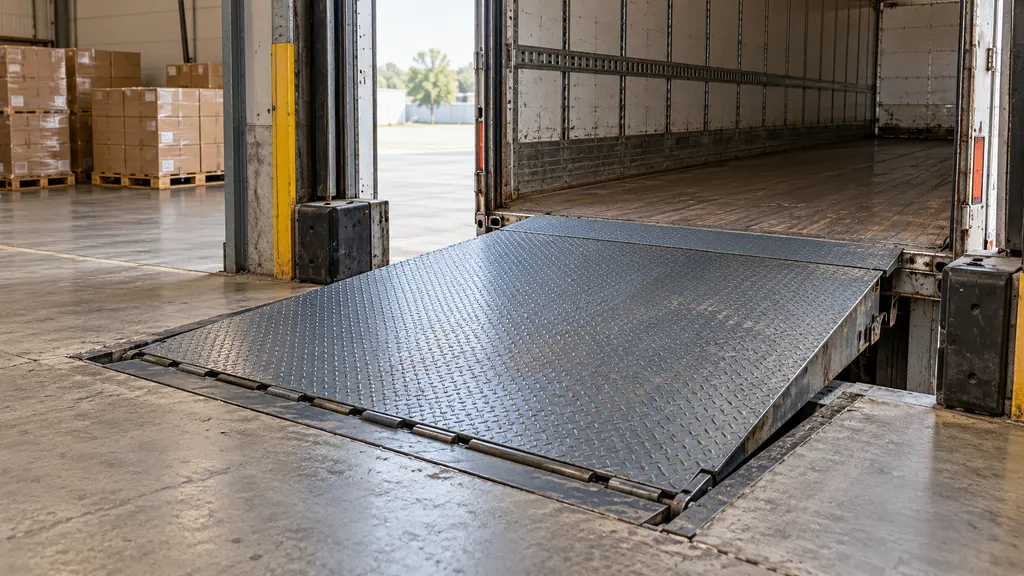
A dock leveler usually has a main platform, often called a deck, and an extending or hinged section called a lip that rests on the vehicle floor. Its adjustable position accommodates differences in vehicle height within the equipment's operating range. The term is also spelled dock leveller, particularly in British English.
A dock leveler is not a lifting platform for raising an entire truck, and it does not secure the vehicle against movement. It forms one part of a loading-dock system that may also include vehicle restraints, wheel chocks, dock bumpers, doors, seals, communication signals, and protective barriers.
Role in Logistics and Ecommerce Fulfillment
Dock levelers serve the physical transfer point between road transport and warehouse operations. On an inbound movement, goods cross the leveler before receiving checks, inventory recording, and putaway. On an outbound movement, picked and staged goods cross it as they are loaded for transport. Returns arriving on pallets or in bulk containers may pass through the same interface.
In ecommerce fulfillment, a dock leveler is associated with handling consolidated goods rather than tracking individual customer orders. For example, a retailer may receive pallets of imported products at a distribution center, unload them across a leveler, and subsequently allocate the inventory to customer orders. The equipment enables the physical transfer; it does not perform customs clearance, update inventory records, or generate shipment tracking events by itself.
Readers may encounter the term in warehouse specifications, equipment manuals, facility inspections, maintenance records, and loading procedures. In a facility assessment, the presence of dock levelers does not by itself establish that every truck can be handled. Vehicle geometry, dock height, equipment capacity, and the movement being performed must also be compatible.
How a Dock Leveler Works
A truck or trailer floor may be above or below the warehouse dock. Its height can also change as cargo is added or removed and the vehicle suspension responds. A suitable dock leveler creates a transition across this interface, within the limits of its design. The platform may therefore slope upward or downward rather than remain horizontal.
In a common hinged-lip arrangement, the deck is raised, the lip extends, and the assembly lowers until the lip is supported by the trailer floor. The deck then provides the crossing surface. Other designs use an extending lip or a different movement arrangement. Controls, support conditions, and storage procedures vary, so the manufacturer's instructions govern the actual operating sequence.
Main Components
- Deck: The main surface over which handling equipment and goods travel.
- Lip: The section that extends toward the vehicle and establishes the supported transition onto its floor.
- Support structure: The frame, hinges, and other structural elements that transfer loads into the dock installation.
- Operating mechanism: The mechanical, hydraulic, or air-powered arrangement used to position the deck and lip.
- Controls and protective features: Components that govern movement or reduce particular hazards. Their design and availability depend on the model.
These components function as an installed system. A sound deck cannot compensate for inadequate anchorage, damaged hinges, an unsuitable vehicle floor, or insufficient lip support.
Common Configurations and Operating Methods
Dock levelers can be described by their installation arrangement and by their operating mechanism. These are separate dimensions: a pit-mounted unit, for example, may use different methods of actuation.
Installation Arrangement
| Arrangement | Description | Compatibility Consideration |
|---|---|---|
| Pit-mounted dock leveler | Installed in a recessed pit at the dock, with the deck forming part of the crossing surface when stored. | The pit, structural support, deck dimensions, and working range must suit the application. |
| Edge-of-dock leveler | Mounted at the dock face rather than within a full recessed pit. | Its available travel must be checked against the expected vehicle-floor heights. |
| Vertical-storing dock leveler | Stores with its deck raised vertically when not in use. | The installation requires appropriate clearance, controls, and coordination with the dock door and vehicle position. |
Operating Mechanism
| Mechanism | General Principle | Operational Implication |
|---|---|---|
| Mechanical | Uses mechanical components, such as springs and linkages, to assist positioning. | Release, positioning, and return procedures depend on the design. |
| Hydraulic | Uses hydraulic cylinders to move the deck, lip, or both. | Inspection and maintenance include the relevant hydraulic components and controls. |
| Air-powered | Uses an air-actuated lifting arrangement to position the deck. | The air system and associated components require inspection according to the equipment instructions. |
These descriptions do not establish a universal ranking. Suitability depends on vehicle compatibility, loading activity, site conditions, maintenance arrangements, and the manufacturer's specifications.
Capacity and Compatibility
A dock leveler's stated capacity should not be interpreted as the allowable weight of the cargo alone. Selection must account for the handling vehicle, its carried load, and the operating conditions identified by the manufacturer. Repeated crossings, concentrated wheel loads, and forces created during movement are relevant to equipment assessment.
The following checks help define whether a proposed leveler is suitable:
- Combined crossing load: Identify the handling equipment, operator where applicable, attachments, and goods that will cross together.
- Vehicle-floor height: Check expected heights in both loaded and unloaded conditions against the leveler's permitted operating range.
- Transition slope: Confirm that the forklift or pallet truck can negotiate the transition under its applicable operating limits.
- Ground clearance: Check for contact at changes of slope, particularly with low-clearance handling equipment.
- Deck width and alignment: Confirm adequate usable width and a controlled approach without relying on travel close to exposed edges.
- Lip support: Verify that the lip can achieve the support required by the manufacturer throughout the intended operation.
- Vehicle-floor condition: Inspect for damage or weakness that could make entry unsafe even when the leveler itself is serviceable.
- Installation condition: Assess anchorage, structural support, drainage where relevant, and compatibility with surrounding dock equipment.
A leveler does not make an unsuitable vehicle safe to enter. Likewise, increasing the leveler's capacity does not resolve a weak trailer floor or an excessive transition angle.
Operating Safety and Inspection
Loading docks combine moving vehicles, exposed edges, changing floor levels, and heavy equipment. A leveler addresses the crossing interface but does not eliminate these hazards. Operating procedures must coordinate the driver, dock personnel, and handling-equipment operator.
The following sequence describes control points rather than instructions for operating a particular model:
- Establish vehicle position and security. Confirm alignment and apply the vehicle-securing measures required by the site procedure and applicable rules. Prevent departure while loading or unloading is in progress.
- Inspect the crossing area. Check the leveler, vehicle floor, and approach for damage, obstructions, contamination, or other unsafe conditions.
- Position the leveler. Follow the manufacturer's procedure and verify that the lip is properly supported before anyone crosses.
- Control traffic. Keep pedestrians clear of vehicle movements and pinch points. Operate handling equipment within the applicable load and movement limits.
- Monitor changing conditions. Stop if the vehicle moves, lip support becomes inadequate, equipment malfunctions, or the crossing becomes unsafe.
- Complete the departure procedure. Clear the vehicle, return equipment to its designated safe position, and communicate authorization to depart under the site's procedure.
Maintenance introduces additional risks because parts of the leveler can move or fall. Personnel must not work beneath an unsupported deck. Servicing requires the prescribed maintenance support and control of hazardous energy, including stored energy where present.
In the United States, OSHA's dockboard requirements address matters including load capacity, secure positioning, vehicle movement, and safe handling of portable dockboards. Its powered industrial truck rules also contain relevant provisions on loading operations and trailer-floor inspection. These are jurisdiction-specific requirements, not a substitute for the equipment manual or a statement of rules applicable worldwide.
Related Equipment and Terminology
| Term | Relationship to a Dock Leveler |
|---|---|
| Dockboard | A term used for a bridging surface between a dock and vehicle. Its scope can overlap with dock levelers, particularly in safety terminology, so the document's context matters. |
| Dock plate | Often refers to a portable bridging plate. Permitted equipment and loads depend on the product; it should not be assumed suitable for forklift traffic. |
| Yard ramp | A ramp that provides a longer approach between ground level and a raised loading surface, rather than only bridging the dock-to-vehicle interface. |
| Dock lift | A platform that raises or lowers goods and handling equipment between elevations, rather than simply forming an adjustable bridge. |
| Vehicle restraint | A separate device intended to help prevent unintended vehicle movement at the dock. A leveler is not a substitute for it. |
| Dock seal or shelter | Equipment around the doorway that helps limit exposure to outside conditions. It does not provide the load-bearing crossing surface. |
Terminology varies between suppliers, jurisdictions, and technical documents. The functional description and rated application are more reliable than a product name alone when deciding whether equipment is appropriate.
QA
Does a dock leveler lift the truck?
No. It adjusts the crossing platform between the dock and the vehicle floor. It does not raise the entire truck or trailer.
Can every forklift use every dock leveler?
No. Compatibility depends on the combined load, equipment dimensions, transition slope, ground clearance, and the leveler's specified operating limits. The vehicle floor must also be suitable.
Is a dock leveler the same as a dock plate?
Not necessarily. A dock leveler is an adjustable platform, while a dock plate often means a portable bridging plate. Terminology can overlap, so the equipment's design and permitted use must be checked.
Does a dock leveler prevent a trailer from moving away?
No. Vehicle movement requires separate controls, such as an appropriate restraint or other measures specified by applicable rules and site procedures.
Sources
- Occupational Safety and Health Administration: 29 CFR 1910.26, Dockboards — U.S. requirements concerning capacity, securing dockboards, and preventing transport-vehicle movement.
- Occupational Safety and Health Administration: 29 CFR 1910.178, Powered Industrial Trucks — Loading-operation precautions, vehicle-floor checks, and powered industrial truck operating requirements.
- Health and Safety Executive: Loading and Unloading — Loading-area controls, vehicle security, and coordination to prevent premature departure.
- MHI: Loading Dock Equipment Manufacturers — Industry context for loading-dock equipment and dock-leveling systems.