Two-Dimensional Bar Code
What Is a Two-Dimensional Bar Code?
A two-dimensional bar code, also written as two-dimensional barcode or 2D barcode, is a machine-readable symbol that encodes information through a pattern arranged in two dimensions. In logistics and ecommerce, it can carry identifiers or other data used to recognize products, parcels, inventory units, and return transactions. Depending on its format and application, the symbol may contain data directly or provide an identifier or web address through which a system retrieves associated information.
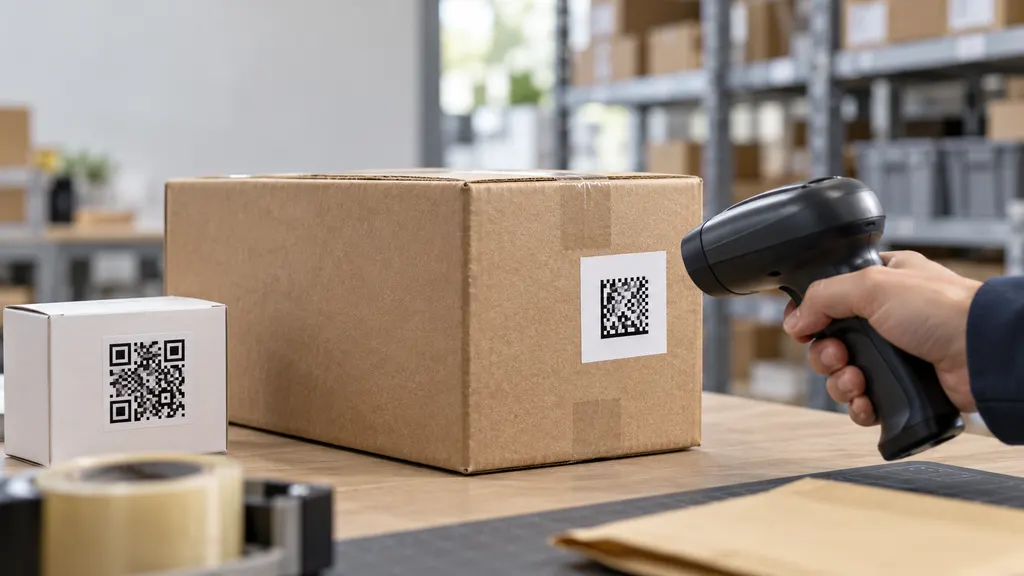
Unlike a linear barcode, which encodes information along one dimension using bars and spaces, a 2D barcode uses a matrix of elements or multiple stacked rows. QR Code, Data Matrix, and PDF417 are examples of 2D barcode formats. The format determines how information is represented and decoded; the business application determines what that information means.
How a Two-Dimensional Bar Code Works
A barcode-generating application converts a data string into a symbol according to the rules of a particular barcode format, also called a symbology. The data might be a product identifier, a serial number, a shipment reference, or a URL. A compatible reader captures the symbol and decodes its pattern back into data.
Decoding does not necessarily complete the business task. Warehouse, shipping, or retail software must interpret the decoded content and associate it with the correct record or action. A successful scan can therefore produce readable text while still failing an operational check if the receiving application does not recognize the data structure or identifier.
- Define the data: The organization selects the identifier, attributes, or reference required for the transaction.
- Encode the symbol: Software generates a barcode using the chosen symbology and applicable data rules.
- Print or display it: The symbol appears on packaging, a shipping label, a document, or a screen.
- Capture and decode it: A compatible imaging device or camera-based application reads the pattern.
- Validate and process it: The receiving system checks the content and, where appropriate, retrieves or updates a business record.
These steps explain why barcode quality, reader compatibility, and software integration must be considered separately. A well-printed symbol cannot compensate for an incorrect identifier, and correct data cannot compensate for a symbol that the available equipment cannot read.
Main Formats and Their Differences
Two-dimensional barcodes include matrix symbols and stacked symbols. Matrix symbols arrange elements across a two-dimensional grid. Stacked symbols arrange encoded information in multiple rows. These are structural distinctions, not rankings of quality or suitability.
| Format | Structure | Relevant characteristics | Application considerations |
|---|---|---|---|
| QR Code | Matrix | Can encode text, identifiers, and URLs; recognizable by its prominent corner finder patterns. | Useful where camera-based access to a web resource or application is intended. The destination and data syntax still need to be defined. |
| Data Matrix | Matrix | Uses a grid of cells with characteristic boundary patterns; GS1 DataMatrix applies GS1 data conventions. | Relevant to structured product identification and applications where label space is constrained. |
| PDF417 | Stacked | Encodes information across multiple rows rather than in a single linear sequence. | Requires equipment and software that support this symbology and the receiving application's data requirements. |
The barcode format alone does not establish a complete industry identification system. For example, Data Matrix names a symbology, whereas GS1 DataMatrix refers to its use with GS1-specific encoding and data rules. Similarly, a QR Code containing an arbitrary web address is not automatically equivalent to a QR Code carrying a GS1 Digital Link URI.
Use in Logistics and Ecommerce
Product Identification and Inventory
A 2D barcode on a product or its packaging can support identification during receiving, picking, packing, or stock checks. Where the relevant data standard allows it, one symbol can carry a product identifier together with attributes such as a batch number, serial number, or expiration date. The receiving application must understand which fields are present and how they are separated.
For example, a warehouse may scan a GS1 DataMatrix symbol to capture a product identifier and batch reference during receiving. The inventory system can then use those values when recording stock. This is an illustrative workflow, not a claim that every warehouse accepts the same symbol or captures the same attributes.
Shipping and Parcel Processing
A shipping label may contain machine-readable information used by a carrier or fulfillment operation. If a 2D barcode is specified, its role depends on the applicable label specification: it might carry a shipment reference, operational data, or a structured combination of fields.
A product barcode and a shipping barcode should not be treated as interchangeable. The first may identify the item inside a parcel, while the second identifies the shipment or supports a transport process. Scanning the wrong symbol can retrieve an unrelated record even when both symbols are technically readable.
Returns and Customer Handoffs
A retailer may issue a 2D barcode that represents a return authorization or gives an accepted collection location access to a return record. In such a workflow, the code is a reference used by participating systems; it is not inherently a shipping label or a guarantee that any location can accept the return.
The customer-facing instructions should distinguish between presenting a code for processing and attaching a transport label to a parcel. The applicable return arrangement determines whether packaging, label printing, or additional identification is required.
Cross-Border Supply Chains
In cross-border commerce, organizations may exchange goods whose labels must be interpreted by different trading partners. Shared identifier and data standards help establish a common meaning for the information encoded in a symbol. Reader compatibility alone is insufficient if the sender and recipient interpret the fields differently.
A 2D barcode does not, by itself, replace a commercial invoice, customs declaration, or other required trade documentation. Whether a particular barcode is accepted in a customs or transport process depends on the rules and technical specifications of that process.
Related Terms and Important Boundaries
| Term | Meaning | Relationship to a 2D barcode |
|---|---|---|
| Linear barcode | A symbol that represents data through a one-dimensional arrangement of bars and spaces. | An alternative barcode structure, not a synonym for a 2D barcode. |
| QR Code | A specific matrix barcode symbology. | One type of 2D barcode; not the name for the entire category. |
| Tracking number | An identifier used to retrieve information about a shipment within a tracking system. | May be encoded in a barcode, but exists independently of the symbol carrying it. |
| GS1 Application Identifier | A prefix that identifies the meaning and format of a data field in the GS1 system. | Helps receiving software interpret structured fields carried in supported GS1 barcodes. |
| GS1 Digital Link URI | A web-address structure that represents GS1 identifiers and can connect them to online information. | Can be carried in a suitable 2D barcode; the URI structure and barcode symbology are separate concepts. |
| RFID | A technology that uses radio-frequency communication to read information from tags. | Not a barcode technology; optical barcode reading and radio-frequency identification use different capture methods. |
Reading, Printing, and Implementation Checks
Choosing a 2D barcode requires more than selecting a familiar symbol. The following checks address separate causes of operational failure.
- Confirm the receiving specification. Establish which symbology, data fields, identifier rules, and label layout the trading partner or application accepts. Do not assume that any readable 2D barcode is acceptable.
- Check the scanning equipment. A conventional linear-only laser scanner cannot decode a matrix symbol simply because it can read linear barcodes. Confirm support for the selected format in the actual device and software configuration.
- Control symbol dimensions. More encoded data can require a larger symbol or smaller individual elements. Select dimensions that remain readable under the intended printing and scanning conditions.
- Preserve contrast and clear space. Follow the symbology's requirements for the unprinted area around the symbol, commonly called the quiet zone. Avoid placing text, borders, or other graphics inside that space.
- Assess the physical surface. Wrinkles, seams, glare, curvature, and abrasion can interfere with image capture. Test the label on the actual packaging rather than only on a flat design proof.
- Validate the decoded data. Check identifiers, field lengths, separators, and application rules. A scanner displaying characters is not proof that a warehouse or carrier system will accept them.
- Distinguish scanning from verification. A successful scan demonstrates readability under one set of conditions. Barcode verification evaluates symbol quality against defined criteria and is not equivalent to a single operational scan.
- Test the complete workflow. Confirm that scanning retrieves the intended record and triggers the correct action, including how the application handles duplicate, unknown, or invalid identifiers.
Common Misunderstandings
A 2D barcode does not provide live tracking by itself. It may encode a tracking identifier or link to a tracking resource, but shipment events must come from the connected operational systems. The printed symbol does not independently observe a parcel's movement.
Error correction does not make a symbol damage-proof. Formats such as QR Code and Data Matrix include error-correction mechanisms, but recovery depends on the format, configuration, and nature of the damage. Obscured recognition patterns or poor image quality can still prevent decoding.
More data is not always more useful. Encoding unnecessary information can increase symbol size or reduce printing tolerance if the available area is fixed. An identifier linked to a maintained record may be more appropriate than embedding details that can change.
Readable does not mean trustworthy. A barcode is a data carrier, not an automatic guarantee of authenticity or safe content. Applications should validate identifiers and handle encoded URLs according to their security requirements.
QA
Is a QR Code the same as a two-dimensional barcode?
A QR Code is one type of two-dimensional barcode. Data Matrix and PDF417 are other formats within the broader category.
Can a 2D barcode contain a parcel tracking number?
Yes. It can encode a tracking number or a URL used to access tracking information. The receiving application must recognize the content and connect it to the appropriate shipment record.
Can an existing barcode scanner read 2D barcodes?
Only if the equipment and its configuration support the relevant symbology. A linear-only scanner is insufficient for matrix barcodes; compatible imaging equipment or a suitable camera-based application is needed.
Does a 2D barcode work without an internet connection?
The symbol can be decoded offline when compatible local software is available. Opening an online destination or retrieving a remote business record requires access to the relevant network or service.
Sources
- GS1: Barcodes — Barcode types, identification standards, and the distinction between linear and two-dimensional symbols.
- GS1: Two-dimensional barcodes — Structured product data and the use of 2D barcodes in retail and supply-chain applications.
- GS1: GS1 DataMatrix — Data Matrix implementation, GS1 data encoding, and symbol-quality considerations.
- GS1: GS1 Digital Link — The relationship between standardized identifiers, web addresses, and access to online information.
- DENSO WAVE: About QR Code — QR Code structure, data representation, and error-correction characteristics.