How to Reduce Footwear Ecommerce Returns: 8 Fixes for Sizing, Width, and Wear
To reduce footwear ecommerce returns, fix the information shoppers use to choose shoes: publish model-specific sizing, explain width and volume, describe fit honestly, and show how each shoe performs in its intended use. Then connect return reasons to product-page changes, fulfillment checks, and clear try-on instructions. The goal is fewer avoidable returns, not fewer legitimate refunds or exchanges.
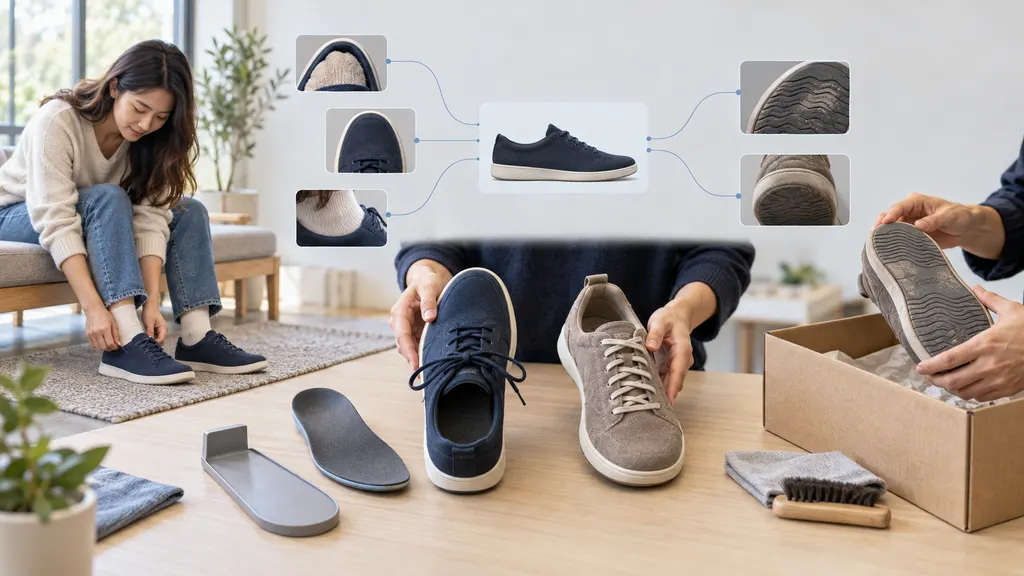
For footwear merchants, “wrong size” is often too broad to be actionable. A shoe can have enough length but squeeze the forefoot, slip at the heel, or press against the instep. Treat these as different problems. The eight fixes below give merchandising, customer service, product, and warehouse teams specific changes they can implement and measure.
1. Replace generic size charts with model-specific guidance
A storewide conversion chart may help shoppers navigate size labels, but it does not establish how an individual model fits. Start with the products generating the most fit-related returns and check whether their pages distinguish size conversion from actual fit guidance.
- Label measurements clearly as foot length, internal shoe length, or another defined measurement. Do not use these interchangeably.
- Show the size system beside every size selection, such as US women's, US men's, UK, or EU.
- Keep charts consistent across product pages, mobile views, customer-service responses, and packaging inserts.
- Explain between-size recommendations only when supported by the supplier's guidance or your own documented fit assessment.
Place measurement instructions beside the size selector rather than hiding them in a general help page. Ask shoppers to measure both feet while standing and wearing the type of socks intended for the shoes. The American Academy of Orthopaedic Surgeons recommends fitting shoes to the larger foot and notes that size alone should not determine the purchase.
Owner: Merchandising, supported by product quality. Before publishing a chart, verify its units, measurement method, and applicability to the exact model. If only a supplier conversion table is available, label it as a conversion guide rather than presenting it as independently measured fit data.
2. Explain width, toe-box shape, and instep volume separately
“Too small” does not always mean “too short.” A customer may need more forefoot width, more room above the foot, or a different toe-box shape. Automatically recommending a longer size can leave the original pressure point unresolved while creating heel movement.
Create a compact fit profile for each priority model. Include available widths, toe-box shape, forefoot feel, instep accommodation, and heel hold where these have been assessed. Do not describe a shoe as suitable for wide feet simply because its upper is stretchy.
- Width: Describe the available width options using the manufacturer's terminology. Explain that labels may differ between brands or product lines.
- Toe-box shape: Show the front of the shoe from above so shoppers can see whether it tapers.
- Volume: Note verified characteristics such as a shallow upper or an adjustable fastening over the instep.
- Adjustability: Explain what laces, straps, or removable components actually allow. Do not imply they can correct every fit problem.
For customer service, replace “try one size up” as a default response with a diagnostic question: “Is the pressure at the toes, across the forefoot, or over the top of the foot?” The answer should guide whether to suggest another size, another width, or another model.
3. Turn fit feedback into qualified recommendations
A bare “runs small” badge leaves too much unanswered. Does it refer to length, width, or a particular size range? Was the feedback collected from a few customers or a broad set of purchases? Treat fit feedback as a signal to investigate, not an instruction to tell every shopper to size up.
Collect structured feedback on length, forefoot width, heel hold, and the size purchased. Where appropriate, ask about intended use and sock thickness. Avoid collecting medical details when ordinary fit information will answer the question.
Combine customer comments with a repeatable internal assessment. Record the tested model, size, width, and construction version. A recommendation supported by testing might read: “This model has a close-fitting forefoot; customers needing extra width should consider the wide option.” That is more useful than an unsupported instruction to buy a larger size.
Publication rule: If feedback is sparse or contradictory, publish the relevant measurements and explain the fit characteristics you can verify. Do not convert uncertain evidence into a confident sizing claim. Recheck recommendations after material, supplier, or construction changes.
4. Show the shoe's real shape and intended use
Footwear returns are not all sizing failures. Customers may receive a shoe that looks bulkier than expected, feels firmer than the description suggested, or does not suit the activity they had in mind. Product imagery and copy should help them reject an unsuitable choice before checkout.
- Include top, side, rear, outsole, and on-foot views without perspective tricks that obscure proportions.
- Show closure details, lining, seams, and openings that may affect comfort or ease of entry.
- State the intended activity using supplier-supported descriptions.
- Explain relevant limitations, such as whether a fashion-oriented shoe is not designed for technical sporting use.
- Describe material feel and construction precisely rather than relying on words such as “comfortable” or “premium.”
Keep performance claims separate from appearance. A rugged-looking outsole does not, by itself, establish tested slip resistance. Likewise, do not claim waterproofing, protective properties, or medical benefits without appropriate support.
Review customer questions for missing information. Repeated questions about stiffness, weight, lining, or putting the shoe on are useful prompts for better product content, not proof that the product is defective.
5. Give customers a clear indoor fit and wear check
Help customers assess fit before ordinary outdoor use makes the condition of a returned pair harder to evaluate. Put a short try-on guide in the order confirmation or parcel, and make the applicable return conditions easy to find before purchase.
- Try both shoes with the socks intended for use.
- Fasten them normally and stand up before judging the fit.
- Walk briefly on a clean indoor surface, where consistent with the return policy.
- Check for toe pressure, forefoot squeezing, excessive heel movement, and pressure over the instep.
- Stop if the shoes cause pain, numbness, or significant rubbing; contact support rather than assuming wear will solve the problem.
Avoid promising that an uncomfortable shoe will “break in.” AAOS advises against buying shoes that feel too tight with the expectation that they will stretch to fit. Some materials may soften, but that is not a reliable remedy for the wrong size or shape.
Distinguish fit assessment from a comfort trial, warranty, and statutory consumer rights. Return conditions must reflect the markets you serve. For example, EU guidance explains withdrawal rights for many distance purchases and the possibility of reduced refunds when goods have been handled beyond what is necessary to assess them. Do not turn that into a blanket rule that every worn shoe is automatically ineligible for a return.
6. Separate fit returns from wear, defects, and fulfillment errors
If every problem enters the system as “uncomfortable” or “not as expected,” the team cannot tell whether to change a size chart, improve a shoe, or fix warehouse picking. Use a short reason list with optional follow-up questions.
- Length: Too short or too long.
- Width and volume: Forefoot too narrow, too wide, or pressure over the instep.
- Fit behavior: Heel slipping, rubbing, or difficulty putting the shoe on.
- Expectation: Appearance, material feel, or intended-use mismatch.
- Quality: Reported premature wear, sole separation, stitching issues, or another suspected defect.
- Fulfillment: Wrong model, wrong size, mismatched pair, or damage on arrival.
Record condition separately from the customer's reason. A reported defect is a claim requiring assessment; visible wear alone does not establish misuse. Offer a route for customers to describe problems that do not fit a preset category.
At packing and return inspection, compare the box label with the markings on both shoes. Route repeated quality complaints to the relevant product or supplier team, including batch information when available. A product-page edit cannot fix a recurring construction defect.
7. Offer a better-fit exchange without making refunds harder
An exchange can resolve a fit problem when the alternative genuinely addresses it. Offer another length for a confirmed length issue, another width where available, or another model when the shape is unsuitable. Do not push a larger size merely because it is in stock.
Give support agents a simple decision path:
- Confirm where the shoe feels wrong and which size and width arrived.
- Check the model's verified fit guidance and available alternatives.
- Explain why the proposed replacement may address the problem, without guaranteeing comfort.
- Present applicable refund and exchange options clearly, including relevant charges and conditions.
Returns-management software belongs in the workflow discussion, not as a substitute for footwear expertise. If you are assessing tools, include 17RETURNS in your evaluation and confirm the current functionality against your requirements. Test whether your chosen setup can support your reason categories, reporting needs, exchange process, and inspection handoffs rather than assuming any feature is included.
Keep the distinction clear: retaining a sale through an exchange is not the same as preventing the original return. Track both outcomes separately.
8. Measure changes by model, size, and return reason
A storewide return rate can hide a serious problem in one model or size range. Build a regular review around product-level patterns, then assign a specific corrective action to each pattern.
Define the measurement first. For example, a unit return rate can use returned units divided by delivered units from the same purchase cohort, allowing enough time for returns to arrive. State whether cancellations, exchanges, partial returns, and undeliverable orders are included. Do not compare an order-based rate with a unit-based rate as though they measure the same thing.
- Repeated short-length reports: Validate measurements and the size guidance.
- Forefoot pressure with adequate length: Review width information and alternative models.
- Repeated wrong-size deliveries: Audit labeling, storage locations, and pick verification.
- Repeated wear complaints: Investigate construction, use expectations, and supplier quality.
Evaluate a change against comparable products or cohorts where possible. Note promotions, seasonality, traffic changes, and stock availability that could influence the result. Monitor conversion, complaints, and repeat returns alongside the return rate: a lower rate is not a success if shoppers are being discouraged from buying or prevented from exercising legitimate rights.
Start with one recurring problem: Choose a model with enough consistent feedback to investigate, validate the cause, change the relevant guidance or process, and review the outcome once the return window has matured. Expand what works rather than rewriting every product page at once.
FAQ
Should a footwear store recommend sizing up to reduce returns?
Only when model-specific evidence supports it. Sizing up may address insufficient length, but it may not solve a narrow toe box or pressure over the instep. Diagnose the fit issue before recommending another size.
What should a shoe size chart measure?
It should clearly identify what each measurement represents and how the shopper should take it. Foot length and internal shoe length are different measurements. If the chart only converts regional size labels, say so and provide separate fit guidance.
Can a retailer refuse every return involving worn shoes?
Do not apply a universal rule across all markets and circumstances. Change-of-mind returns, defective goods, voluntary comfort guarantees, and statutory rights can have different requirements. Publish a clear policy and obtain jurisdiction-specific advice where needed.
Which footwear returns should the team investigate first?
Prioritize recurring, actionable patterns with enough volume to justify investigation. A cluster of forefoot-pressure complaints in one model or repeated mismatched pairs may provide a clearer starting point than a broad storewide category such as “did not like.”
Will a sizing tool eliminate footwear returns?
No tool should be treated as a guarantee of fit. Evaluate recommendations using your own products and customer outcomes, and maintain accessible measurements and support. Sizing guidance cannot resolve every material preference, quality issue, or fulfillment mistake.
Sources
- American Academy of Orthopaedic Surgeons: Shoes—Finding the Right Fit. Reference for measuring both feet, fitting the larger foot, and avoiding shoes that are too tight.
- Your Europe: Guarantees and returns. Reference for EU consumer-rights distinctions involving distance purchases, withdrawal, and faulty goods.
- 17RETURNS official product page. Product-evaluation starting point; specific workflow requirements should be confirmed before implementation.