DHL or DPD Tracking Not Found? How 17TRACK API Uses AI to Improve Tracking Success Rates
Why does the same tracking number return no results on one platform but show a complete tracking history on another?
When businesses encounter issues such as DHL Tracking Not Found or DPD Tracking Not Found, they often assume the tracking number is invalid or the carrier has yet to update its records.
In practice, submitting a tracking number to an API does not guarantee that tracking events will be returned.
Retrieving tracking information first depends on correctly identifying the carrier and sending the request to the right data source. If the carrier is misidentified, the request may return Not Found even when the package is moving normally.
The problem becomes more apparent at scale. For example, a business using both the DHL Tracking API and the DPD Tracking API must first determine which API should receive each tracking number.
17TRACK API combines an in-house AI identification model, rule-based matching, and ongoing monitoring to help businesses reduce preventable carrier mismatches and improve tracking success rates.
1. Why Can a Tracking Number Return No Tracking Events?
There is no universal tracking number format. Each carrier uses its own numbering rules, and a tracking number alone may not contain enough information to identify the carrier.
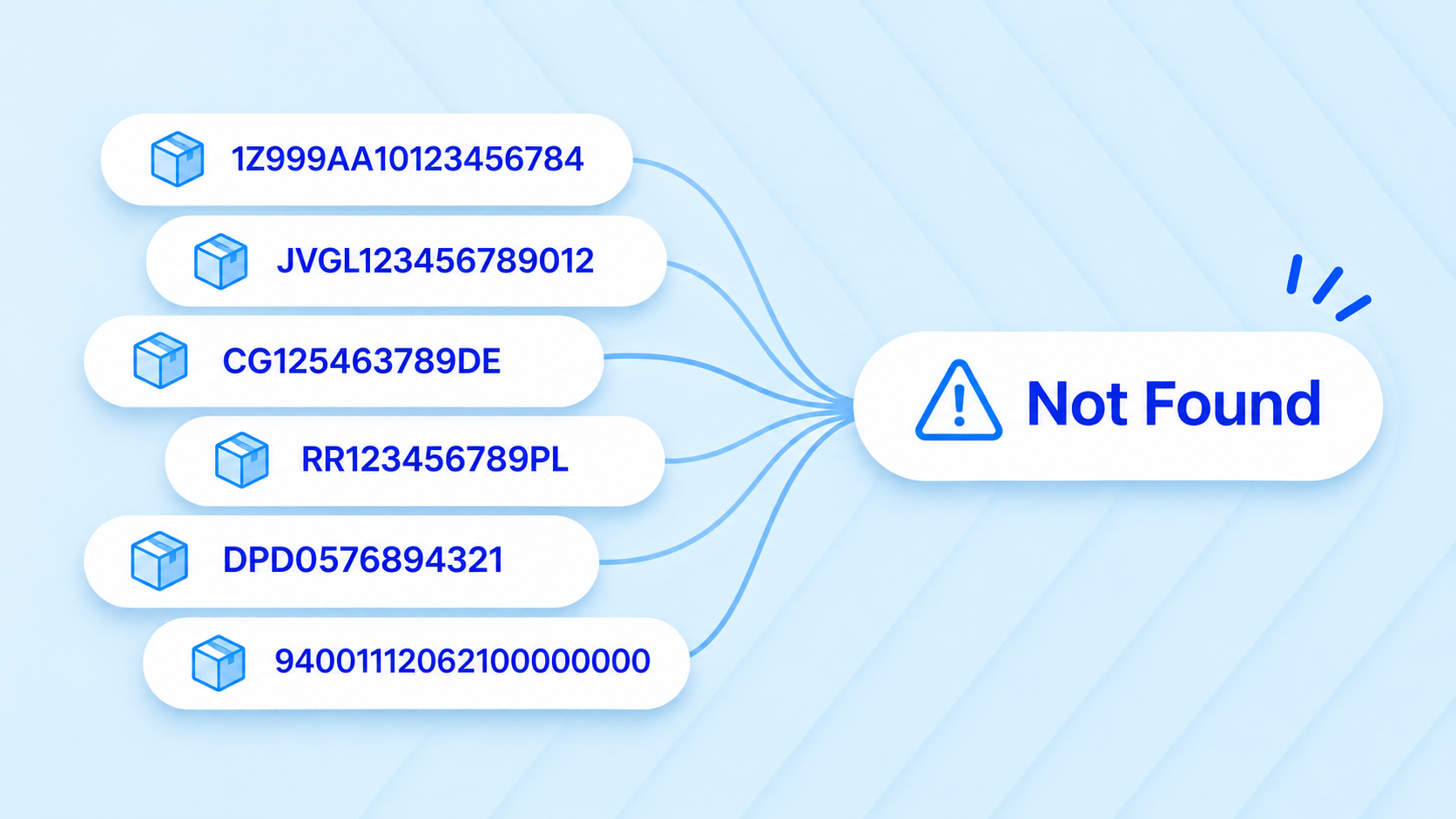
1.1 Similar Tracking Number Formats Make Carriers Harder to Identify
Different carriers may use tracking numbers of the same length, with similar prefixes or patterns of letters and digits.
A single tracking number can fit the numbering formats of multiple carriers. Traditional rule-based matching looks at length, prefixes, and character patterns. When those rules overlap, format alone may be insufficient to identify the correct carrier.
A carrier whose format matches the number is only a candidate. Another carrier may actually be handling the package.
A mismatch can send the request to the wrong data source and result in a Not Found response.
1.2 Submitted Carrier Information May Be Inaccurate
Businesses often submit shipment information through ERP, WMS, OMS, or other order management systems.
These systems may represent the same carrier using its official name, an abbreviation, or an internal code. A record can also contain a valid tracking number with an incorrect carrier field.
If the tracking system relies entirely on the submitted carrier information, it may keep querying the wrong source.
A tracking system therefore needs to identify carriers, check matches, and correct mismatches.
1.3 Cross-Border Shipments Can Have Data Spread Across Carriers
Cross-border shipping typically involves pickup, line-haul transport, customs clearance, and last-mile delivery.
Multiple carriers may handle a package in succession, and a linked last-mile tracking number may be assigned along the way.
Querying only one of those carriers may return a partial history, leaving gaps in the package’s journey.
Along with broad carrier coverage, the system needs to identify the right sources and combine tracking data.
Tracking success depends on API availability, tracking number quality, carrier identification, data source availability, and whether tracking events have been generated.
2. How Does 17TRACK API Use AI to Improve Carrier Identification Accuracy?
Fixed rules can lead to incorrect matches when number formats overlap or the submitted carrier information is inaccurate.
AI can help resolve these ambiguous matches.
17TRACK combines its in-house AI model with traditional rule-based matching. It draws on years of logistics data to identify the most likely carrier and reduce lookups that fail because the wrong source was queried.
2.1 Combining Fixed Rules with AI-Assisted Identification
Traditional carrier identification relies mainly on predefined rules to match candidate carriers based on number length, prefixes, and character patterns.
This approach works well when numbering rules are distinct. Similar rules across carriers or incomplete tracking number information can produce ambiguous results.
17TRACK combines AI identification and rule-based matching, using both tracking number characteristics and available carrier information to determine the likely source.
When the carrier identified by the system differs from the one supplied by the business, the match can be checked further.
For example:
- The business submits DHL as the carrier.
- The system identifies another candidate based on the tracking number pattern.
- The system can check both matches to reduce the risk of a failed lookup due to incorrect carrier information.
This reduces reliance on manual carrier selection and cuts down on repeated checks across large batches of tracking numbers.
2.2 An In-House AI Model Built on Years of Logistics Data
AI identification performance depends on the training data, the range of examples it covers, and how the model is refined.
17TRACK has focused on global shipment tracking since 2010. It now covers 3,500+ carriers and accumulates substantial volumes of logistics data each month.
Using this data, 17TRACK trains and refines its own identification model. Ongoing training and tuning help the model learn carrier-specific tracking number patterns and improve identification in complex scenarios.
AI can provide additional signals when carriers use similar numbering rules and are difficult to distinguish through conventional matching.
This approach reduces the work of manually maintaining fixed rules and offers more flexible identification for newly added carriers and complex shipping scenarios.
2.3 Combining AI Identification with Dual Registration to Reduce Mismatches
17TRACK also offers a way to improve tracking success after a candidate carrier has been identified.
If the system identifies a different carrier from the one submitted, businesses with dual registration enabled can also query the carrier identified by AI.
For example:
A business submits a shipment marked as DHL, but the system identifies another carrier as a more likely match.
With dual registration enabled, the system can try to retrieve tracking events from the identified carrier in addition to making the original query.
This gives the business a chance to retrieve the correct tracking data even if it originally submitted the wrong carrier.
Together, these capabilities help reduce preventable lookup failures caused by carrier mismatches.

3. Investigating the Causes of Not Found Results
Even when the carrier is identified correctly, some queries may return no tracking events at first.
A tracking number may have just been created and the carrier may still be waiting to receive the package. The carrier’s tracking service may also be temporarily unavailable. Either situation can lead to a Not Found result.
A Not Found result alone is insufficient to conclude that a package has yet to ship or has been lost.
Improving tracking success rates requires identifying the cause and taking the appropriate action.
3.1 Identifying the Cause to Avoid Unnecessary Lookups
Common causes of Not Found results or failed lookups include:
| Issue Type | Possible Cause | Recommended Action |
|---|---|---|
| Incorrect Carrier Matching | The actual carrier does not match the selected carrier. | Re-identify and verify the carrier. |
| Incorrect Tracking Information | Incorrect tracking number or missing required parameters. | Verify the tracking number and query parameters. |
| No Tracking Updates Available | The tracking number has been generated, but the carrier has not yet provided the first tracking event. | Wait for the carrier to update the tracking information. |
| Data Source Error | Carrier API failure, service restrictions, or other issues. | Monitor carrier API status and investigate exceptions. |
Each cause calls for a different response.
For a carrier mismatch, re-identifying the carrier and verifying the data source can resolve the problem. If the carrier has yet to generate the first tracking event, repeated lookups may still return no new information.
Distinguishing between these scenarios reduces unnecessary requests and repeated troubleshooting.
3.2 Monitoring Carrier Data to Detect Issues Early
Along with individual lookup failures, businesses need to watch for issues affecting groups of shipments.
If a carrier normally returns tracking events but a large number of shipments suddenly show Not Found, the next step is to check the carrier’s API, website tracking service, or data retrieval process.
17TRACK continuously monitors carrier data performance. When it detects a drop in performance or unusual fluctuations, it raises alerts and informs customers.
This gives businesses an earlier view of carrier-side issues so they can adjust lookup and handling procedures before customer complaints accumulate.
Carrier identification, troubleshooting, and source monitoring give teams a way to investigate and follow up on Not Found results.
4. Customer Examples of Improved Tracking Success Rates
Tracking performance in real operations shows the impact of AI identification and Not Found management.
Tracking success rates vary by customer and depend on factors such as carrier coverage, tracking number quality, lookup strategy, and data source availability.
Two 17TRACK customer examples:
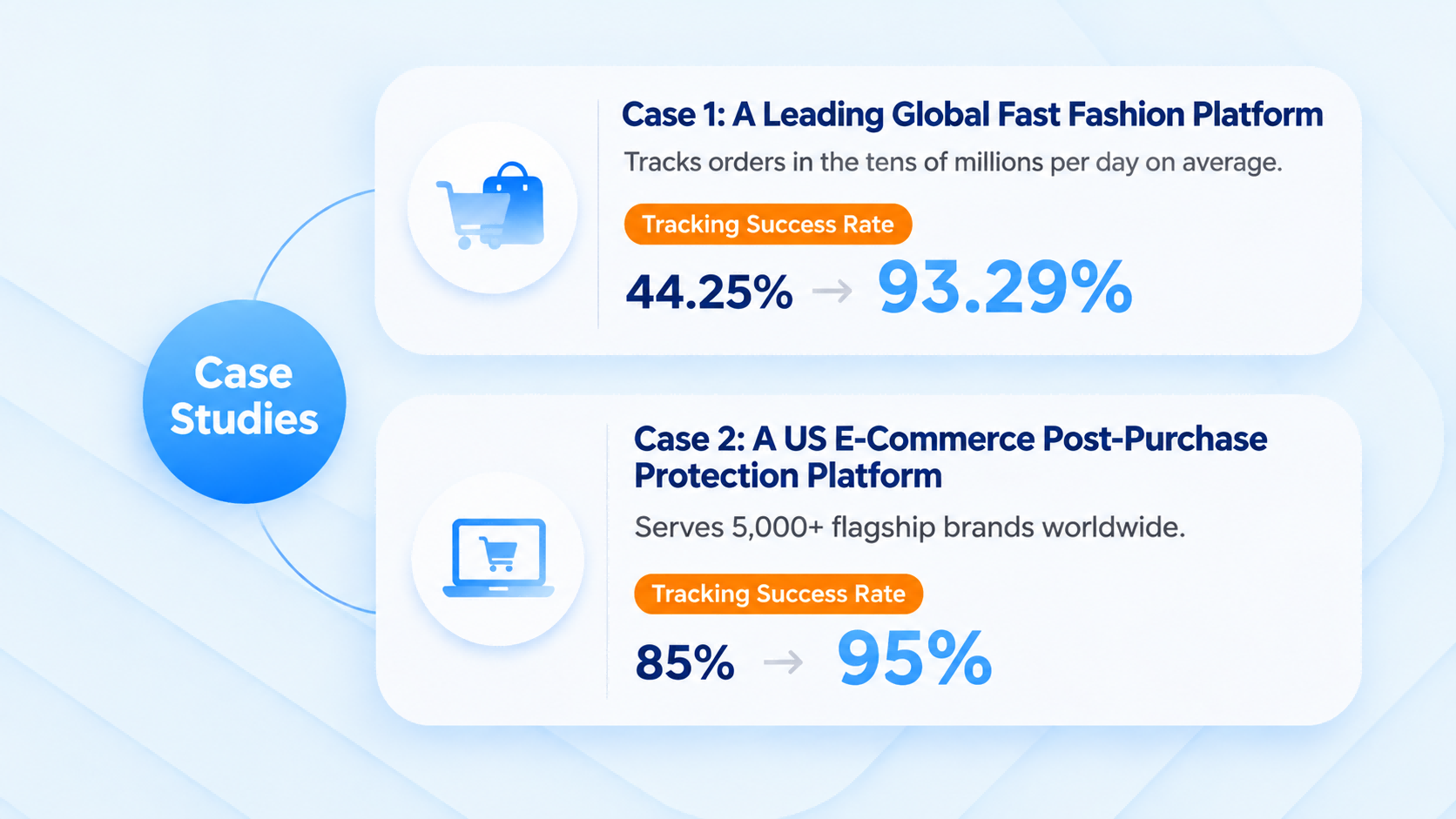
Case 1: A Leading Global Fast Fashion Platform
- Scale: Tracks orders in the tens of millions per day on average.
- Tracking success rate: Increased from 44.25% to 93.29%.
Case 2: A US E-Commerce Post-Purchase Protection Platform
- Scale: Serves 5,000+ flagship brands worldwide.
- Tracking success rate: Increased from 85% to 95%.
These results reflect improvements across the customers’ overall tracking operations. They cannot be attributed to AI alone or used as carrier-specific success rates for DHL or DPD.
For businesses processing large volumes of cross-border orders, higher tracking success rates mean more usable shipment data for order management, customer support, and post-purchase operations.
Improving the Chances of Retrieving the Right Tracking Events for Each Valid Number
A tracking lookup may look as simple as entering a number. Behind the scenes, it involves carrier identification, data source matching, data retrieval, and ongoing monitoring.
Overlapping number formats, incomplete carrier information, and handoffs between carriers can all affect the result, especially in cross-border shipping.
17TRACK API combines AI-driven carrier identification, an in-house logistics data model, dual registration, and ongoing Not Found management to help businesses reduce preventable data source mismatches and retrieve tracking data more efficiently.