Lift Table(Lt)
What Is a Lift Table?
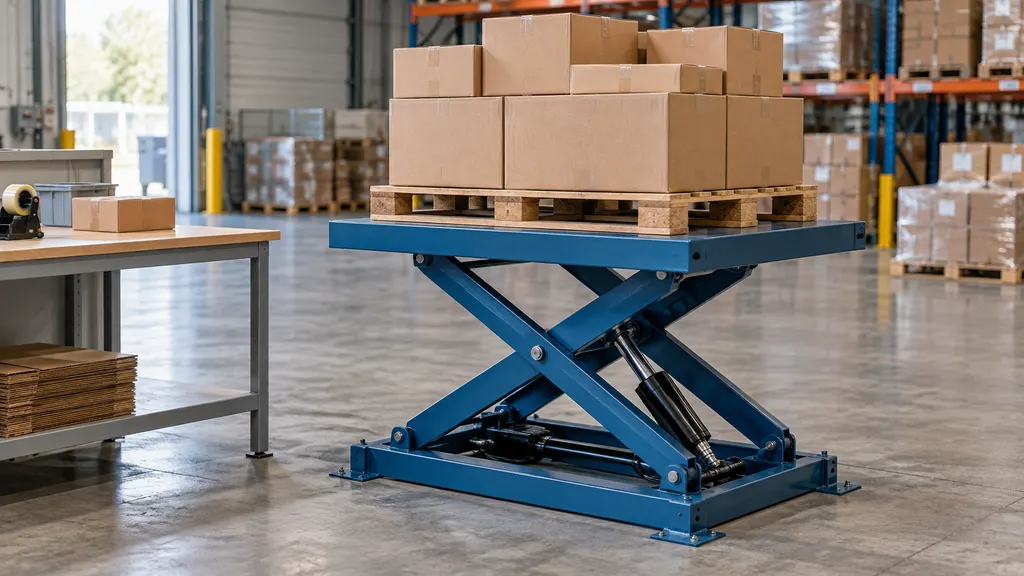
A lift table is a material-handling device with a platform that raises or lowers goods to a suitable working or transfer height. In warehouses, fulfillment centers, and production facilities, it can support pallets, cartons, components, or other loads while workers load, unload, pack, inspect, or transfer them. Its principal function is vertical positioning rather than long-distance transport, although some models are mobile.
The abbreviation LT may appear in equipment schedules, warehouse layouts, or supplier documentation. Its meaning should be confirmed from the relevant document rather than treated as a universally standardized logistics abbreviation. The term describes physical handling equipment, not an inventory status, shipment event, or transport service.
How a Lift Table Works
A lift table combines a load-supporting platform, a base or supporting structure, a lifting mechanism, and controls. A common arrangement uses linked scissor arms that open as the platform rises and fold as it descends. However, lift table and scissor lift are not exact synonyms: the first identifies the equipment's function, while the second describes a lifting mechanism that can also appear in other equipment.
Hydraulic models use a cylinder to move the lifting mechanism. Pressure may be supplied by a manually operated pump or a powered hydraulic unit. Other designs use pneumatic or electromechanical mechanisms. The mechanism, available travel, control arrangement, and permitted operating conditions depend on the particular model.
The platform is positioned so that goods can be handled without repeatedly reaching down to floor level or lifting them to an unnecessarily high surface. During pallet unloading, for example, the platform can be raised as successive layers are removed. During pallet building, it can be lowered as the stack grows. This changes the load's presentation height; it does not eliminate the need to assess manual handling, load stability, or access around the equipment.
Role in Warehousing and Ecommerce Fulfillment
Lift tables operate at physical handling points within a supply chain. They do not record stock movements or determine where an order should be shipped. Instead, they support the work through which goods are received, processed, stored, or dispatched. Any inventory transaction associated with that work must still be recorded through the site's established procedures.
| Handling stage | Illustrative use | Main consideration |
|---|---|---|
| Receiving | Presenting a pallet at a convenient height while cartons are removed for checking. | The platform must accommodate the pallet and its load distribution. |
| Packing | Adjusting the height of a heavy item before protective packaging is applied. | The working height must suit the task, not merely the operator's standing height. |
| Pallet building | Lowering a pallet as packed cartons are added. | The completed stack must remain stable throughout the movement. |
| Returns processing | Supporting a bulky returned item during inspection and repacking. | Damaged packaging or an uncertain center of gravity may require additional precautions. |
| Workstation transfer | Aligning a platform with an adjacent conveyor or workbench. | Transfer gaps, equipment movement, and trapping points require assessment. |
For example, an ecommerce retailer may receive cartons on a pallet and use a lift table to maintain a practical picking height as the pallet is emptied. This is a handling example, not a claim that every fulfillment operation needs this equipment. The suitability of a lift table depends on the actual loads, workflow, available space, and risks.
In cross-border commerce, its role remains physical rather than regulatory. A warehouse handling imported goods may use the same equipment for unpacking, inspection, or repacking, but the lift table itself does not perform customs clearance or establish the goods' customs status.
Design Features and Configuration Choices
Lift tables can be described along several independent dimensions. These are practical selection categories, not a single hierarchy: a table can be stationary, hydraulically powered, and fitted with a rotating platform at the same time.
| Dimension | Possible configurations | Why it matters |
|---|---|---|
| Installation | Stationary or mobile | Determines whether the equipment serves a fixed workstation or can be repositioned under specified conditions. |
| Actuation | Manual hydraulic, powered hydraulic, pneumatic, or electromechanical | Affects control, power requirements, and suitability for the intended operating cycle. |
| Platform arrangement | Plain platform, roller surface, turntable, or tilting arrangement | Changes how goods are accessed, transferred, or presented. |
| Floor interface | Floor-mounted, low-profile, or pit-mounted | Affects loading access, building work, and surrounding floor conditions. |
Accessories and combined movements introduce their own constraints. A rotating top may help present different sides of a pallet, but rotation can change the load's position relative to nearby structures. A tilting platform may improve access to parts, but it also requires a suitable means of retaining the load. Neither feature should be assumed to be present on an ordinary lift table.
Selection and Operating Limits
A stated lifting capacity is only one part of equipment suitability. Selection should use the manufacturer's specifications for the actual application, including the loading arrangement and permitted movements. The following checks help translate a warehouse task into an equipment requirement:
- Total supported weight: Include the goods, pallet, container, and any fixtures or attachments carried by the platform.
- Load distribution: Check the permitted loading pattern. A concentrated load, an overhanging item, or a load near an edge may not be acceptable even when total weight is below the nominal capacity.
- Platform dimensions: Confirm that the load can be supported and accessed without creating an unstable arrangement or obstructing controls.
- Lowered and raised heights: Match both limits to the loading method and receiving surface. Vertical travel alone does not establish whether the required heights are achievable.
- Operating frequency: Confirm suitability for the expected lifting cycle and operating environment rather than assuming all powered tables support the same workload.
- Floor and installation conditions: Assess the supporting surface, required anchoring, clearances, and any pit or ramp arrangement.
- Transfer method: Establish whether goods arrive by hand, pallet truck, forklift, conveyor, or another device. A conventional pallet truck may not be able to place a pallet directly on a raised platform.
- Maintenance access: Ensure the equipment can be isolated and mechanically supported for servicing as specified by its manufacturer.
Mobile equipment needs additional checks. Wheels do not automatically make a lift table suitable for transporting an elevated load. Permitted travel conditions, braking arrangements, floor gradients, and load position must follow the model's instructions.
Safety and Ergonomic Considerations
A lift table can reduce some bending and vertical lifting demands by bringing goods closer to a suitable handling height. It does not automatically make a task safe. Excessive reach, twisting, repetitive handling, unstable cartons, and heavy individual items may remain problems even when the platform height is adjustable.
Moving mechanisms can create crushing, shearing, and trapping hazards beneath the platform and around adjacent structures. Controls and safeguards must suit the equipment and its installation. Operators should keep people clear of hazardous areas, maintain visibility of the movement, and stop using equipment that shows damage, leakage, abnormal movement, or malfunctioning controls.
Before maintenance beneath a raised platform, the platform must be secured using the manufacturer's specified maintenance support and isolation procedure. Hydraulic pressure alone should not be treated as a maintenance support. Repairs and inspections should be performed by people competent for the work.
Equipment intended to lift goods must not be assumed suitable for lifting people. Personnel lifting requires equipment expressly designed and authorized for that purpose. Applicable inspection, maintenance, training, and lifting-equipment obligations depend on jurisdiction and use. For example, UK Health and Safety Executive guidance explains separate requirements concerning work equipment and lifting operations; those rules should not be presented as globally uniform requirements.
Related Equipment and Term Boundaries
| Term | Distinction from a lift table |
|---|---|
| Scissor lift | Describes equipment using a scissor mechanism. Depending on context, it may refer to a goods-handling table or a personnel work platform. |
| Pallet positioner | Describes equipment that presents palletized goods for handling. Some lift tables perform this function, but positioning equipment can use different designs. |
| Pallet truck | Primarily moves palletized goods horizontally and usually lifts them enough for travel. Some high-lift designs overlap with positioning applications. |
| Forklift truck | A powered industrial truck used to lift and transport loads. A lift table primarily provides a platform for vertical positioning at a handling location. |
| Dock leveler | Bridges the height difference between a loading dock and a vehicle bed. It is not interchangeable with a general-purpose lift table. |
| Dock lift | A lifting platform designed for loading or unloading across different elevations. Its application and specification differ from those of a workstation table. |
These boundaries describe principal functions rather than absolute separations between all commercial products. The equipment's specification and intended use are more reliable than a product name alone.
QA
What does LT mean in a warehouse equipment list?
It may mean lift table. Check the equipment legend, drawing notes, or supplier documentation because the abbreviation is not unambiguous across all warehouse systems.
Is a lift table the same as a scissor lift?
Not necessarily. Many lift tables use scissor mechanisms, but the term scissor lift can also refer to equipment intended for other purposes, including personnel access.
Can a lift table replace a forklift?
Not as a general replacement. A lift table mainly positions a supported load vertically, while a forklift also transports and places loads. Suitability depends on the specific handling task.
Can workers stand on a lift table?
A goods-handling lift table must not be used to lift people unless its design, authorization, and operating instructions expressly permit that use.
Sources
- MHI — Lift Manufacturers Product Group: Industry reference for industrial lifting equipment, lift tables, and material-handling applications.
- Canadian Centre for Occupational Health and Safety — Manual Materials Handling: Mechanical Aids: Guidance on mechanical assistance, load positioning, and reducing manual-handling demands.
- Health and Safety Executive — Provision and Use of Work Equipment Regulations: UK guidance on equipment suitability, maintenance, inspection, information, and training.
- Health and Safety Executive — Lifting Operations and Lifting Equipment Regulations: UK guidance on lifting-equipment responsibilities, safe lifting operations, and examination requirements.