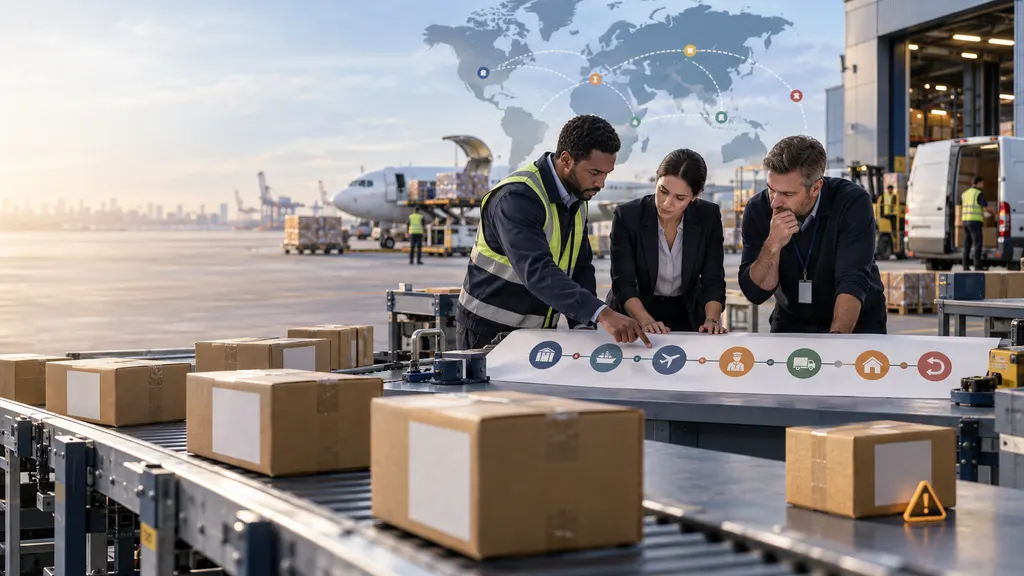
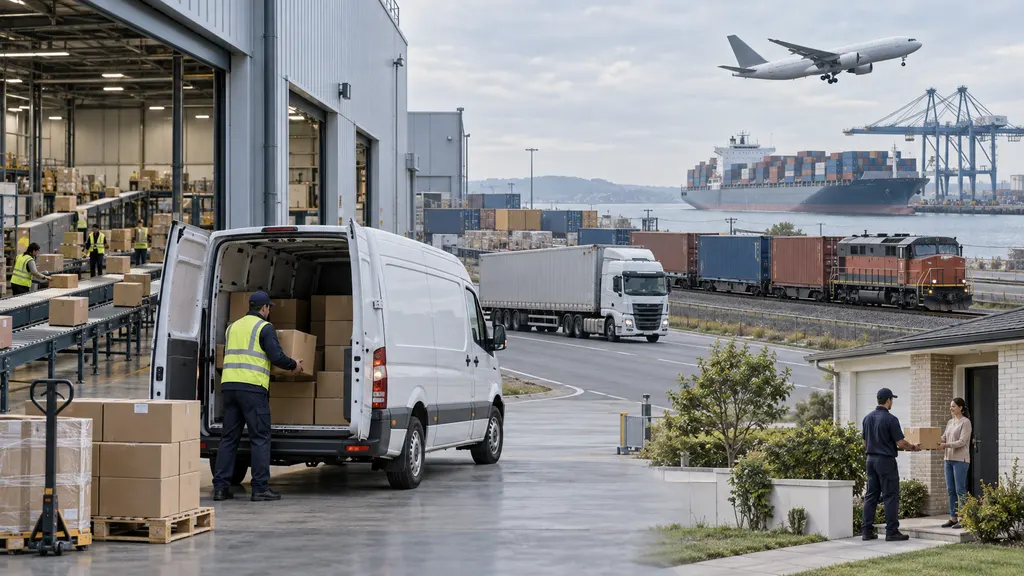
Supply Chain Management
Definition
Supply chain management (SCM) is the coordinated planning and control of the activities, resources, information, and relationships involved in sourcing materials, producing or acquiring goods, moving them, and delivering them to customers. In logistics, ecommerce, and cross-border trade, supply chain management connects suppliers, manufacturers, warehouses, carriers, customs processes, retailers, and customers across the product life cycle.
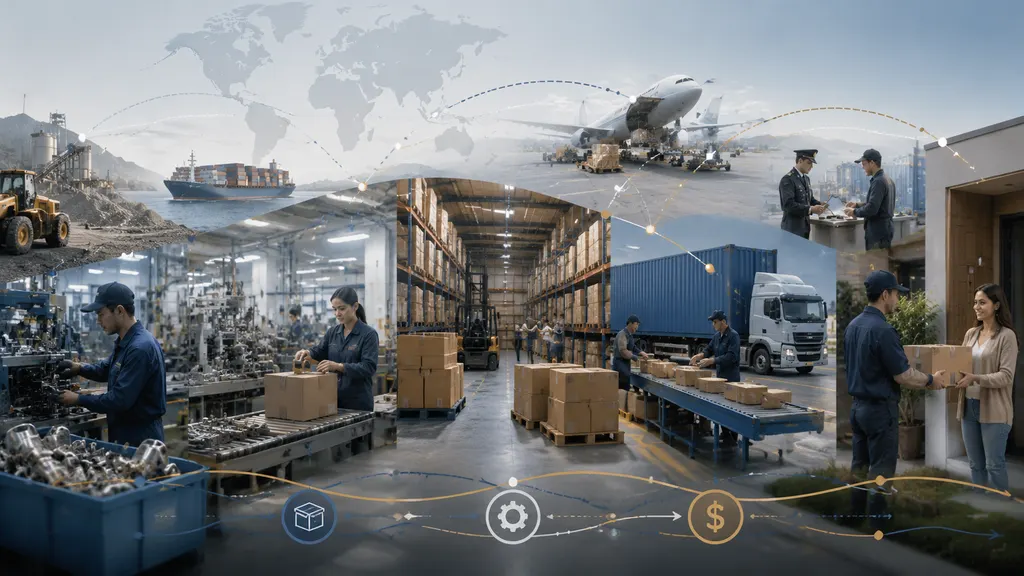
SCM is broader than transportation or warehousing alone. It includes decisions about procurement, production, inventory, order fulfillment, distribution, returns, supplier coordination, and the information used to align these activities with demand.
Supply Chain Management in Logistics and Ecommerce
In a supply chain, logistics is primarily concerned with the movement and storage of goods and the related flow of information. Supply chain management provides a wider coordinating framework that also covers supply decisions, production or preparation, inventory positioning, supplier relationships, customer orders, and returns.
An ecommerce business may use supply chain management to coordinate product purchasing, inventory held in fulfillment centers, order processing, carrier selection, international transportation, customs documentation, final delivery, and returned goods. The exact activities depend on the business model and the parties involved.
In cross-border ecommerce, SCM may involve suppliers and customers in different countries. This can require coordination of international shipping, import and export documentation, customs procedures, duties and taxes, regulatory requirements, delivery partners, and country-specific returns processes. These activities are operational examples of supply chain coordination, not a single universal process.
Key Activities
Supply chain management commonly brings together several connected activities. Their relative importance varies by industry, product, and operating model.
| Activity | Purpose | Example in Ecommerce or Logistics |
|---|---|---|
| Planning | Align expected demand, supply, capacity, and inventory decisions. | Estimating the stock needed for an upcoming sales period. |
| Procurement | Obtain goods, materials, or services from suppliers. | Purchasing products from a manufacturer or wholesaler. |
| Inventory management | Control the quantity and location of goods available for use or sale. | Positioning stock in one or more fulfillment centers. |
| Production or preparation | Convert, assemble, package, or otherwise prepare goods for distribution when applicable. | Manufacturing an item or preparing it for shipment. |
| Transportation and distribution | Move goods between supply chain nodes and to the customer. | Sending an order from a fulfillment center through a carrier network. |
| Returns management | Coordinate goods sent back by customers or other supply chain participants. | Inspecting a returned product and deciding whether to restock, repair, or dispose of it. |
Flows in a Supply Chain
Supply chain management coordinates more than the physical movement of products. It also involves information and financial transactions between participants.
- Product flow: the movement, storage, handling, transformation, and return of goods.
- Information flow: data such as forecasts, purchase orders, inventory records, shipment status, customs documents, and delivery confirmations.
- Financial flow: payments, invoices, credit arrangements, duties, taxes, and other commercial settlements associated with transactions.
These flows are connected. For example, an order creates information that can trigger inventory allocation and transportation activity, while delivery confirmation may support invoicing or customer-service decisions.
Supply Chain Tiers
A supply chain can contain multiple tiers of suppliers and intermediaries. A business may purchase directly from a first-tier supplier while that supplier obtains components or raw materials from other organizations. The number and visibility of tiers vary by product and industry.
| Tier or participant | Typical relationship |
|---|---|
| Raw-material or component supplier | Provides inputs used to make or prepare a product. |
| Manufacturer or assembler | Produces, transforms, or assembles goods. |
| Wholesaler or distributor | Buys, stores, and redistributes goods to other businesses. |
| Retailer or ecommerce merchant | Offers goods for sale and manages customer orders. |
| Fulfillment provider or warehouse operator | Stores inventory and may pick, pack, and dispatch orders. |
| Carrier and delivery provider | Transports shipments between locations and may perform final delivery. |
| Customer | Receives the order and may initiate a return or other post-purchase process. |
This is a descriptive model rather than a mandatory formal classification. A single organization can perform several of these roles.
How Supply Chain Management Works
- Plan: assess expected demand, available supply, inventory, capacity, and operational constraints.
- Source: select and coordinate suppliers, purchase goods or materials, and manage relevant commercial terms.
- Make or prepare: manufacture, assemble, package, or otherwise prepare goods when required.
- Fulfill: receive and process customer orders, allocate inventory, pick and pack items, and arrange shipment.
- Deliver: move the shipment through the applicable transportation and delivery network, including required cross-border procedures.
- Return or recover: handle returned goods, exchanges, repairs, resale, recycling, or disposal when applicable.
- Review and adjust: use operational information to revise plans, inventory decisions, supplier coordination, and service processes.
Actual supply chains may run these activities concurrently rather than as a strictly linear sequence. A return, stock shortage, transport delay, or supplier change can affect several other activities.
Supply Chain Management and Related Terms
| Term | Meaning | Relationship to Supply Chain Management |
|---|---|---|
| Logistics | Planning and controlling the movement and storage of goods and related information. | A major component of SCM, but usually narrower in scope. |
| Procurement | The process of obtaining goods, materials, or services. | One activity within SCM, particularly on the supply side. |
| Inventory management | Control of the quantity, location, condition, and availability of stock. | Supports supply, fulfillment, and customer-service decisions. |
| Order fulfillment | Processing an order and preparing and delivering the ordered goods. | One downstream part of SCM. |
| Transportation management | Planning and controlling the movement of goods by carriers or transport modes. | A logistics function within the broader supply chain. |
| Supply chain visibility | The ability to access and understand relevant information about supply chain events and status. | Supports coordination, monitoring, and response to changes. |
Common Misunderstandings
SCM is not the same as shipping. Shipping usually refers to arranging or performing the movement of a shipment. SCM includes shipping but also covers upstream and downstream activities such as sourcing, inventory, order planning, and returns.
SCM is not limited to physical goods. Physical products are central to many supply chains, but decisions also depend on information, commercial transactions, services, and relationships between participating organizations.
A supply chain is not always a simple one-way chain. Products and information may move through multiple suppliers, distribution channels, fulfillment locations, carriers, and return routes. The structure may therefore resemble a network rather than a single line.
Supply chain management is not only an internal business function. It often requires coordination among independent suppliers, logistics providers, carriers, retailers, platforms, customs-related parties, and customers.
Examples
For example, an ecommerce merchant may purchase products from a supplier, store them in a warehouse, receive a customer order, allocate available inventory, prepare a parcel, arrange transportation, provide shipment information, and process a return if the customer sends the product back. Supply chain management concerns the coordination of these connected activities, not only the parcel's movement.
In a cross-border example, a shipment may move from a supplier in one country to a fulfillment location in another country and then to the customer. The supply chain may require coordination of inventory records, transport arrangements, commercial documents, customs information, delivery status, and the handling of any returned goods.
QA
What is supply chain management in logistics?
It is the coordination of sourcing, inventory, storage, transportation, delivery, information, and related activities across the supply chain. Logistics is an important part of SCM but does not cover every SCM activity.
What is the difference between logistics and supply chain management?
Logistics focuses mainly on the movement and storage of goods and related information. Supply chain management has a broader scope that includes logistics as well as procurement, planning, supplier coordination, production or preparation, fulfillment, and returns.
Why is supply chain management relevant to ecommerce?
It connects purchasing, inventory, order fulfillment, transportation, delivery, customer information, and returns so that an ecommerce business can coordinate the activities required to complete an order.
Does supply chain management include returns?
It can include returns management, including the movement and handling of goods sent back after delivery. The exact return activities depend on the business and its operating arrangements.
Sources
- ASCM Dictionary — professional terminology and definitions related to supply chain management, logistics, inventory, and operations.
- Council of Supply Chain Management Professionals Glossary — industry terminology and distinctions involving supply chain management and logistics.
- IBM, “What is Supply Chain Management?” — overview of SCM activities, participants, and operational flows.