Goods-Tracked System
What Is a Goods-Tracked System?
A goods-tracked system is a system that records the identity, location, movement, or status of physical goods as they pass through storage, handling, transportation, or delivery processes. In logistics and ecommerce, it connects identifiable goods or handling units with recorded events, allowing users to determine what was observed, where it was observed, and when the observation occurred.
The phrase is used here descriptively, rather than as the name of a particular product or a formal system category defined by the standards cited below. More established expressions include goods tracking system, shipment tracking system, and traceability system. Their scope depends on what is identified and which events are recorded. A system following individual serialized products is different from one following only the pallets or parcels containing them.
The underlying concepts are supported by the GS1 Global Traceability Standard and the GS1 Electronic Product Code Information Services standard, known as EPCIS. These provide frameworks for identifying traceable objects and recording or exchanging information about supply-chain events; they do not establish a separate definition for the exact phrase “goods-tracked system.”
What the System Tracks
The first question is the unit of tracking. Goods can be identified at different levels, and those levels should not be treated as interchangeable. A record for a product type does not necessarily identify a particular physical item, while a record for a transport container does not automatically establish the identity of everything inside it.
| Tracking level | What is identified | Interpretation boundary |
|---|---|---|
| Product type | A category of trade item | Does not by itself distinguish individual physical units. |
| Batch or lot | A group of goods associated with a batch or lot identifier | Supports group-level traceability without necessarily distinguishing each unit. |
| Serialized item | An individual physical unit | Requires the item identifier to remain associated with that unit. |
| Logistic unit | A unit assembled for transport or storage, such as a pallet or parcel | Knowledge of its contents depends on recorded associations. |
GS1 identification standards illustrate these distinctions. A Global Trade Item Number, or GTIN, identifies a trade item; additional information can distinguish batches or individual instances. A Serial Shipping Container Code, or SSCC, identifies a logistic unit. These identifiers serve different purposes and should not be substituted for one another merely because both appear on labels.
How a Goods-Tracked System Works
1. Establish identity
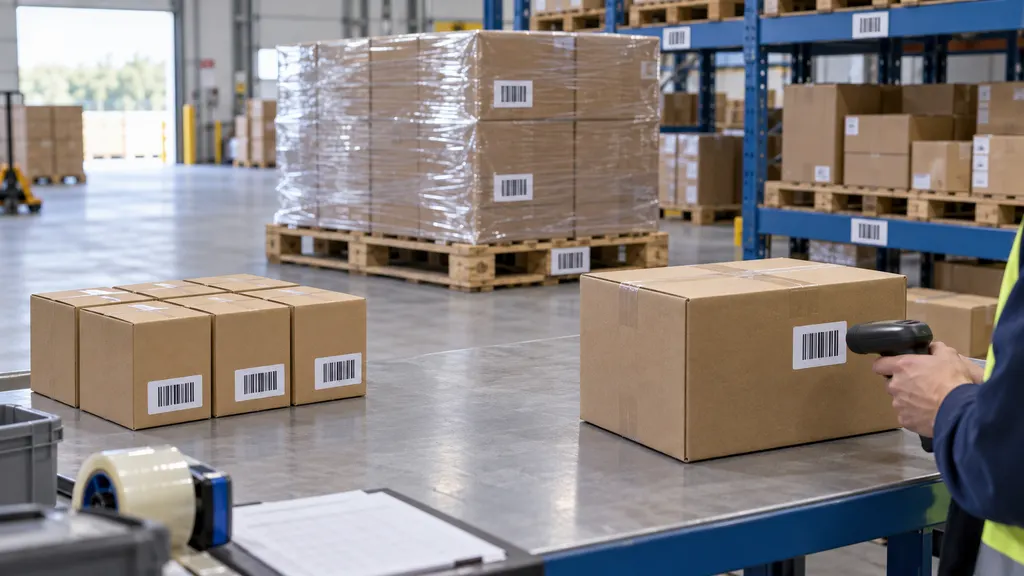
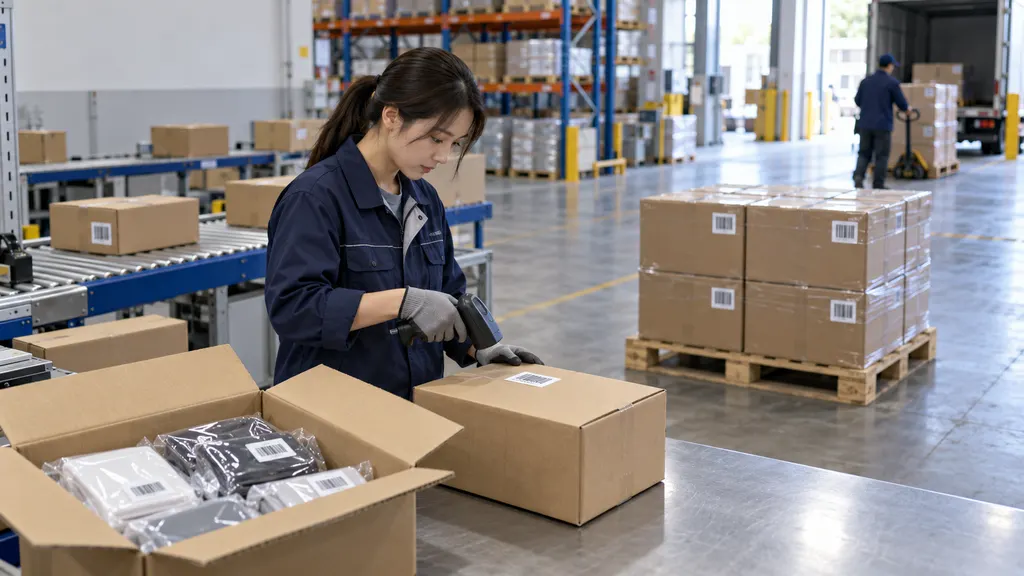
The process begins by assigning or capturing an identifier for the object being followed. Depending on the implementation, the identifier may be carried in a barcode, an RFID tag, or another data carrier. The system also needs contextual information that explains what the identifier represents, such as a product, a batch, or a logistic unit.
2. Capture events
Events are recorded at relevant process points, such as receiving, packing, dispatch, transfer, and delivery. A useful event connects an object identifier with a time, a location, and a business context. EPCIS supports the exchange of visibility event data addressing dimensions such as what happened, when and where it happened, and the business context of the event.
An event is an observation or business record, not an unlimited statement about the object. A warehouse departure scan, for example, can indicate that a logistic unit was recorded at dispatch. It does not by itself prove that every expected item was correctly packed inside it.
3. Maintain relationships
Goods may be packed into cartons, cartons placed on pallets, and pallets loaded into transport equipment. To follow goods through these changes, the system needs relationships between the relevant identifiers. When goods are unpacked, split, consolidated, or repacked, those relationships may need updating.
Without these associations, a pallet event provides information about the pallet but may not provide reliable item-level visibility. This distinction becomes important when only part of a shipment is delivered or when a particular batch must be located.
4. Share and interpret records
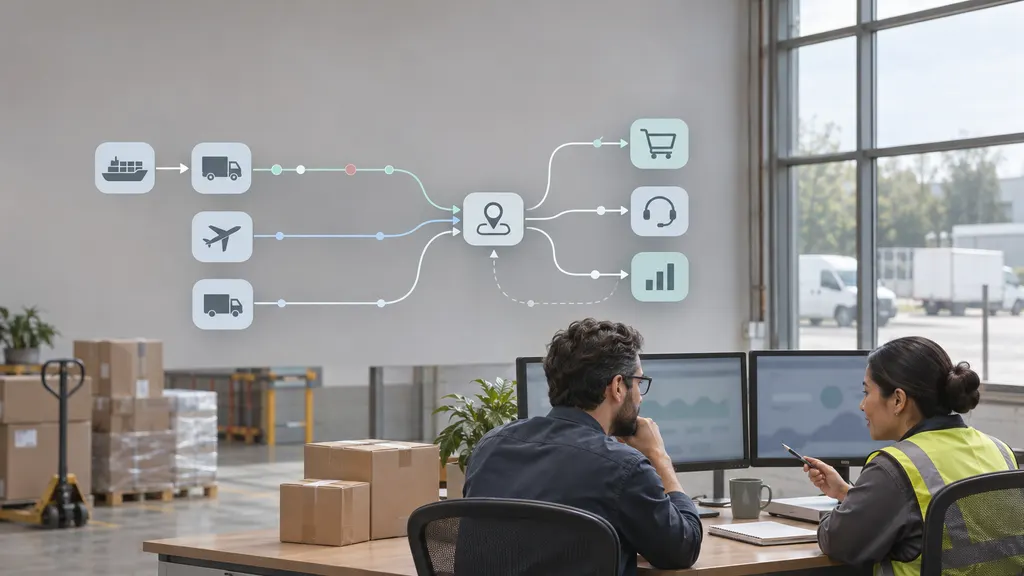
Event records may be made available to warehouse staff, merchants, carriers, customer-service teams, or other authorized participants. A customer-facing tracking page may show a simplified status, while an operational interface retains more detailed events. Shared identifiers and agreed event meanings help participants interpret records consistently.
Use in Logistics and Ecommerce
A goods-tracked system can connect physical handling with commercial records, but those records remain distinct. An order describes a commercial request; a shipment concerns goods dispatched through a transportation process. One order may be fulfilled through several shipments, and a shipment may contain several items. The system needs explicit links if users are to move reliably between order information and physical tracking records.
In warehousing, tracking records can document receipt, movement between storage locations, picking, and dispatch. Inventory records may use this information, but tracking alone does not guarantee an accurate stock balance. Inventory accuracy also depends on recording quantity changes, damage, adjustments, and other relevant transactions.
In transportation, the system may follow handovers, arrival at facilities, departure, and delivery. Tracking identifiers issued by different participants may need to be associated when responsibility changes. If that relationship is missing, visibility can appear to stop even though physical movement continues.
In cross-border ecommerce, records may span export handling, international transportation, import processing, and domestic delivery. A tracking status describing customs activity is not automatically an official customs decision. Tracking information must be interpreted according to its source, and it does not replace declarations, supporting trade documents, or evidence required by the relevant authority.
For returns, the system can connect a returned parcel with an original shipment or return authorization. However, receipt of the parcel does not necessarily establish which goods are inside or their condition. Inspection and reconciliation may be needed before inventory or refund records are updated.
Illustrative Example
For example, a retailer may ship several serialized appliances in cartons consolidated onto a pallet. The following sequence illustrates how tracking information can remain connected as the handling arrangement changes. It is a hypothetical workflow, not a company case study.
| Stage | Record created | What the record supports |
|---|---|---|
| Packing | Item identifiers associated with carton identifiers | Identifying which recorded items belong to each carton. |
| Consolidation | Carton identifiers associated with a pallet identifier | Connecting the cartons to the pallet's subsequent events. |
| Dispatch | Pallet departure event | Showing the pallet's recorded departure from the facility. |
| Deconsolidation | Cartons separated from the pallet in the records | Allowing later carton movements to be followed independently. |
| Return | Returned item identified and inspected | Connecting the physical return with its original item record. |
If the pallet-to-carton association was never recorded, its departure event cannot independently demonstrate which cartons departed. If an item was placed in the wrong carton, the digital association may also be incorrect. Tracking therefore depends on both data structure and physical process accuracy.
Related Terms and Boundaries
| Related concept | Primary focus | Relationship to goods tracking |
|---|---|---|
| Shipment tracking | Progress of a shipment through transportation | May provide shipment-level visibility without identifying every item. |
| Inventory management | Stock quantities, locations, availability, and adjustments | Can use tracking events but includes functions beyond movement visibility. |
| Traceability | Following an object's history, application, or location through records | Requires records and relationships suitable for the intended traceability task. |
| Warehouse management system | Execution and control of warehouse activities | May capture goods-tracking events as part of broader warehouse operations. |
| Proof of delivery | Evidence associated with a delivery event | Supports a particular stage rather than the entire tracking history. |
Tracking and tracing overlap in practical usage. Tracking often emphasizes current status or progress, while tracing often emphasizes reconstructing history or identifying origins and relationships. This distinction is useful, but terminology varies between systems and organizations.
Limitations and Practical Checks
A goods-tracked system should be assessed by the evidence it provides, not simply by whether it displays a map or a sequence of statuses. The following checks help establish its actual scope:
- Identification: Does the identifier refer to a product type, batch, individual item, or logistic unit?
- Coverage: Which facilities, participants, and process stages generate records, and where are there gaps?
- Timing: Does a timestamp represent the physical event, data capture, or later receipt by another system?
- Associations: Are packing, unpacking, and consolidation relationships maintained when goods change handling units?
- Provenance: Can users distinguish direct observations from derived statuses or information supplied by another participant?
- Corrections: Can errors be corrected without obscuring the relevant event history?
- Access: Can authorized participants retrieve the information needed for their operational or traceability tasks?
Tracking does not necessarily mean continuous, real-time positioning. A system based on scans reports recorded observations at particular points; movement between them may remain unobserved. Sensor-enabled systems can provide additional measurements, but the available information still depends on equipment, connectivity, and implementation.
Likewise, a missing event does not conclusively prove that goods stopped moving, and a recorded movement does not prove their condition. Location, custody, ownership, authenticity, and condition are different questions. Each requires appropriate evidence rather than an assumption based on a generic tracking status.
QA
Is “goods-tracked system” a standardized technical term?
It is treated here as a descriptive phrase. The cited standards address identification, traceability, and supply-chain event data, rather than defining this exact expression as a separate system category.
Does a goods-tracked system show live locations?
Not necessarily. A scan-based system shows recorded events at particular locations and times. Continuous positioning requires suitable technology and does not follow automatically from having a tracking identifier.
Can parcel tracking identify every item inside a parcel?
Only if reliable records connect the parcel identifier with its contents. Parcel-level events alone do not establish item-level identity or confirm packing accuracy.
Is goods tracking the same as inventory management?
No. Goods tracking concerns recorded identity, movement, location, or status. Inventory management also addresses stock quantities, availability, and adjustments, although the two functions can share information.
Sources
- GS1 — Global Traceability Standard: Framework for traceability processes, identification, and information requirements across supply chains.
- GS1 — EPCIS: Standard for sharing visibility event data, including event context and relationships between objects.
- GS1 — Global Trade Item Number: Identification of trade items and the distinction between trade-item identity and physical-instance information.
- GS1 — Serial Shipping Container Code: Identification of logistic units, including units assembled for storage or transportation.