Who Pays Import Tariffs? Importer, Seller, or Buyer under Ddp and Dap?
Under DDP (Delivered Duty Paid), the seller is generally responsible for arranging import clearance and paying import duties and taxes as part of the delivery obligation. Under DAP (Delivered at Place), the buyer normally handles import clearance and pays the applicable tariffs, taxes, and other import charges. However, an Incoterms rule does not override customs law: the party legally responsible to customs may depend on the destination country, the importer-of-record arrangement, and the sales contract.
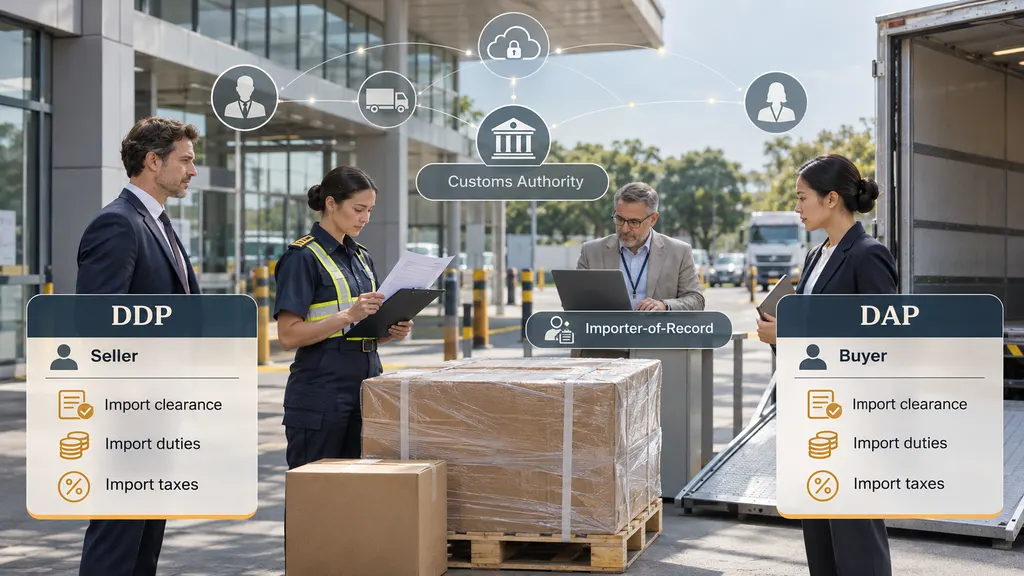
The practical answer therefore has two parts. First, determine what the agreed delivery term allocates between seller and buyer. Then confirm whether that allocation can legally and operationally be implemented in the destination market.
The short answer: DDP versus DAP
| Question | DDP | DAP |
|---|---|---|
| Who arranges import clearance? | Seller | Buyer |
| Who normally pays import duties and import taxes? | Seller, under the agreed commercial allocation | Buyer |
| Who bears risk during transport? | Seller until the goods are delivered at the named destination, ready for unloading | Seller until the goods are delivered at the named destination, ready for unloading |
| Who unloads the goods? | Buyer, unless the contract separately provides otherwise | Buyer |
This summary reflects the usual allocation under Incoterms® 2020. The exact result can change if the contract contains additional terms, if local customs rules impose different requirements, or if the shipment is handled through a special tax or fulfillment arrangement.
What DDP means for import tariffs
DDP stands for Delivered Duty Paid. It places the broadest delivery responsibility on the seller among the Incoterms rules. The seller must arrange transport to the named place, complete export formalities, complete import formalities where applicable, and pay duties and taxes required for importation. The goods are delivered when they are placed at the buyer’s disposal at the destination, ready for unloading.
For a buyer, the commercial benefit is predictability. The quoted price may include the expected customs costs, so the buyer is less likely to receive a separate request for payment from a carrier or customs broker. The seller, however, must price the shipment using a realistic estimate of classification, customs value, duty rates, import taxes, brokerage, and any destination-specific compliance costs.
DDP does not mean that the seller can ignore the destination country’s rules. In many markets, import clearance requires a local importer of record, a tax registration, a customs identification number, or other authorization. A seller that cannot legally perform the import formalities should not promise DDP merely because it wants to offer an all-inclusive customer experience.
There is also an important distinction between paying customs charges and absorbing them economically. A seller may pay customs at the border and recover the cost through the product price or shipping charge. The buyer may therefore bear part of the cost indirectly even though the seller is responsible for the import process under the sales term.
What DAP means for import tariffs
DAP stands for Delivered at Place. The seller arranges delivery to the named destination and bears the transport risk until the goods are made available to the buyer, ready for unloading. The buyer is responsible for import clearance and for paying import duties, taxes, and other charges connected with importation.
Under DAP, the buyer may need to appoint a customs broker, provide importer information, submit documents, pay the customs authority or carrier, and arrange any required permits. If the buyer delays clearance, the buyer may also face storage, demurrage, handling, or redelivery costs, depending on the carrier’s terms and the circumstances of the shipment.
DAP is often easier for a seller that does not have an established customs or tax presence in the destination country. It also gives the buyer more control over classification, valuation, broker selection, and the recovery of import VAT where local rules permit it. The trade-off is that the buyer must understand the landed-cost and compliance obligations before placing the order.
Who is the importer of record?
The importer of record is the party recognized by the relevant customs authority as responsible for the import entry and associated obligations. That party may need to ensure that the goods are correctly classified, that the declared value is accurate, that required permits are available, and that duties and taxes are paid. The precise definition and responsibilities vary by jurisdiction.
The Incoterms rule helps allocate responsibilities between the commercial parties, but it does not automatically appoint an importer of record. A contract saying “DDP” cannot by itself give a foreign seller a legal right to act as importer in every country. Conversely, a seller may agree to pay the buyer’s import charges under a customized arrangement even when the selected delivery term is not DDP. That arrangement should be written clearly rather than inferred from a shipping quote.
Before using DDP, the seller should confirm at least the following:
- Whether it can legally act as, or appoint, the importer of record.
- Whether it has the required customs, tax, or business registrations.
- Whether the product requires permits, licenses, conformity documents, or special treatment.
- Who will receive and retain customs records.
- How unexpected duties, reassessments, inspections, and storage charges will be handled.
Tariffs, import VAT, and other charges are not the same
“Import tariffs” is often used as a general label for every border charge, but the components can be different. A shipment may involve customs duty, import VAT or sales tax, excise duty, customs brokerage, clearance fees, port or terminal charges, inspection costs, and storage or handling charges. The rate and legal treatment of each item may depend on the product, origin, destination, customs value, and the importer’s status.
DDP normally assigns the seller responsibility for duties and taxes required to import the goods. It does not necessarily mean the seller must pay every charge that arises after delivery or every fee caused by the buyer’s actions. DAP normally assigns import duties and taxes to the buyer, but the contract should still state whether brokerage and carrier disbursement fees are included in the transport price or billed separately.
Import VAT deserves special attention in business transactions. Whether a buyer can reclaim it, and how it must be reported, depends on local tax rules and the buyer’s registration status. A seller’s promise to pay import VAT may not produce the same accounting result as a buyer paying it directly. The parties should obtain local tax advice when the value or volume of shipments is material.
A practical decision guide for sellers and buyers
Choose DDP when the seller can manage destination import obligations
DDP may be appropriate when the seller has reliable customs support, a workable importer-of-record solution, accurate landed-cost data, and a commercial reason to offer a delivered price. It can simplify checkout and reduce payment friction for consumers who do not want to manage customs clearance.
The seller should avoid treating DDP as a marketing label only. A calculation should account for the correct HS classification, origin rules, customs valuation, tax treatment, and possible carrier or broker charges. If a duty estimate is uncertain, the quotation should explain whether it is fixed, estimated, or subject to adjustment.
Choose DAP when the buyer is better positioned to import
DAP may be appropriate when the buyer already has a customs broker, a local tax or customs registration, or experience importing the product. It can also be practical when the seller cannot legally act as importer of record in the destination country.
The buyer should request the commercial invoice, packing list, transport document, origin information, product description, and any available classification details before shipment. It should also confirm the customs value and estimate the full landed cost rather than comparing the seller’s DAP price with an all-inclusive price from another supplier.
A checklist before agreeing to DDP or DAP
- Name the place precisely. “DAP” or “DDP” should be followed by a specific destination, not just a country or region.
- Identify the importer of record. Confirm who will appear on the import entry and who is legally responsible to customs.
- Separate the charges. Ask whether the quote includes duty, import VAT, brokerage, disbursement fees, inspection, storage, and delivery surcharges.
- Check product compliance. Customs clearance may depend on permits, labeling, safety documentation, sanctions controls, or other product-specific rules.
- Confirm responsibility for errors. The contract should address incorrect documents, classification disputes, customs reassessment, refused delivery, and delays caused by missing buyer information.
- Check the unloading obligation. Under both DDP and DAP, delivery is generally completed before unloading, so unloading equipment and labor should be assigned separately if needed.
Bottom line
For the normal commercial allocation, the seller pays import tariffs and import taxes under DDP, while the buyer pays them under DAP. The more important operational question is whether the responsible party can legally complete import clearance in the destination country. Before selecting either term, verify the importer-of-record arrangement, distinguish duty from tax and brokerage, and write the treatment of unexpected charges into the contract.
FAQ
Does DDP always mean the buyer pays nothing at delivery?
No. DDP generally allocates import duties and taxes to the seller, but a buyer may still face charges if the contract excludes particular fees, if customs reassesses the shipment, or if the buyer causes a delay or provides incorrect information. The quotation and sales terms should define what “duty paid” includes.
Can a seller use DDP without being registered in the destination country?
Not necessarily. The seller must confirm whether it can act as importer of record or use an authorized local arrangement. Destination-country customs and tax rules control this issue; the Incoterms rule alone does not create the required legal status.
Does DAP mean the seller is responsible for all shipping costs?
The seller normally arranges and pays for transport to the named place under DAP, but the buyer handles import clearance and import-related charges. The contract should clarify any unloading, storage, demurrage, brokerage, and local delivery fees.
Who pays customs duty if the sales contract and the customs entry name different parties?
The parties may have a reimbursement or cost-allocation claim under their contract, but the customs authority will apply its own rules to the importer of record and the import entry. They should not assume that a private contract changes statutory liability.
Is DDP better than DAP for ecommerce orders?
Neither term is universally better. DDP can make the checkout price more predictable when the seller has a compliant import solution. DAP may be more workable when the buyer controls customs clearance or the seller cannot legally import the goods. The choice should follow the actual customs and tax setup, not only the desired customer experience.
Sources
- International Chamber of Commerce: Incoterms® 2020 — official overview of the Incoterms rules and their role in allocating delivery responsibilities.
- U.S. Customs and Border Protection: Importing into the United States — customs guidance on importing goods and importer responsibilities.
- GOV.UK: Import goods into the UK step by step — official guidance on customs declarations, import duties, and import VAT in the United Kingdom.
- World Customs Organization: Guidelines on Customs Valuation — background on customs valuation and the treatment of value for duty purposes.