How to Ship Glass Items: Box-In-Box Packing, Carrier Rules, and Damage Claims
To ship glass items safely, use a rigid inner carton, generous cushioning on every side, and a strong outer box with no room for movement. A box-in-box design is usually more reliable than a single carton, but packaging alone does not guarantee a claim payment. Before shipping, check the carrier’s current packaging, service, and claims rules, document the item and packing process, and keep the packaging until any damage investigation is complete.
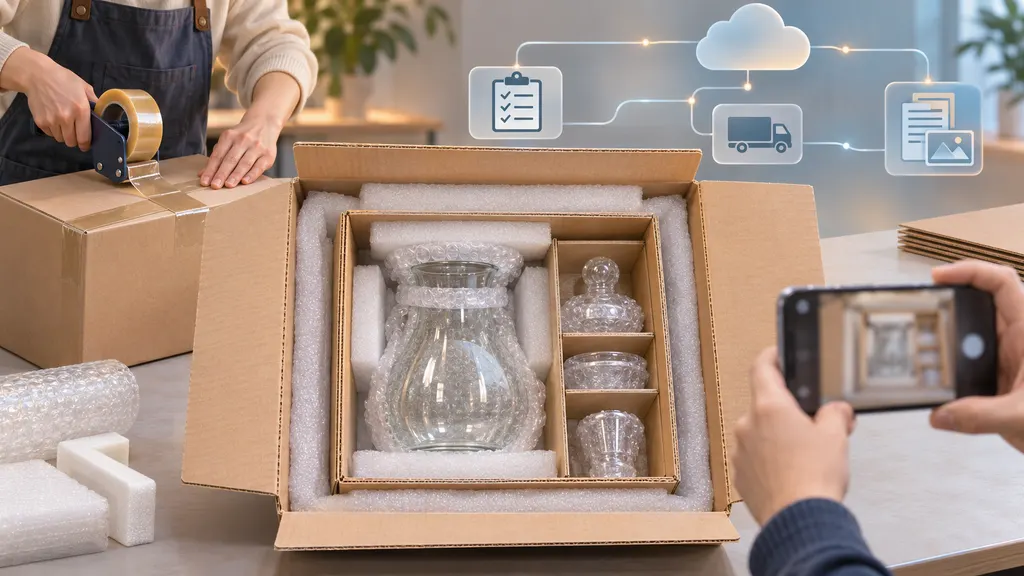
Glass is vulnerable to impact, vibration, compression, and sudden changes in direction. The goal is not simply to wrap the product. It is to create a packaging system that keeps the glass away from the carton walls, prevents movement, and absorbs energy before it reaches the item.
Why glass shipments fail
Most breakage has a recognizable cause. A carton may be dropped on a corner, compressed under heavier parcels, or moved repeatedly through sorting equipment. Even when the outside box looks acceptable, an item can crack if it shifts inside the package and strikes another object or the box wall.
Common packaging failures include thin single-wall cartons, insufficient cushioning, exposed corners, empty spaces, and multiple glass pieces packed together without separation. A “Fragile” label may communicate handling intent, but it should not be treated as a substitute for structural protection. Carrier networks are designed for parcels to be handled with other freight, not carried by hand from origin to destination.
The box-in-box method
Box-in-box packing uses two separate cartons. The inner box holds and protects the glass item. The outer box provides additional distance, stiffness, and impact protection. The inner package should be suspended inside the outer package with cushioning on all sides, including the top and bottom.
1. Inspect and prepare the glass
Check the item before packing. Photograph existing scratches, chips, seams, decorative parts, and any removable components. If the item has a lid, stopper, handle, or other detachable piece, protect that part separately so it cannot strike the glass. Empty vessels completely and allow any moisture to dry.
For sets or multiple pieces, do not allow glass surfaces to touch. Wrap each piece individually with a suitable cushioning material, then add dividers or molded inserts so the pieces remain separated. A thin layer of paper may prevent surface contact, but it is not enough by itself to protect against a significant impact.
2. Wrap the item securely
Use cushioning that is appropriate for the item’s weight, shape, and fragility. Wrap the glass so the protective material stays in place during handling. Pay particular attention to rims, corners, stems, handles, and other projecting areas. These parts often need extra protection because they can receive a concentrated impact.
Do not rely on one thin layer of bubble wrap around a heavy object. The wrap can compress, leaving the glass exposed to the carton. For valuable, unusually shaped, or very fragile items, a custom insert made from foam or molded material may provide more consistent spacing than loose fill.
3. Pack the inner box
Choose an inner carton that is large enough to accommodate the wrapped item without forcing it against the walls. Place cushioning at the bottom first. Center the item, fill the side spaces, and add cushioning above it before closing the carton.
The inner item should not rattle when the closed carton is gently moved. Do not conduct a violent shake test, because testing can damage a poorly supported item. Instead, check whether the contents can shift when the carton is rotated carefully. If they move, reopen the package and improve the fit.
4. Place the inner box inside the outer box
Select a strong outer carton that leaves space around the inner box on every side. The inner box should not touch the outer walls. Add cushioning underneath, around the sides, and on top. The spacing must remain effective after compression, so avoid creating a package that depends entirely on a fragile air gap.
Use enough material to prevent the inner carton from moving, but do not compress the glass so aggressively that pressure is transferred directly to a rim, corner, or thin wall. Close the outer carton with durable packing tape, sealing all major seams. If the carton has been reused, make sure it is dry, clean, rigid, and free from old labels or damage that could weaken it.
Choosing materials and carton size
A good package balances protection, weight, dimensions, and handling practicality. Oversized cartons increase material use and may increase shipping charges, while undersized cartons leave too little room for cushioning. The correct size is the smallest practical configuration that still provides protective space around the glass.
- Use a rigid inner carton and a strong outer carton with intact corners and seams.
- Use cushioning that does not collapse easily under the item’s weight.
- Separate individual glass pieces with dividers, sleeves, or dedicated inserts.
- Protect projections and corners rather than relying only on a flat wrap.
- Fill voids so the contents cannot move, while avoiding direct pressure on fragile surfaces.
- Remove or cover old barcodes and shipping labels before applying the new label.
For recurring shipments, test the actual packaging configuration rather than assuming that a material specification guarantees performance. The International Safe Transit Association publishes test procedures and guidance for evaluating packaged products. A small business may not need formal laboratory testing for every shipment, but repeated breakage is a strong signal that the package should be redesigned and tested under more realistic conditions.
Carrier rules and service limitations
Carrier requirements differ by service, destination, item value, and packaging condition. A carrier may accept a parcel while reserving the right to exclude or limit liability for inadequate packaging, certain types of glass, used cartons, or damage that cannot be documented. Acceptance at a counter or a scan in the tracking system is not the same as a promise that every loss or breakage claim will be paid.
Review the official packaging guidance for the carrier and service you intend to use. UPS provides packaging guidance for parcel shipments, and FedEx publishes instructions for preparing packages. USPS also sets mailing standards and provides a separate process for filing claims. These rules can change, so use the current carrier pages and the terms applicable to the specific service.
Declared value, additional coverage, and liability are not interchangeable terms. A declared value may establish a value limit or affect the carrier’s liability framework, but it does not automatically mean that all breakage is covered. Coverage can depend on the item, packaging, proof of value, exclusions, and the service purchased. Read the terms before accepting an order that would be expensive to replace.
International shipments require additional care. Customs documentation should describe the goods accurately, and the shipper should check destination-country restrictions, taxes, and import requirements. A carrier’s transit service does not remove the sender’s responsibility for accurate commercial documentation or lawful contents. Fragile goods may also face more handling events during international transport.
Labels, handling instructions, and shipment visibility
Mark the package clearly with the recipient’s address and a return address where appropriate. Handling labels can provide useful information, but they should support—not replace—the package design. Do not place a label across a seam or on a surface likely to be damaged during handling.
For online sellers, send the buyer a tracking link and realistic delivery expectations. Tracking can show scans and exceptions, but it normally cannot prove that the glass was handled gently or that a parcel’s contents are intact. Avoid telling customers that a tracking status confirms safe delivery of the item. A delivery scan usually confirms a carrier event, not the condition of the merchandise.
If you ship frequently, record the packing configuration for each product type. A simple packing specification can list the inner carton, outer carton, cushioning material, insert position, tape method, and photographs required before dispatch. Consistent procedures make it easier to identify whether a problem came from packaging, fulfillment, transport, or customer handling.
What to do when glass arrives broken
Ask the recipient to preserve the item and all packaging. Do not discard the carton, cushioning, labels, or damaged pieces before the carrier or seller has completed its review. Take clear photographs of the outer carton from every side, the shipping label, visible punctures or crushing, the inner box, the cushioning, and the broken product. If safe, photograph the contents in the position in which they were found.
- Record the tracking number, delivery date, and order or invoice reference.
- Describe the damage factually, without guessing when or how it occurred.
- Keep the package and contents together in a safe place.
- Notify the seller or shipping account holder promptly.
- File the claim with the party authorized under the carrier’s rules.
- Submit proof of value, shipping documents, photographs, and any requested inspection information.
The correct claimant depends on the shipment arrangement and the carrier account. In many transactions, the account holder or sender must work with the carrier, while the buyer communicates the damage to the seller. Do not promise a refund or claim outcome before checking the applicable terms. If the shipment was insured through a separate provider, that provider may have its own notice and evidence requirements.
A practical pre-shipment checklist
- Confirm the item is intact and photograph its condition.
- Remove detachable parts or secure them separately.
- Wrap each piece and protect vulnerable edges, rims, and projections.
- Use an inner carton with cushioning on the bottom, sides, and top.
- Place the inner carton inside a strong outer carton with no wall contact.
- Close and tape the package securely; remove old labels.
- Check the carrier’s current service restrictions and coverage terms.
- Photograph the packed shipment before handing it to the carrier.
- Keep the receipt, tracking number, invoice, and packing record.
FAQ
Is a “Fragile” sticker enough for shipping glass?
No. A sticker may communicate a handling preference, but it does not prevent drops, compression, or movement inside the carton. Structural protection, separation, and cushioning matter more than the label.
Should glass always be shipped in two boxes?
A box-in-box configuration is a strong general approach for many glass items because it creates a second protective layer. It is not a universal guarantee. The carton strength, cushioning, item shape, weight, and carrier terms still determine whether the package is suitable.
Can I use newspaper as the only packing material?
Loose paper may help fill light voids, but it can compress and may not provide enough impact protection for heavy or fragile glass. Use a cushioning system appropriate to the item and verify that the contents cannot move.
Who files a damage claim?
The responsible claimant depends on the shipping account, seller agreement, and carrier terms. Contact the seller or account holder first, preserve the packaging, and follow the carrier’s claim instructions rather than assuming the recipient can always file directly.
What evidence helps a glass damage claim?
Useful evidence commonly includes the tracking number, proof of value, shipping receipt, photographs of the outer and inner packaging, photographs of the damage, and a description of the condition at delivery. The carrier or coverage provider may request additional documents or an inspection.