Trans-Customs Transportation
What Is Trans-Customs Transportation?
Trans-customs transportation is a descriptive expression for the movement of goods across customs boundaries or between locations while customs requirements apply. In logistics and cross-border commerce, it can refer broadly to transportation involving customs formalities or, more narrowly, to goods moving under a customs transit procedure before reaching the place where the next customs procedure is completed.
The expression should not be treated as the name of a universally standardized customs procedure. The official frameworks cited below use more specific terms, including customs transit, transshipment, and release of goods. When this wording appears in a transport quotation, shipping instruction, or service description, its meaning should be established from the route, the customs status of the goods, and the procedure actually being used.
A customs boundary is not necessarily identical to a national border. The relevant concept is the customs territory and the rules governing movement into, out of, or through it. Consequently, understanding the applicable customs arrangement is more useful than relying on the word “trans-customs” alone.
Meaning in Logistics and Cross-Border Commerce
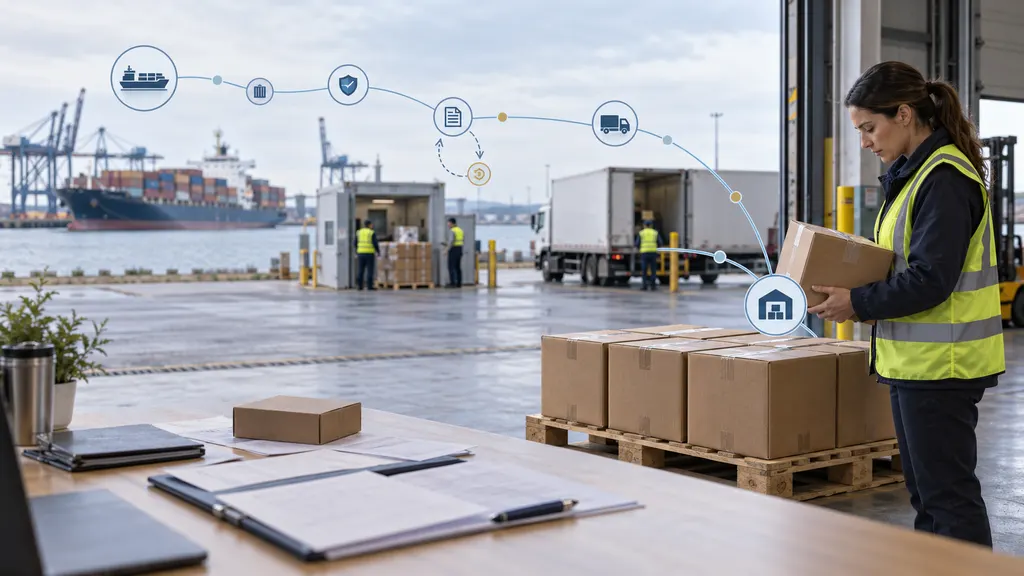
Physical transportation and customs processing are connected but separate activities. A carrier moves the goods; a customs authority oversees the applicable customs requirements; and a declarant or representative submits information and assumes responsibilities defined by the relevant law. Depending on the arrangement, one organization may perform more than one operational role.
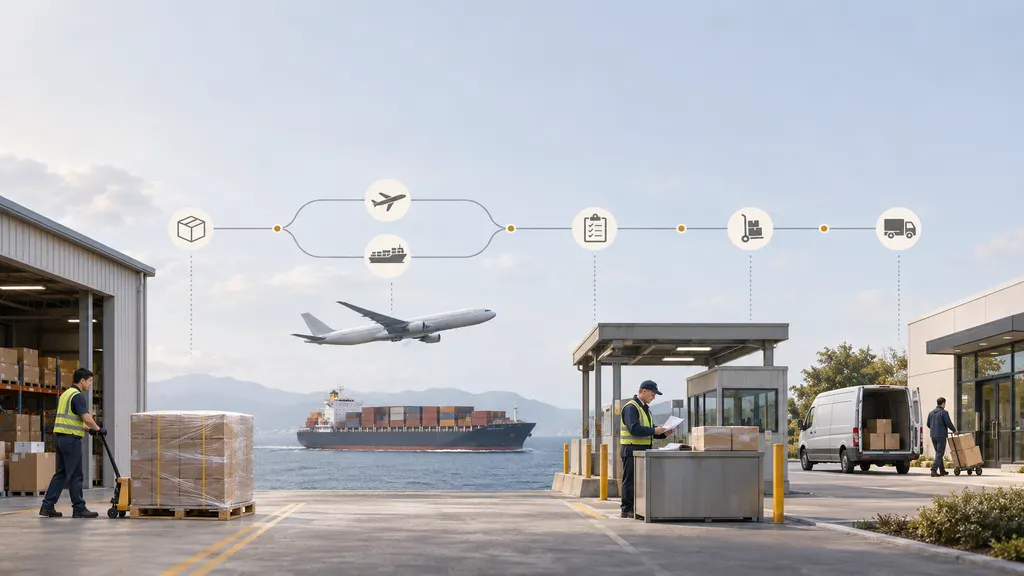
In cross-border ecommerce, an order may travel through several stages: collection from a seller, consolidation, export processing, international transport, import processing, and delivery. Customs-controlled transportation can occur within this sequence, but it does not describe the entire order lifecycle. A parcel can be physically moving without having been released for domestic circulation, and it can be released by customs before final delivery begins.
The distinction matters when interpreting shipment updates. A message indicating departure from a border facility does not, by itself, establish whether import clearance is complete. The goods could instead be moving to another authorized location under a transit arrangement. Likewise, arrival at an inland terminal does not necessarily mean that the consignee can collect or use the goods.
Customs Transit: The More Precise Related Concept
The World Customs Organization’s Revised Kyoto Convention describes customs transit as a procedure under which goods are transported under customs control from one customs office to another. This is the appropriate reference concept when transportation occurs under a defined transit procedure rather than simply involving an international border crossing.
Transit can allow goods to move to another customs office without completing ordinary import formalities at the initial point of entry. The conditions, security requirements, permitted uses, and treatment of duties and taxes depend on the applicable system. Transit does not mean that goods are exempt from all customs obligations or that import charges can never become payable.
For example, the European Union’s Union Customs Code distinguishes external and internal transit arrangements. These are legal procedures with specific conditions, not general categories that should be applied automatically to shipments elsewhere. An accurate description should identify the jurisdiction and procedure instead of assuming that all customs-controlled movements operate under equivalent rules.
Distinctions from Related Terms
| Term | Meaning | Important distinction |
|---|---|---|
| Cross-border transportation | Physical movement of goods across a border. | A border crossing alone does not establish that a customs transit procedure is being used. |
| Customs transit | Movement between customs offices under customs control through an applicable transit procedure. | It has a procedural meaning beyond ordinary international transportation. |
| Customs clearance | Completion of the customs formalities necessary for the relevant customs procedure. | It concerns formalities, not merely movement or arrival. |
| Transshipment | In the Revised Kyoto Convention’s customs context, transfer under customs control from an importing means of transport to an exporting means within the area of one customs office. | It concerns a transfer between means of transport rather than necessarily a movement between customs offices. |
| Bonded transportation | An expression used in some jurisdictions for transportation subject to customs controls and associated security arrangements. | Its legal meaning and requirements must be checked locally; it is not a universal substitute for every transit movement. |
| Customs warehousing | A procedure allowing goods to be stored under customs control under specified conditions. | Storage is distinct from transportation, although a shipment may move between a warehouse and another customs location. |
How a Customs-Controlled Movement May Work
The following sequence illustrates a transit-type movement. It is an operational outline, not a universal filing procedure. National law, international arrangements, the mode of transport, and the goods involved determine the actual requirements.
- Identify the customs route. Establish the departure location, destination, transit territories, and intended customs offices. Determine whether the goods will be imported at the first entry point or moved onward under another procedure.
- Establish the procedure and responsible parties. Confirm who will act as declarant, who is responsible for the transit operation, and which carrier will perform the movement. A commercial shipping agreement does not by itself settle statutory customs responsibilities.
- Prepare the required information. Assemble the goods description, quantity, transport references, consignor and consignee details, and any other information required by the applicable procedure. Supporting documents must be consistent with the shipment.
- Meet authorization and security conditions. Where required, arrange a guarantee, obtain an authorization, or satisfy conditions relating to the vehicle, container, identification measures, or seals. These requirements should not be assumed to apply identically everywhere.
- Move the goods under the applicable controls. Follow any prescribed route, presentation requirements, or time limit. An accident, broken seal, diversion, or change of vehicle may require notification or another prescribed action.
- Present the goods at destination. Provide the goods and required information to the destination customs office or another location permitted by the procedure. Physical arrival alone may not complete the formalities.
- Complete the transit procedure and arrange the next step. Customs records must establish the appropriate completion of the movement. The goods may then enter another procedure, such as importation, customs warehousing, or export, as applicable.
The WTO Trade Facilitation Agreement provides a broader framework for freedom of transit, including provisions concerning transit formalities and guarantees. It does not replace the shipment-level requirements imposed through the applicable customs system.
Illustrative Commercial Situations
Movement from a port to an inland customs office
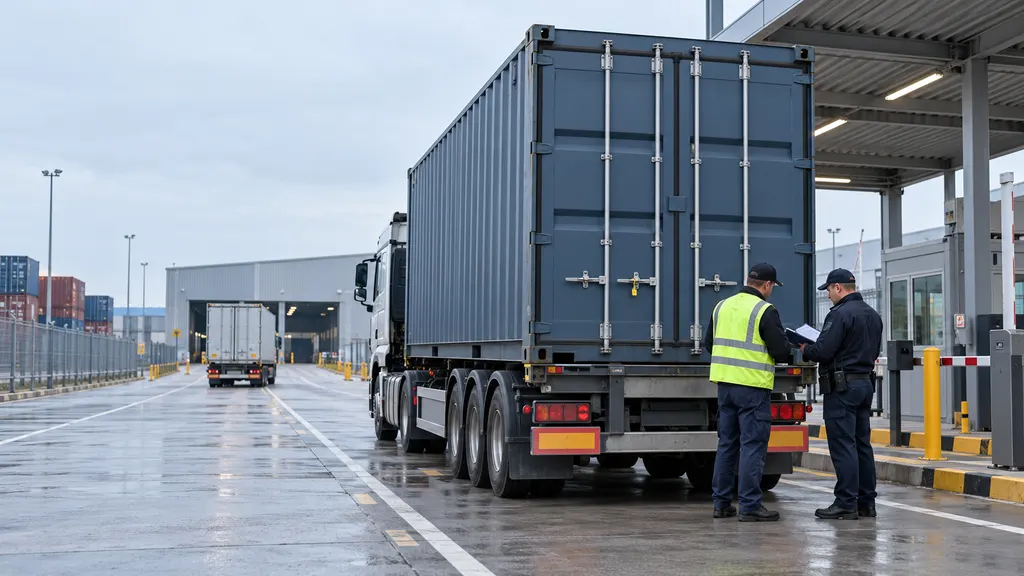
A retailer may import a container that arrives at a seaport but is intended for customs processing inland. Where the applicable procedure permits, the container can move under customs transit to the inland office before the relevant import formalities are completed. The inland journey is not evidence that the goods have already been released for domestic circulation.
Passage through an intermediate customs territory
A road shipment may cross an intermediate territory on its way to the buyer’s destination. A suitable transit arrangement can govern that passage without treating the goods as an ordinary domestic import into the intermediate territory. The available arrangement and its conditions depend on the territories and agreements involved.
Consolidated ecommerce consignments
An ecommerce operator may consolidate multiple orders into a larger transport movement. Where authorized, that movement may travel under transit to a facility where further customs processing and shipment separation take place. Consolidation does not automatically make the individual orders exempt from declarations, restrictions, or applicable charges.
Operational Checks and Common Misunderstandings
When a document uses “trans-customs transportation,” the practical task is to replace ambiguity with verifiable details. The following checks help establish what service or movement is actually intended:
- Procedure: Ask for the official procedure name and the customs territory in which it applies.
- Locations: Identify the customs departure and destination points, not just the commercial pickup and delivery addresses.
- Responsibility: Confirm who submits declarations, provides any required security, presents the goods, and retains completion records.
- Customs status: Determine whether the goods remain under a transit procedure, are in storage, or have been released under another procedure.
- Documents and references: Distinguish transport documents and tracking numbers from customs declaration references. Their functions are different even when a system connects them.
- Completion evidence: Establish which record demonstrates that the customs movement has ended appropriately. A delivery receipt is not necessarily sufficient.
- Exceptions: Determine the required response to damage, shortages, route changes, or interrupted transportation.
Three assumptions deserve particular care. First, movement under customs control does not mean movement without declarations or oversight. Second, temporary suspension of duties or taxes under a procedure is not the same as permanent exemption. Third, a commercial tracking event is not a substitute for an official customs decision or procedural completion record.
The same distinction applies to ecommerce returns. Sending goods back across a border does not automatically cancel the original import treatment or establish entitlement to repayment. The relevant export, reimportation, returned-goods, or repayment provisions must be assessed separately under the applicable law.
QA
Is trans-customs transportation the same as customs transit?
Not necessarily. Trans-customs transportation is a descriptive expression whose meaning depends on context. Customs transit is a defined procedure involving movement under customs control between customs offices.
Does it mean the shipment has cleared import customs?
No. Goods may be moving under transit before import formalities are completed at another location. Confirmation requires information about the actual customs procedure and release status.
Are duties and taxes always waived during transit?
No. Transit arrangements can provide for movement without immediate payment of certain import charges, subject to conditions. This is not a blanket exemption, and liability can arise under the applicable rules.
What should a business ask when a quotation uses this term?
Ask which official customs procedure is included, which locations it connects, who is responsible for declarations and any guarantee, and what evidence confirms completion.
Sources
- World Customs Organization — Revised Kyoto Convention. Supports the customs framework and terminology, including the General Annex definitions, Specific Annex D on customs warehousing, and Specific Annex E on customs transit and transshipment. These materials define the related procedures, rather than the expression “trans-customs transportation.”
- World Trade Organization — Agreement on Trade Facilitation. Article 11 supports the discussion of transit formalities, customs controls, and guarantees.
- European Union — Union Customs Code, Regulation (EU) No 952/2013. Supports the jurisdiction-specific discussion of external and internal transit, procedural responsibilities, guarantees, customs warehousing, and the distinction between customs procedures and physical transportation.