Land Bridge Transport
What Is Land Bridge Transport?
Land bridge transport is the movement of freight across a landmass as part of a wider transport route, usually using rail to connect maritime gateways. In its classic form, a shipment travels by sea to one coast, crosses the intervening land by rail, and continues by sea from another coast. The overland section acts as a bridge between maritime routes, replacing a longer or otherwise less suitable all-water journey.
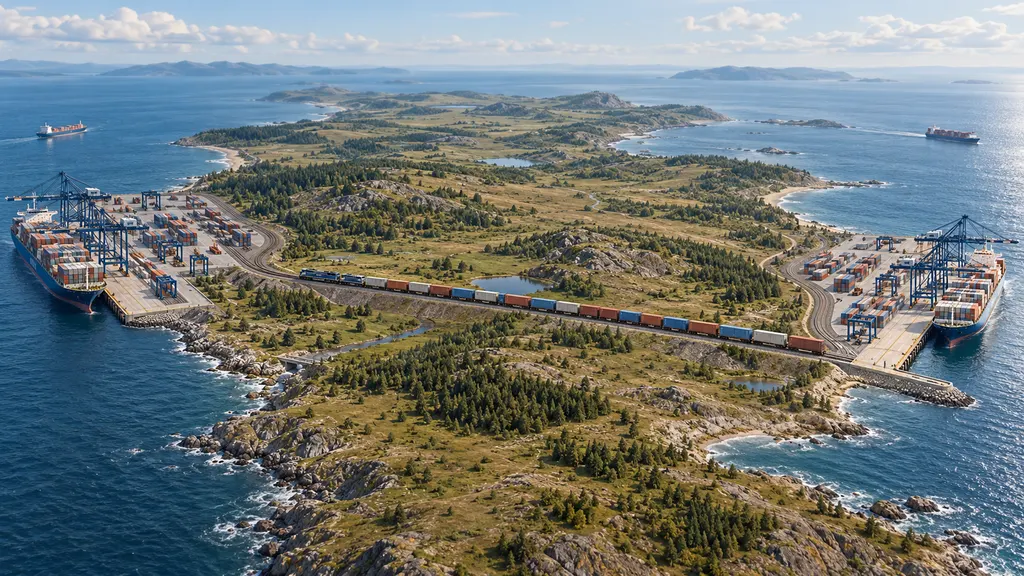
In logistics, the term is also written as landbridge. Related expressions, including mini-landbridge and micro-landbridge, describe arrangements in which the shipment's inland origin or destination replaces one of the sea legs. Usage varies between transport references and commercial services, so the actual route and endpoints matter more than the label alone.
Land bridge transport is a freight-routing concept, not a physical bridge, a customs procedure, or a particular carrier's product. It is especially relevant to container shipping, intermodal transport, international trade, and inventory replenishment.
How Land Bridge Transport Works
A classic land bridge combines sea and land transport within one freight journey. Containers make this arrangement practical because the container can move between a vessel, a terminal, and a rail service without unpacking its contents at each transfer. The equipment changes, but the cargo can remain inside the same loading unit.
- Origin shipment: Goods are packed and moved to the departure port. Export formalities and transport documentation are arranged as required.
- First sea leg: A vessel carries the container to the maritime gateway serving the land bridge.
- Port transfer: The container is discharged and transferred to a rail terminal. Depending on the gateway, this may involve an on-dock rail facility or a separate road transfer.
- Overland crossing: A rail service moves the container across the landmass. Road transport may supplement the crossing or connect terminals.
- Second maritime transfer: The container reaches another port and is transferred to the onward vessel.
- Final movement: The shipment continues by sea and then moves to its destination under the applicable import and delivery arrangements.
The stages must work as a connected itinerary. A short rail journey does not necessarily produce a short end-to-end journey if the container misses a vessel connection or waits for terminal processing. Route assessment therefore includes transfer time, service frequency, border procedures, and the availability of compatible equipment.
Land Bridge, Mini-Landbridge, and Micro-Landbridge
These terms describe different relationships between maritime legs and inland endpoints. They are established transport expressions, but they should not be treated as universally standardized service specifications.
| Term | Route pattern | Defining distinction |
|---|---|---|
| Land bridge | Sea–land–sea | The overland crossing connects two maritime legs across an intervening landmass. |
| Mini-landbridge | Sea–land, or the reverse | The inland movement connects a maritime gateway with a destination or origin in another coastal region, without a second sea leg. |
| Micro-landbridge | Sea–land, or the reverse | The inland movement connects a maritime gateway with an inland destination or origin rather than another coastal gateway. |
For example, an ocean shipment arriving on one coast and continuing by rail to a destination near the opposite coast may be described as a mini-landbridge movement. If the rail destination is an inland distribution center, the arrangement may be described as a micro-landbridge. These are explanatory route patterns, not statements about any particular service's availability.
In operational documents, a forwarder or carrier may use broader terminology. Confirm the named ports, rail terminals, place of receipt, and place of delivery rather than assuming that a land bridge quotation includes two ocean voyages.
Relationship to Other Transport Concepts
| Related term | Relationship to land bridge transport |
|---|---|
| Intermodal transport | Describes movement in the same loading unit or road vehicle using successive transport modes without handling the goods themselves during mode changes. A containerized land bridge is an application of this concept. |
| Multimodal transport | Broadly describes carriage using two or more transport modes. It does not, by itself, identify a land bridge route or establish the contractual arrangement. |
| All-water route | Keeps the principal international movement at sea rather than substituting an overland crossing between maritime legs. Local inland collection and delivery may still be necessary. |
| Transshipment | Refers to transferring cargo between transport services or vehicles. Transfers occur within a land bridge journey, but a transfer alone does not make a route a land bridge. |
| Transport corridor | Describes a broader geographic route and its infrastructure or services. A corridor may support land bridge movements as well as other freight flows. |
A continuous international rail journey is not automatically a classic land bridge merely because it crosses a continent. The defining feature of the classic arrangement is the overland connection between maritime legs. Broader commercial uses of the term should be interpreted in context.
Use in Logistics and Cross-Border Ecommerce
Land bridge transport belongs primarily to the long-distance freight portion of a supply chain. It connects production locations, maritime gateways, and destination markets before goods reach their final distribution or delivery network.
For ecommerce, its relevance is often inventory movement rather than individual parcel delivery. A retailer may use a sea-and-rail route to replenish a fulfillment center, where the goods are later stored, picked, packed, and dispatched as separate customer orders. The upstream freight movement and the downstream parcel deliveries remain distinct shipments with different operational milestones.
Consider a hypothetical retailer comparing an all-water shipment with a land bridge itinerary. The land bridge option could deliver the container to a destination-side gateway before warehouse delivery. The retailer would need to compare the complete route, including terminal transfers and the final warehouse appointment, rather than comparing the rail crossing with the ocean voyage alone.
The term may appear in freight quotations, routing instructions, transport geography references, carrier service descriptions, and discussions with freight forwarders. A transport document may identify the ports and inland delivery point without using the expression explicitly.
Route Selection and Operational Trade-Offs
A land bridge can provide an alternative to a longer maritime routing, but it is not inherently faster, cheaper, or more reliable. Those outcomes depend on the specific itinerary and operating conditions.
- End-to-end transit time: Include ocean schedules, port dwell, rail departure availability, connection buffers, and final delivery. Individual leg times are not a complete forecast.
- Total transport cost: Compare equivalent scopes. Ocean freight, inland carriage, terminal handling, transfers, storage, and applicable equipment-related charges may be included differently in quotations.
- Connection reliability: A delayed vessel can affect a rail booking, and a delayed train can affect an onward sailing. Recovery options matter alongside the planned schedule.
- Capacity and equipment: Confirm container acceptance, rail capacity, terminal capability, and any cargo-specific restrictions across every leg.
- Cargo suitability: Dangerous goods, temperature-sensitive products, heavy loads, and oversized cargo require route-specific checks. Acceptance on one leg does not establish acceptance throughout the route.
- Inventory requirements: Assess whether the arrival pattern supports replenishment needs and whether uncertainty requires additional inventory buffers.
- Environmental assessment: Compare the actual routes, modes, distances, and calculation boundaries. Combining rail and sea does not establish a lower-emission outcome in every case.
These factors are decision criteria rather than guaranteed advantages or disadvantages. A useful comparison evaluates the same origin, destination, cargo, and service scope for each alternative.
Customs, Documents, and Shipment Visibility
Crossing a country as part of a land bridge does not necessarily mean that the goods are imported there for domestic consumption. Where an applicable customs transit procedure is used, goods can move through the territory under customs control. The required declarations, guarantees, seals, and discharge procedures depend on the jurisdictions and transit arrangements involved.
The WTO Trade Facilitation Agreement addresses freedom of transit, but it is not a shipment-specific operating manual. Shippers still need to establish the applicable procedures with their forwarder, customs representative, or relevant authorities. A route description alone cannot determine whether duties are payable, whether a guarantee is required, or which party must complete the formalities.
Transport responsibility also needs separate confirmation. A land bridge itinerary may be arranged under a through transport document or through separate contracts. The physical combination of sea and rail does not automatically establish one carrier's responsibility for the entire movement.
Visibility can involve several references, including a booking number, bill of lading number, container number, and rail-related identifiers. Useful milestones include vessel discharge, terminal availability, rail departure, rail arrival, onward loading, and delivery. An event at one stage should not be interpreted as completion of the entire journey.
Practical Checks Before Booking
- Identify every port, inland terminal, transfer point, and final delivery location.
- Confirm whether the itinerary is sea–land–sea or ends after the inland movement.
- Check which party arranges each transfer and handles missed connections.
- Establish the customs status of the goods during the crossing and at destination.
- Confirm cargo acceptance and equipment requirements for every transport leg.
- Compare quotations on an equivalent basis, including exclusions and potential waiting-related charges.
- Verify the transport documents, contractual scope, and claims contacts.
- Define which tracking milestone constitutes arrival for inventory planning.
QA
Does land bridge transport always use rail?
Rail is characteristic of classic containerized land bridge movements. Road transport may connect ports and rail terminals or form part of the overland routing. The essential concept is the land connection within the wider freight journey.
Is land bridge transport faster than an all-water route?
It can be, but not automatically. Port processing, rail schedules, transfer delays, and onward vessel connections determine the end-to-end result.
Does a land bridge shipment need customs clearance in the transit country?
It requires the applicable customs formalities, but those may involve customs transit rather than import clearance for domestic consumption. Requirements depend on the route and jurisdictions.
Is land bridge transport the same as intermodal transport?
No. Intermodal transport describes how freight moves between modes in the same loading unit. Land bridge transport describes a route arrangement that can use intermodal transport.
Sources
- The Geography of Transport Systems: Intermodal Transportation and Containerization — Educational reference for intermodal networks, containerized transport, and land bridge route concepts.
- UNECE, European Conference of Ministers of Transport, and European Commission: Terminology on Combined Transport — Definitions supporting the distinction between intermodal, multimodal, and related transport concepts.
- World Trade Organization: Agreement on Trade Facilitation — Article 11 provides the international trade framework concerning freedom of transit; it does not prescribe a single operating procedure for every land bridge shipment.