Logistics Outsourcing
What Is Logistics Outsourcing?
Logistics outsourcing is the practice of contracting an external service provider to perform logistics activities that a business would otherwise manage or carry out internally. These activities may include transportation, warehousing, inventory handling, order fulfillment, customs-related services, and returns processing. In ecommerce and cross-border trade, outsourcing connects a seller’s commercial operations with the physical movement and storage of goods.

The arrangement may cover a single activity, such as parcel delivery, or a coordinated group of activities, such as receiving inventory, storing products, preparing orders, and arranging dispatch. Outsourcing changes who performs the work; it does not automatically transfer ownership of the goods or remove the contracting business’s legal and commercial obligations.
Scope Within the Supply Chain
Logistics outsourcing concerns the movement, storage, and associated information flows of goods. It is narrower than outsourcing an entire supply chain, which could also involve procurement, manufacturing, or other business functions. The Council of Supply Chain Management Professionals distinguishes logistics management from the broader coordination activities covered by supply chain management.
A business can retain control over purchasing, product selection, inventory policies, and customer relationships while assigning physical logistics work to external organizations. It may also retain some warehouses or transport operations and outsource others. The following are examples of possible service scopes, not a formal classification system.
| Activity | Possible Outsourced Work | Decisions the Business May Retain |
|---|---|---|
| Inbound transportation | Collecting goods from suppliers and arranging delivery to a warehouse | Supplier selection and replenishment priorities |
| Warehousing | Receiving, storing, counting, and handling inventory | Stock ownership and inventory policies |
| Order fulfillment | Picking products, packing orders, and handing shipments to carriers | Product assortment and customer service policies |
| Outbound transportation | Moving freight or parcels to delivery destinations | Available shipping options and customer delivery promises |
| Customs-related services | Preparing or submitting declarations where authorized | Compliance responsibilities that remain with the importer or exporter under applicable law |
| Returns processing | Receiving returned goods, recording condition, and carrying out agreed disposition instructions | Refund eligibility and resale or disposal rules |
How Logistics Outsourcing Works
1. Defining the Operating Scope
The contracting business identifies which activities will move outside the organization and which will remain internal. A useful scope specifies locations, product characteristics, shipment types, handling requirements, and expected order patterns. It also identifies exclusions. For example, a provider might receive and store ordinary packaged goods but not accept temperature-controlled products or dangerous goods.
Clear boundaries matter because similar service descriptions can conceal different responsibilities. A warehouse service may include storage without order picking, while a fulfillment arrangement may include picking and packing but exclude customer returns.
2. Establishing Responsibilities and Service Terms
The parties document operating instructions, charges, service expectations, liability provisions, and procedures for resolving exceptions. A service-level agreement may define measurable commitments, but its meaning depends on the contract rather than the label alone.
Measurements need precise starting points, exclusions, and data sources. An order-processing deadline, for example, should distinguish between an order received by the seller and an order successfully transmitted to, accepted by, and released for processing at the warehouse. Without that distinction, the parties may calculate performance differently.
3. Connecting Inventory, Orders, and Shipment Information
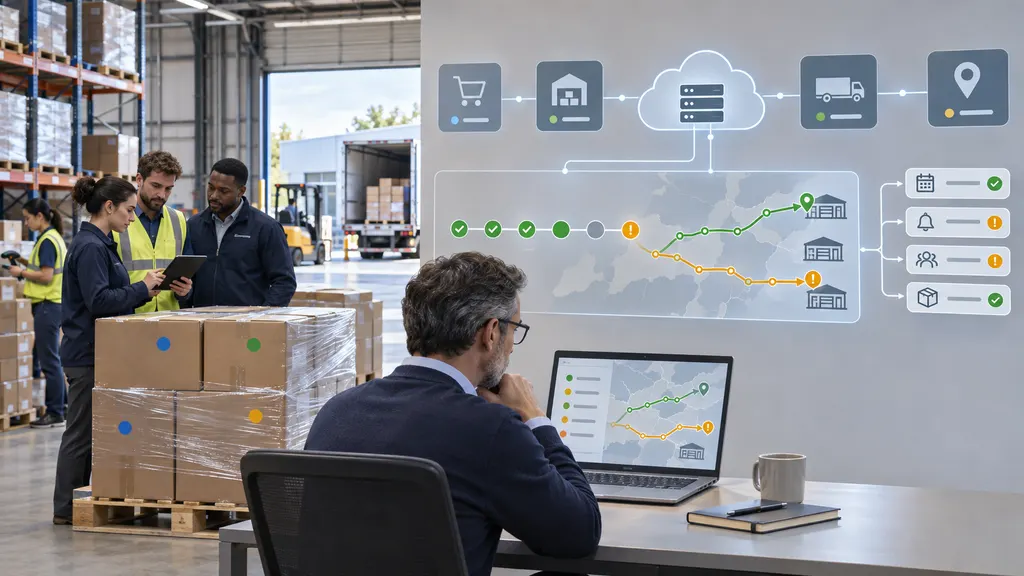
The business and provider establish how operational data will move between their systems. Information may include product identifiers, stock receipts, customer addresses, order instructions, shipment references, and return authorizations. Connections can use application programming interfaces, electronic data interchange, file transfers, or controlled manual procedures.
The required integration depends on the service. A transport-only arrangement may need shipment instructions and delivery updates, while outsourced fulfillment also needs inventory balances and order status information. Data exchange does not by itself establish accuracy: both parties need procedures for identifying missing records, duplicate orders, and stock discrepancies.
4. Managing Daily Operations and Exceptions
After implementation, the provider performs the contracted work while the business monitors results and handles retained decisions. Exceptions may include damaged stock, incomplete addresses, customs queries, missed collections, or returned goods that do not match an authorization. Escalation procedures should identify who can approve additional work, communicate with customers, and authorize changes to an order or shipment.
5. Reviewing Performance and Planning Changes
Ongoing management compares service results with the agreed definitions and investigates recurring problems. Relevant measures may include inventory accuracy, picking accuracy, dispatch timeliness, damage incidents, and the time needed to resolve exceptions. These are possible measures, not a universal scorecard. Their usefulness depends on the outsourced activity and on whether the provider controls the outcome being measured.
Related Terms and Important Distinctions
| Term | Relationship to Logistics Outsourcing |
|---|---|
| Third-party logistics, or 3PL | A service arrangement or provider category associated with externally performed logistics activities. Logistics outsourcing describes the business practice; 3PL describes the external logistics role. |
| Fourth-party logistics, or 4PL | A term used for arrangements emphasizing the coordination or integration of multiple logistics resources and providers. Its practical scope varies, so contractual responsibilities are more informative than the label alone. |
| Freight forwarding | Arranging the transportation of goods and related services. It can form part of an outsourcing arrangement but does not necessarily include warehousing or order fulfillment. |
| Order fulfillment | The work needed to prepare and dispatch customer orders. It can be performed internally or outsourced. |
| Contract logistics | A term often used for contract-based logistics services, including combinations of warehousing, handling, and distribution. It overlaps with logistics outsourcing rather than having a universally separate boundary. |
| Dropshipping | A fulfillment model in which a supplier or another designated party ships goods directly to the customer for the seller. Logistics outsourcing does not necessarily involve dropshipping. |
| Offshoring | Moving an activity to another country. Outsourcing concerns the use of an external organization and can take place domestically or internationally. |
These terms describe different aspects of an operating arrangement. A business might outsource fulfillment to a domestic warehouse without offshoring any activity. It might also use an overseas warehouse to hold inventory that it owns, without using a dropshipping model.
Use in Ecommerce and Cross-Border Trade
In ecommerce, outsourced logistics can connect online orders with warehouse execution and carrier handover. For example, a retailer may own its inventory but contract an external warehouse to store products and prepare customer orders. The retailer transmits approved orders, the warehouse records fulfillment activity, and the carrier performs transportation under the relevant service arrangement.
Cross-border operations add questions about import procedures, documentation, product restrictions, and the allocation of responsibilities among sellers, buyers, logistics providers, and customs representatives. A provider’s ability to arrange transport does not establish that it can act as importer of record or perform regulated customs representation in every jurisdiction.
For example, a retailer may move inventory into a destination-country warehouse before selling individual units locally. That arrangement requires clarity about who imports the inventory, who supplies customs information, and who bears applicable obligations. Outsourcing warehouse work alone does not answer those questions.
Legal responsibility must be assessed under the relevant jurisdiction. U.S. Customs and Border Protection, for instance, explains that using a customs broker does not relieve an importer of its responsibility for entry documentation and applicable duties, taxes, and fees. This is a jurisdiction-specific example, not a statement that every country uses identical rules.
Reasons for Outsourcing and Associated Trade-Offs
A business may consider outsourcing to access warehouse space, transport capacity, specialist handling, or operational capabilities without building every capability internally. Whether an arrangement produces a financial or service benefit depends on its design and performance. Outsourcing does not inherently make logistics cheaper, faster, or more reliable.
A meaningful assessment compares equivalent service scopes. An external quotation should be considered alongside internal staffing, facilities, equipment, systems, management, and exception-handling costs. It should also account for charges that may arise from storage duration, additional handling, packaging, returns, or transition work, where those charges apply.
Operational trade-offs include dependence on another organization’s capacity, less direct control over physical work, and the need to coordinate data and decisions across organizational boundaries. Subcontracting can introduce further handovers. These considerations do not make outsourcing unsuitable, but they affect how the arrangement should be specified and supervised.
Practical Checks Before an Outsourcing Agreement
- Service fit: Confirm that the agreed operation can handle the relevant products, destinations, order profiles, and handling restrictions.
- Responsibility boundaries: Identify who controls stock decisions, carrier selection, customs instructions, customer communications, and returns disposition.
- Inventory records: Establish receipt confirmation, stock reconciliation, discrepancy investigation, and access to inventory reports.
- Performance definitions: Specify how each measure is calculated, including cut-off times, exclusions, and evidence requirements.
- Charges and exceptions: Identify the charging units and how additional work must be authorized.
- Liability and claims: Review contractual liability limits, insurance arrangements, reporting deadlines, and claims procedures without assuming full reimbursement for every loss.
- Data and access: Define data permissions, security requirements, reporting access, and procedures for correcting transmission failures.
- Continuity and exit: Plan how inventory, records, and unfinished orders would transfer if the service changes or ends.
Common Misunderstandings
Outsourcing is not the same as transferring all responsibility. A provider can perform an activity while the contracting business retains customer obligations, compliance duties, or decisions under the applicable agreement and law.
Outsourcing does not require handing over the entire logistics operation. A business can outsource one transport route, one warehouse, or returns handling while retaining other activities internally.
Shipment visibility is not operational control. Receiving tracking updates can help identify a delay, but it does not necessarily allow the seller or logistics coordinator to change a carrier’s physical handling of the shipment.
QA
Is logistics outsourcing the same as 3PL?
The terms are closely related but describe different things. Logistics outsourcing is the practice of assigning logistics work to external organizations; a 3PL is an external logistics provider or service arrangement used to perform that work.
Can a business outsource logistics without outsourcing inventory management?
Yes. It can retain purchasing, replenishment policies, and stock-allocation decisions while outsourcing storage, physical handling, or transportation. The agreement should distinguish decision-making responsibilities from execution tasks.
Does logistics outsourcing transfer ownership of the goods?
Not automatically. An external provider can store or transport goods owned by the contracting business. Ownership and custody are separate matters and should not be inferred from the outsourcing arrangement alone.
Does outsourcing customs work remove the importer’s obligations?
Not necessarily. Obligations depend on the jurisdiction and the parties’ legal roles. Using an external customs service does not, by itself, establish that the importer’s statutory responsibilities have transferred.
Sources
- Encyclopaedia Britannica: Outsourcing — General definition of outsourcing and its distinction from performing activities within an organization.
- Council of Supply Chain Management Professionals: Supply Chain Management Definitions and Glossary — Scope of logistics management and its relationship to supply chain management.
- U.S. Customs and Border Protection: Tips for New Importers and Exporters — U.S.-specific importer responsibilities and the limits of relying on a customs broker to discharge those responsibilities.