Multimodal Transport
What Is Multimodal Transport?
Multimodal transport is the movement of goods by at least two different modes of transport under a single multimodal transport contract, from a place where the goods are taken in charge to a place designated for delivery. The modes may include road, rail, inland waterway, sea, or air transport. In the usual legal and industry usage, one party, commonly called the multimodal transport operator, assumes responsibility for arranging or performing the transport as a whole, even when different carriers physically handle separate legs.
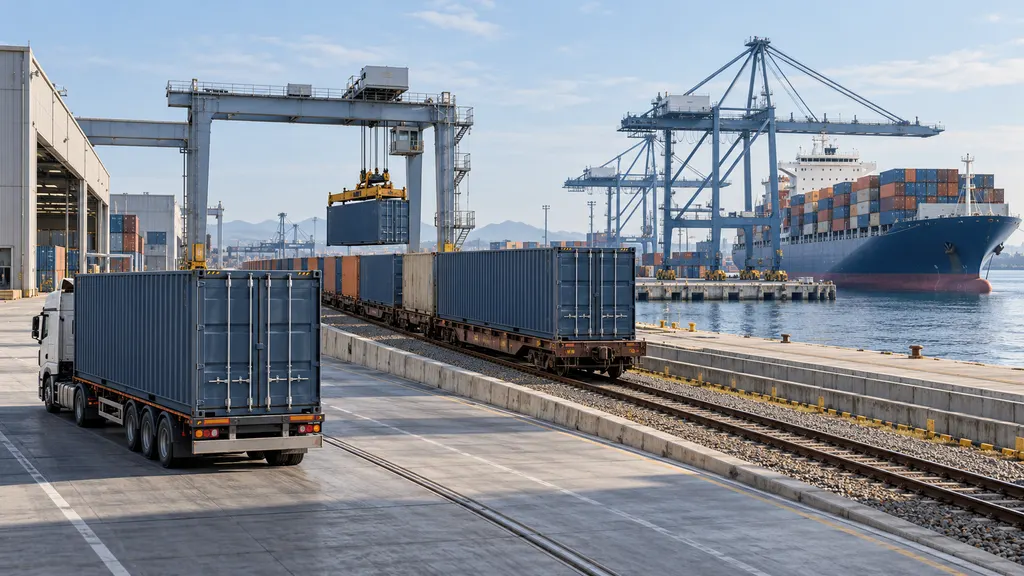
The term is used mainly in logistics, international trade, freight forwarding, shipping, and cross-border ecommerce. It describes the structure of a complete movement rather than one particular vehicle or route. For example, a container may move by truck from a seller's warehouse to a rail terminal, by rail to a seaport, by ocean vessel to another country, and by truck to the consignee. If the movement is organized as one contracted transport service, it may be described as multimodal transport.
Definitions can differ between international conventions, national laws, commercial contracts, and industry practice. The central idea remains the same: at least two transport modes are used for one overall movement, and the relationship between the customer and the responsible transport organizer is defined by a contract that covers the journey or a substantial part of it.
Multimodal Transport in Logistics
Multimodal transport occupies the connection between supply-chain planning and physical freight movement. A shipper usually has one origin, one destination, and a required delivery arrangement, but the journey may involve several carriers, terminals, customs events, and handling operations. Multimodal transport provides a framework for coordinating those stages as one movement.
In a typical arrangement, the shipper provides cargo information, pickup and delivery instructions, and any documents required for transport or customs processing. The multimodal transport operator or contracting logistics provider plans the route, selects or coordinates the carriers, books capacity, and issues transport documentation. Individual carriers then perform particular legs, such as a road pickup, a rail movement, or an ocean crossing.
The operator's precise responsibility depends on the applicable law and contract. A multimodal transport document may identify the operator as the contracting party, while separate carrier documents may exist for particular legs. The existence of one commercial contract does not eliminate the need to comply with the rules applicable to each mode, including requirements concerning dangerous goods, customs, cargo security, weight, packaging, and transport equipment.
How Multimodal Transport Works
- Transport planning: The shipper or logistics provider defines the origin, destination, cargo characteristics, delivery requirements, and available transport options.
- Mode selection: The route is divided into transport legs. A planner may combine road, rail, sea, inland waterway, or air according to the cargo, geography, service requirements, infrastructure, and contractual constraints.
- Contracting: The parties establish who is responsible for the overall movement, which documents apply, how charges are calculated, and how liability and claims are handled.
- Origin handling: Goods are packed, identified, and collected. Cargo may be consolidated into a container, trailer, swap body, palletized unit, or another suitable loading unit.
- Transfer between modes: The loading unit or cargo is transferred at a terminal, depot, port, airport, rail yard, or warehouse. The goods may remain in the same unit, although transfers can still involve inspection, storage, or additional handling.
- International and border procedures: Where a national border is crossed, the shipment may require export, transit, import, security, or other customs procedures. The party responsible for these steps should be identified rather than assumed.
- Final delivery: The destination carrier completes the final leg and delivers the goods to the consignee or another agreed location. Proof of delivery may close the operational movement, while claims or returns may continue afterward.
Tracking information is often collected from several carriers and systems. As a result, status descriptions, event timing, and data quality can vary between legs. A single customer-facing tracking view may combine those events, but it does not necessarily mean that all transport legs are performed by one company.
Main Characteristics
- Multiple modes: At least two distinct modes of transport are used in the same overall movement.
- One planned movement: The legs are coordinated as parts of an end-to-end route rather than treated as unrelated shipments.
- Contractual coordination: A contract identifies the party arranging or assuming responsibility for the overall transport, subject to applicable law and the agreed terms.
- Transfer points: Terminals, ports, airports, depots, and warehouses connect the modes and may introduce handling, storage, or documentation requirements.
- Different operational rules: Each mode may have distinct limits, schedules, documents, liability rules, and safety requirements.
- End-to-end visibility needs: Shippers and consignees may need information from multiple carriers to understand the shipment's complete status.
Types and Related Concepts
There is no single universal classification that covers every commercial arrangement. The following distinctions describe common concepts, but the meaning of a particular document or service should be checked against the governing contract and applicable law.
| Term | Meaning | Typical Distinction | Example |
|---|---|---|---|
| Multimodal transport | Transport using at least two modes under one overall multimodal transport arrangement. | Focuses on the combination of modes and the contractual organization of the movement. | Truck, rail, and vessel movement covered by one end-to-end transport contract. |
| Intermodal transport | Transport using more than one mode while the goods remain in the same loading unit or vehicle, with the goods themselves not normally handled during mode changes. | Often emphasizes the loading unit and reduced cargo handling. Commercial and legal usage varies by jurisdiction. | A sealed container transferred from a truck chassis to a train and then to a ship. |
| Combined transport | A form of multimodal or intermodal movement in which the main leg uses rail, inland waterway, or sea and the road legs are limited to the beginning or end of the route. | The term may have a specific regulatory meaning, particularly in some European legal contexts. | A short road pickup to a rail terminal, a long rail movement, and a short road delivery. |
| Unimodal transport | Transport using one mode for the relevant movement. | It may still involve several carriers or transfers, but it does not meet the basic multiple-mode concept. | A shipment moved entirely by road from a warehouse to a customer. |
| Transshipment | The transfer of cargo from one vessel, vehicle, or transport service to another. | It describes an operational transfer and does not by itself establish a multimodal contract. | A container moved from one ocean vessel to another at a hub port. |
Multimodal and intermodal are sometimes used interchangeably in commercial conversation. The distinction is useful when discussing loading units, cargo handling, and contractual responsibility, but it should not be treated as identical in every legal or operational context.
Multimodal Transport in Cross-Border Ecommerce
Cross-border ecommerce orders frequently pass through more than one transport mode. A seller may move inventory by truck to an export terminal, by air or sea to the destination market, and by road through a domestic delivery network. The customer may see one order and one tracking page even though the physical movement consists of several transport legs and service providers.
For ecommerce operations, the important questions are not limited to the mode combination. The seller or logistics manager should also identify the party responsible for pickup, export documentation, import clearance, duties and taxes where applicable, final-mile delivery, delivery exceptions, and returns. These responsibilities depend on the sales contract, shipping terms, service agreement, and local requirements.
Multimodal planning can also affect inventory decisions. A slower but consolidated movement may be suitable for replenishment stock, while a time-sensitive order may require a different combination of modes. Such decisions are operational choices, not fixed characteristics of multimodal transport itself. The term does not guarantee a particular delivery speed, price, level of tracking, or customs outcome.
Benefits and Operational Challenges
Potential Benefits
- Route flexibility: A planner can combine the strengths and geographic reach of different transport modes.
- Network access: Rail, sea, inland waterway, road, and air services can connect locations that are not served efficiently by one mode alone.
- Consolidated coordination: A single contractual arrangement may simplify communication about an end-to-end movement, depending on the service design.
- Loading-unit continuity: When containers or other standardized units are used, cargo may be protected from repeated unpacking and repacking.
- Supply-chain planning: Multimodal options allow shippers to balance service requirements, capacity, infrastructure, and other operational constraints.
Operational Challenges
- Interchange delays: A missed connection, terminal congestion, or equipment shortage can affect later legs.
- Fragmented information: Different carriers may use different event codes, tracking standards, and update schedules.
- Documentation complexity: A movement may involve transport documents, commercial invoices, packing information, customs declarations, transit records, and security data.
- Liability questions: The responsible party and applicable liability rules may vary by contract, transport mode, location of loss, and mandatory law.
- Handling and condition risks: Transfers may expose goods to delay, damage, temperature variation, or security risk if the cargo and equipment are not managed appropriately.
- Dependency between legs: A problem on one leg can affect warehouse appointments, inventory availability, customer promises, and return planning.
Multimodal Transport Documents and Responsibility
A multimodal transport document records the contractual movement and may identify the consignor, consignee, cargo, origin, destination, transport modes, and responsible operator. The exact name and legal effect of the document vary. A document issued by a freight forwarder, carrier, or other operator should not be assumed to create identical obligations in every country.
Before booking, a shipper should check whether the provider is acting as a principal, an agent, a freight forwarder, or a carrier for the full movement. It is also useful to confirm the applicable terms, claim procedure, liability limits, insurance arrangements, delivery scope, customs responsibilities, and treatment of delays or storage. These checks are especially important when cargo crosses borders or when separate subcontracted carriers perform the individual legs.
Responsibility for customs clearance is a related but separate question. Multimodal transport can include border crossings, but it does not automatically determine who is the importer of record, who files a declaration, or who pays duties and taxes. Those matters are governed by the transaction structure, customs law, and the agreed commercial terms.
Examples
| Scenario | Transport Sequence | Why It Is Multimodal |
|---|---|---|
| Containerized export shipment | Truck from a factory to a rail terminal, rail to a port, ocean vessel to another country, and truck to the buyer. | At least three modes contribute to one planned international movement. |
| Retail replenishment | Truck from a supplier to an inland waterway terminal, barge to a seaport, vessel to a destination port, and truck to a distribution center. | Road, inland waterway, sea, and road are coordinated as connected legs. |
| Cross-border ecommerce order | Truck from a fulfillment warehouse to an airport, air transport to the destination country, and a local delivery vehicle to the customer. | The order uses air and road transport within an end-to-end delivery arrangement. |
| Temperature-sensitive cargo | Refrigerated truck to a cargo terminal, air transport, and refrigerated road delivery. | The modes are different, and the transfer plan must also preserve the required handling conditions. |
Common Misunderstandings
Multimodal Transport Is Not the Same as Any Shipment With Multiple Carriers
Several companies can participate in one movement without creating a multimodal transport arrangement. The decisive questions include how the service is contracted, who coordinates the complete route, and which party assumes responsibility. Multiple carriers alone are not sufficient.
Multimodal Transport Does Not Always Mean One Tracking Number
A provider may issue one customer-facing reference, or separate references may be used for different legs. Tracking presentation depends on the systems and contracts involved. One reference does not prove that the movement has only one carrier or one physical handling process.
Multimodal Transport Is Not Automatically Cheaper or Faster
Combining modes may create useful routing options, but cost and transit time depend on distance, capacity, schedules, terminal operations, cargo requirements, customs processes, and the selected service. The term itself is descriptive, not a performance guarantee.
Multimodal Transport Does Not Remove Customs Obligations
Using a single transport arrangement does not eliminate export, transit, import, security, or documentation requirements. The parties must identify which obligations apply and who is responsible for completing them.
QA
What is multimodal transport in logistics?
It is the movement of goods by at least two transport modes under one overall multimodal transport arrangement, usually coordinated by a responsible transport operator.
What is the difference between multimodal and intermodal transport?
Multimodal transport emphasizes the use of multiple modes and the overall contractual arrangement. Intermodal transport often emphasizes moving goods in the same loading unit without handling the goods themselves during mode changes. The terms may overlap, and their legal meanings can vary.
Does multimodal transport include customs clearance?
It may involve customs procedures because the route can cross borders, but the transport term itself does not determine who performs clearance or pays duties and taxes. Those responsibilities depend on the contract, transaction structure, and applicable law.
Sources
- United Nations Conference on Trade and Development, Multimodal Transport — background on multimodal transport and its role in international trade and logistics.
- UNECE and UNCTAD, Glossary for International Trade and Transport — terminology and distinctions used in international trade and transport.
- European Union, Council Directive 92/106/EEC on combined transport — regulatory context for the term “combined transport” within the European Union.
- United Nations Treaty Collection, United Nations Convention on International Multimodal Transport of Goods — international legal framework and terminology concerning multimodal transport of goods.