First-Mile vs Last-Mile Delivery: Key Differences in Operations, Costs, and Tracking
First-mile and last-mile delivery describe different stages of the same shipment, but they create different operational problems. First-mile delivery moves an order from a seller, warehouse, or fulfillment site into a carrier or line-haul network. Last-mile delivery moves it from a local distribution point to the customer. The first stage is usually about pickup coordination, consolidation, and network entry; the second is about route execution, delivery density, customer instructions, and final proof of delivery.
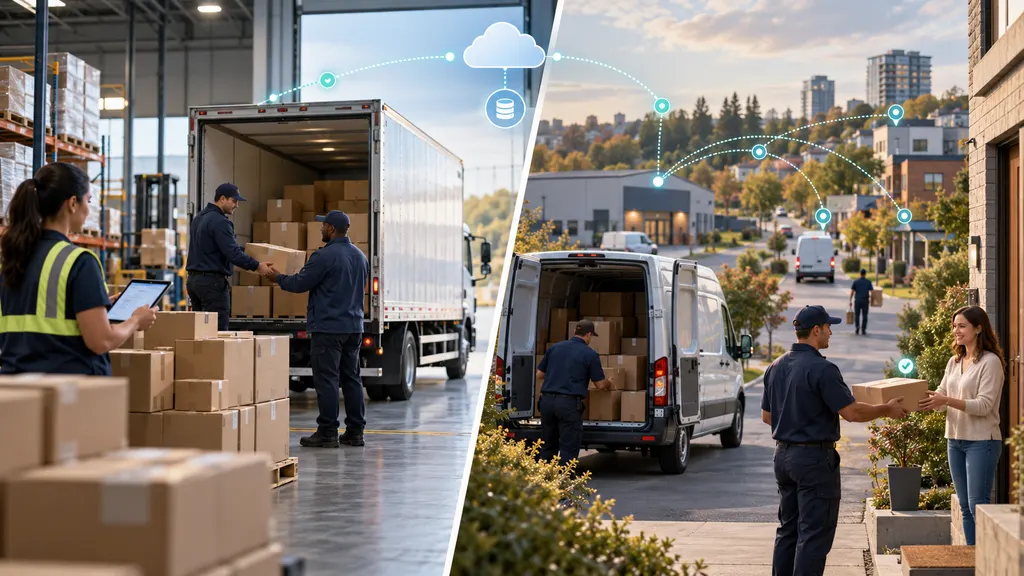
For ecommerce teams, the distinction matters because a shipment can leave the warehouse on time and still arrive late if either handoff is poorly managed. A useful delivery strategy therefore treats first-mile control and last-mile visibility as related, but separate, responsibilities.
What is first-mile delivery?
First-mile delivery is the opening movement of a shipment after an order is prepared. Depending on the supply chain, it may include a seller handing a parcel to a postal operator, a fulfillment center transferring cartons to a parcel carrier, or a manufacturer moving freight to a consolidator or forwarder.
The term is not used identically in every logistics network. In parcel ecommerce, the first mile commonly begins when the package leaves the merchant or fulfillment location. In freight and international shipping, it can also include transportation from a supplier to a warehouse, port, airport, or cross-border gateway. For this reason, businesses should define the first-mile endpoint in their own operating procedures instead of assuming that every carrier uses the term in the same way.
Typical first-mile activities
- Order release and pick-and-pack completion
- Label creation and shipment data transmission
- Pickup appointment scheduling
- Parcel induction or acceptance scanning
- Consolidation into bags, pallets, line-haul containers, or export shipments
- Transfer to a regional, national, or international carrier network
The first-mile handoff is operationally important because the carrier may not be responsible for the shipment until acceptance. A printed label does not necessarily mean that the parcel has entered the carrier network. The first meaningful scan, pickup record, or manifest event is often the point at which the shipment becomes visible to downstream tracking systems.
What is last-mile delivery?
Last-mile delivery is the final transportation leg from a local depot, delivery station, store, or other nearby distribution point to the recipient. It can involve a parcel van, postal route, local courier, pickup point, locker, or another delivery method.
Although the distance may be relatively short, last-mile execution is difficult because deliveries are dispersed across many addresses. Drivers must deal with traffic, access restrictions, apartment buildings, business hours, weather, recipient availability, and delivery instructions. A failed attempt can create additional handling and customer-service work even when the original route was planned correctly.
Typical last-mile activities
- Arrival at a local delivery facility
- Route planning and vehicle loading
- Out-for-delivery processing
- Address, access, and recipient verification
- Delivery, pickup-point placement, or exception handling
- Proof-of-delivery capture and customer notification
Last-mile performance is therefore judged by more than transportation speed. Delivery accuracy, first-attempt success, status clarity, safe placement, and the handling of exceptions all influence the customer’s experience.
First-mile vs last-mile: the main differences
| Dimension | First mile | Last mile |
|---|---|---|
| Primary movement | Seller or fulfillment site into a logistics network | Local facility or delivery point to the recipient |
| Main operational focus | Handoffs, consolidation, pickup readiness, and network induction | Route execution, delivery attempts, access, and proof of delivery |
| Shipment density | Often consolidated into batches, manifests, pallets, or containers | Usually dispersed across individual addresses or pickup locations |
| Typical failure points | Missed pickup, incorrect labels, incomplete manifests, and delayed acceptance scans | Address problems, recipient absence, access issues, failed attempts, and delivery exceptions |
| Customer visibility | Often begins with label creation, pickup, or acceptance events | Usually includes arrival at the local facility, out-for-delivery, delivery, or exception events |
| Best improvement levers | Cutoff discipline, standardized handoffs, inventory accuracy, and batch planning | Address quality, route planning, delivery options, notifications, and exception management |
How the cost structure differs
There is no universal percentage that assigns a fixed share of delivery cost to the first or last mile. The result varies by product size, shipment volume, geography, carrier contract, service level, labor model, fuel costs, customs requirements, and whether transportation is consolidated. A small parcel moving through a dense urban network has a different cost profile from a bulky item delivered to a remote address.
First-mile cost drivers
First-mile costs are influenced by the work required to make shipments ready for network entry. Relevant factors include warehouse labor, packaging materials, label and manifest accuracy, pickup frequency, minimum pickup requirements, staging space, and the distance between the fulfillment location and the carrier’s induction point. International orders may also add export documentation, consolidation, or handoff costs.
First-mile efficiency often improves when a business reduces avoidable touches and presents shipments in a carrier-ready format. Accurate order data and predictable pickup volumes can reduce rework, but the exact savings depend on the carrier agreement and warehouse process.
Last-mile cost drivers
Last-mile costs are shaped by the number of stops per route, distance between stops, failed delivery attempts, parcel dimensions, delivery time windows, local labor conditions, fuel, access complexity, and the use of special services. Residential delivery can be more operationally demanding than a concentrated business route because stops are spread across a wider area and may require more individual instructions.
Businesses can manage last-mile cost by improving address quality, offering pickup points where appropriate, reducing failed attempts, selecting suitable service levels, and communicating realistic delivery expectations. Faster service is not automatically more efficient if it requires premium transport or creates low-density routes.
Tracking differences between the two stages
First-mile tracking is mainly concerned with whether the shipment has been created, packed, collected, accepted, and transferred into the network. A common operational issue is the gap between label creation and the first physical scan. If that gap is not explained clearly, customers may assume that the parcel is lost even when it is waiting for pickup or batch induction.
Last-mile tracking focuses on the shipment’s local progress and final outcome. Useful events may include arrival at a destination facility, customs release where relevant, out-for-delivery status, an attempted delivery, delivery to a pickup location, and final delivery confirmation. The quality of these events depends on the carrier, service, destination, and the way tracking data is transmitted.
For a merchant, last mile tracking is most useful when it turns carrier events into an understandable customer journey. A tracking page should distinguish between a parcel that has not yet been accepted, one that is moving between facilities, one that is out for delivery, and one delayed by an exception. Showing only a generic “in transit” label leaves the customer and support team with little actionable information.
What an operations team should monitor
- Time from label creation to first acceptance scan
- Pickup completion against the planned cutoff
- Time spent between major network events
- Frequency of missing, duplicated, or contradictory status events
- Destination-facility arrival to out-for-delivery time
- First-attempt delivery rate, where the carrier provides a reliable measure
- Exception resolution time and final delivery confirmation
These measures should be segmented by carrier, service, destination, warehouse, and shipment type. An overall average can hide a problem affecting one region or one handoff.
How first-mile problems become last-mile problems
The two stages are separate, but delays can travel through the network. A missed pickup may cause a parcel to miss a consolidation departure. That missed departure can postpone arrival at a destination facility, reducing the time available for local sorting and delivery. By the time the customer sees an “arriving late” update, the original cause may have occurred several handoffs earlier.
Data quality creates a similar chain reaction. An incomplete address may prevent successful last-mile delivery, while an incorrect service code or package dimension can create issues before the parcel even enters the carrier network. Effective investigation therefore looks at the full event sequence rather than assigning every delay to the final carrier or driver.
Which stage should a business improve first?
Start with first-mile controls when parcels regularly remain without an acceptance scan, pickups miss warehouse cutoffs, manifests contain errors, or fulfillment sites release orders inconsistently. These symptoms suggest that the shipment is not entering the network cleanly.
Prioritize last-mile improvements when tracking shows repeated delivery attempts, address-related exceptions, long destination-facility dwell times, or a high volume of “where is my order?” contacts after parcels reach the local network. In this situation, better delivery instructions, notifications, address validation, or carrier-service selection may have more impact than changing warehouse packing procedures.
When both stages appear unstable, map the shipment journey event by event. Define the expected scan or handoff at each point, identify the owner, and set an escalation rule for missing events. This approach is more useful than treating delivery as one undifferentiated service-level number.
How tracking tools support both stages
Tracking tools can help teams consolidate events from different carriers, expose missing milestones, and give customers a consistent place to check status. A multi-carrier tracking service is particularly relevant when an order may use different postal operators, parcel carriers, or regional delivery partners across destinations.
For businesses building tracking into an ecommerce platform, the appropriate setup depends on the required level of control. A customer-facing tracking page may be enough for basic post-purchase communication. An API-based workflow may be more suitable when the merchant needs to connect shipment events with an order management system, customer-service platform, or automated notification logic. The 17TRACK Tracking API is one example of an API resource that businesses can evaluate for this type of integration; implementation should be assessed against the required carriers, event fields, service levels, and data-retention needs.
Tracking does not replace operational control. It can reveal that a parcel is delayed or missing an event, but the business still needs a process for contacting the carrier, correcting an address, reshipping an order, or informing the customer. The strongest setup combines reliable event data with clear ownership for each exception.
A practical checklist for merchants and logistics teams
- Define the first-mile and last-mile boundaries for each shipping service.
- Document the expected handoff, scan, and owner at every major stage.
- Compare label creation time with physical acceptance time.
- Review destination-facility dwell time separately from transit time.
- Segment delivery performance by carrier, region, product type, and service level.
- Validate addresses and capture delivery instructions before dispatch.
- Use customer-facing status language that explains the next expected step.
- Set escalation rules for missing scans, failed attempts, and unresolved exceptions.
- Test tracking integrations with real event sequences, including delays and returns.
FAQ
Is first-mile delivery the same as shipping from a warehouse?
Not always. In parcel ecommerce, warehouse-to-carrier movement is commonly treated as first-mile delivery. In a broader supply chain, first mile may refer to supplier-to-warehouse, origin-to-port, or another initial movement. Define the boundary according to the network being measured.
Which is usually more expensive, the first mile or the last mile?
There is no universal answer. Last-mile delivery can be costly because individual stops are dispersed and failed attempts require extra work, but first-mile expenses can also be significant when shipments need special handling, frequent pickups, consolidation, or export processing. Compare the full cost for the specific service and geography.
Why does tracking show that a label was created but the parcel has not moved?
Label creation is an administrative event, not necessarily a physical acceptance event. The package may still be waiting for pickup, staging, consolidation, or the first carrier scan. If the status remains unchanged beyond the expected handoff window, the fulfillment team should verify dispatch records and contact the carrier when appropriate.
What information matters most for last-mile tracking?
Customers generally need a clear current status, the latest meaningful location or milestone, the next expected step, an estimated delivery window when available, and instructions for handling an exception. Out-for-delivery and delivery-confirmation events are useful, but they should not be presented as guarantees when the carrier does not provide a reliable commitment.
Can one tracking system cover both first-mile and last-mile events?
It can provide visibility across both stages if the relevant carriers and event sources are supported and the data is integrated correctly. However, visibility does not guarantee that every handoff produces a scan. Businesses should define expected events, monitor gaps, and maintain operational procedures for untracked or delayed movements.