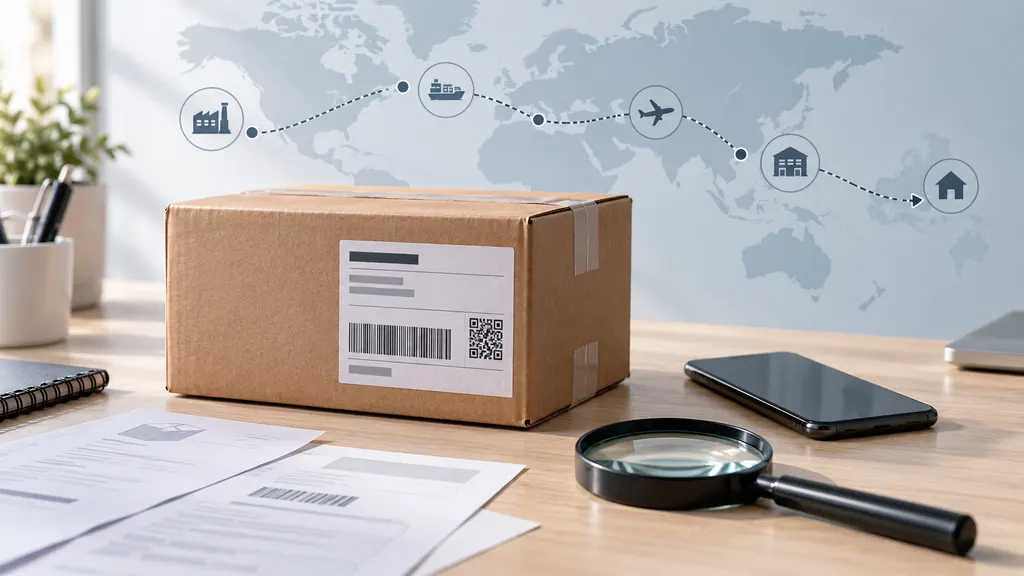
First-Mile Delivery: What It Is and How to Reduce Handoff Delays
First-mile delivery is the initial movement of goods from their origin into a logistics network. For an ecommerce seller, it usually means getting a packed order from a warehouse or fulfillment location into the carrier’s network. To reduce handoff delays, separate order preparation, physical collection, and carrier acceptance into measurable steps, then fix the specific step where parcels are waiting.

The practical challenge is that creating a shipping label, handing over a parcel, and seeing its first tracking scan are different events. Treating them as one milestone makes it harder to locate delays, assign responsibility, and give customers accurate updates.
Where the first mile begins and ends
The boundaries of the first mile depend on the supply chain being discussed. In procurement, it may describe movement from a supplier or production site to a warehouse. In outbound ecommerce fulfillment, it commonly describes movement from the seller’s fulfillment location to the carrier’s initial collection or processing point.
This guide focuses on outbound ecommerce shipments, where the people able to reduce handoff delays are warehouse managers, fulfillment teams, shipping coordinators, and carrier account contacts.
- First mile: the initial collection and movement into the delivery network.
- Middle mile: movement between facilities, such as transportation between sorting hubs.
- Last mile: movement from a local delivery facility to the recipient.
These are operational descriptions, not universal contractual boundaries. A carrier, consolidator, and fulfillment provider may define their responsibilities differently. For performance reporting, document your own start and end events rather than relying on the phrase “first mile” alone.
A useful starting point is to measure the time from parcel ready for collection to documented carrier receipt. Separately measure the time until the first visible acceptance or processing event. This keeps physical movement distinct from tracking visibility.
A shipping label is not proof of handoff
A tracking number can exist before a parcel leaves the warehouse. Electronic shipment information tells the carrier about an expected shipment; it does not, by itself, establish that the carrier has received the physical package.
UPS distinguishes “Label Created” from later movement statuses in its official tracking guidance. USPS also distinguishes pre-shipment information from possession-related events in its package-status guidance. These distinctions matter because a label-created timestamp is a poor substitute for a pickup record.
At the same time, a missing acceptance scan does not conclusively prove that a parcel remains with the seller. Tracking may not yet reflect a physical handoff. Diagnose the situation using more than the public tracking page:
- Was the parcel packed and staged before the collection cutoff?
- Does the warehouse have an actual departure or handover record?
- Does that record identify this parcel or only a larger batch?
- Has the carrier acknowledged receipt or reported a collection exception?
- Are other parcels from the same collection showing movement?
Editorial recommendation: use tracking to identify shipments that need investigation, and use handover evidence to establish custody. Neither a label nor a broad shipment manifest should automatically be treated as proof that every listed parcel was collected.
Find the waiting point before changing the process
“The carrier is slow” is not a useful diagnosis if the parcel missed collection because packing finished late. Likewise, changing warehouse labor will not resolve a recurring collection-capacity problem. Start with a simple event map.
| Observed gap | What to check | Lead action owner |
|---|---|---|
| Order released, parcel not ready | Stock availability, picking queues, packing capacity, address holds | Fulfillment team |
| Parcel ready, collection missed | Staging location, collection booking, vehicle capacity, dock access | Shipping coordinator and carrier contact |
| Collection recorded, no visible acceptance | Handover evidence, parcel reconciliation, carrier event timing | Shipping coordinator and carrier support |
| Carrier received parcel, processing stalled | Carrier exceptions, routing issues, shipment compliance | Carrier, supported by the shipper |
For cross-border shipments, check whether the initial collection is performed by a local transport provider or consolidator before the parcel reaches the carrier shown to the customer. An intermediary’s collection and the downstream carrier’s acceptance are separate handoffs. Record both when they exist.
How to reduce first-mile handoff delays
1. Work backward from the actual collection window
Set internal picking, packing, and staging deadlines around the collection arrangement for each service. An order cutoff advertised to customers is not the same as the latest safe packing time.
Allow room for the work that happens after packing: weighing, label checks, sorting, manifest preparation where required, and movement to the loading area. Use your observed processing times to set that allowance rather than applying an arbitrary universal buffer.
If orders regularly become ready after collection, decide whether to change the customer cutoff, release work earlier, rebalance staffing, or arrange a different collection. Printing labels sooner will not solve a physical readiness problem.
2. Define what “ready for collection” means
A parcel should enter the ready queue only when it is physically prepared for the intended service. A useful checklist includes:
- The correct items are packed and the package is sealed.
- The shipping address has passed the checks appropriate to the destination.
- The label is readable and attached to the correct parcel.
- Required shipment data and documents are complete.
- The parcel is in the correct carrier and service staging area.
Keep parcels awaiting corrections in a separate exception area. Otherwise, a dashboard can show a shipment as ready while warehouse staff are still resolving its address, packaging, or paperwork.
3. Make staging difficult to get wrong
Separate collections by carrier, service, and departure where appropriate. Clearly identify the relevant collection on each cage, pallet, container, or staging zone. Keep yesterday’s uncollected parcels visible rather than mixing them into today’s workload without an exception flag.
Check labels for damaged printing, poor placement, and conflicting old shipping labels. Follow the carrier’s packaging and labeling instructions for the service being used. These checks cannot guarantee immediate scanning, but they remove preventable obstacles to identification and processing.
4. Match collection capacity to the actual shipment mix
A parcel count alone may not describe collection needs. Bulky cartons, pallets, loading requirements, and access restrictions can affect whether a planned vehicle can take everything.
Share expected volume and handling requirements through the agreed booking process. For promotions or seasonal changes, confirm collection arrangements in advance rather than assuming the usual schedule can absorb the increase.
Maintain a fallback procedure for a missed or incomplete collection. Depending on the service agreement and local options, that could mean contacting dispatch, arranging another approved collection, or using an authorized drop-off location. Confirm acceptance conditions before sending staff with parcels.
5. Reconcile what was ready with what actually left
At each collection, compare the parcels staged for departure with the parcels handed over. Record the collection time, carrier or collection partner, relevant shipment identifiers, and any parcels left behind.
Where available, retain a carrier-issued receipt, collection acknowledgment, or other agreed evidence. Understand its scope: a signature acknowledging a container or parcel count may not confirm every tracking number inside it.
Do not assume that closing a manifest establishes physical custody. Treat manifest creation, warehouse departure, and carrier acknowledgment as separate events unless the specific process explicitly links them.
6. Give exceptions an owner and a next action
Review parcels that missed their planned collection and shipments that exceeded your expected interval to the first carrier event. Set review thresholds using service commitments, collection schedules, operating days, and your own shipment history. There is no single waiting period that fits every carrier and route.
Each exception needs a named owner, the last confirmed physical location, supporting evidence, the next action, and a follow-up time. Group exceptions by collection batch as well as tracking number: a whole batch without updates calls for a different investigation than one parcel missing from an otherwise moving batch.
Measure physical handoff and tracking visibility separately
A small set of clearly defined measures is more useful than a dashboard full of ambiguous shipping statuses.
- Ready-to-handover time: elapsed time from physical readiness to documented collection or drop-off.
- Handover-to-first-event time: elapsed time from documented handover to the first relevant carrier acceptance or processing event.
- Missed planned collection rate: eligible parcels that did not leave on their assigned collection, divided by all parcels assigned to that collection.
- Unresolved handoff exceptions: shipments still awaiting a confirmed location or corrective action beyond your internal review threshold.
Keep timestamp definitions consistent across systems and account for time zones. Do not substitute an order’s “fulfilled” status for physical readiness unless your workflow makes those events equivalent. If your data does not record a milestone, mark it as unknown instead of inferring it from label creation.
Compare performance by warehouse, carrier service, collection window, and shipment type. Review both typical performance and longer delays; an average alone can hide a recurring group of parcels that misses collection.
What to tell customers when tracking has not started
Customer messaging should describe the latest confirmed event. “Your shipping label has been created” is different from “Your parcel has been collected.” Avoid saying that the carrier has the package unless you have evidence of handover.
If collection is documented but tracking has not updated, explain that the parcel was handed over and that the tracking event is still pending. Give a next update point your team can meet, rather than promising a scan time outside your control.
If the parcel has not left the warehouse, acknowledge the dispatch delay and provide the next confirmed action. Clear communication does not remove the delay, but it prevents an internal processing milestone from becoming a misleading delivery promise.
FAQ
Does “label created” mean the carrier has my package?
No. It generally means shipment information has been created or sent electronically. Check for a later possession or movement event, and ask the seller to verify handover if the status remains unchanged beyond the expected dispatch window.
Can a package be moving without its first tracking scan?
Yes, a parcel may have been collected before a corresponding event becomes visible. However, that possibility is not proof of movement. A pickup acknowledgment and shipment reconciliation provide a stronger basis for investigation than an assumption about a missed scan.
Who is responsible for a first-mile delay?
The operational owner depends on where the delay occurred. The fulfillment team generally handles readiness and staging issues; the collection provider handles collection issues within its remit. Contractual liability is a separate question governed by the applicable agreement and circumstances.
How long should a seller wait before investigating?
Use the planned collection, the carrier’s relevant guidance, and the expected service schedule. Investigate a known missed pickup when it occurs rather than waiting for tracking to change. For parcels already handed over, apply a documented review threshold appropriate to the service and escalate with supporting records.
Can tracking software eliminate first-mile delays?
Tracking software can help surface missing events and organize follow-up, depending on its capabilities and the data received. It cannot pack a parcel, provide collection capacity, or establish custody merely by displaying a tracking number. Visibility supports the operational fix; it does not replace it.
Sources
The carrier references below support the distinction between electronic shipment information and physical shipment progress. The workflow and measurement recommendations above are operational guidance, not universal carrier requirements.
- UPS: Understanding Tracking Status — explanations of label creation and subsequent shipment statuses.
- USPS: Where Is My Package? — guidance on tracking messages, including pre-shipment and acceptance-related statuses.
- USPS Tracking: The Basics — explanation of tracking information and shipment updates.