How Long Does International Mail Take? Letters, Parcels, Customs and Tracking
International mail can take a few business days with an express service or several weeks with a slower option. There is no single delivery time for all letters and parcels: the service purchased, destination, customs requirements and local delivery network determine the useful estimate. Start with the postal operator’s estimate for the exact service and route, then check whether it is a delivery aim or a guaranteed commitment.
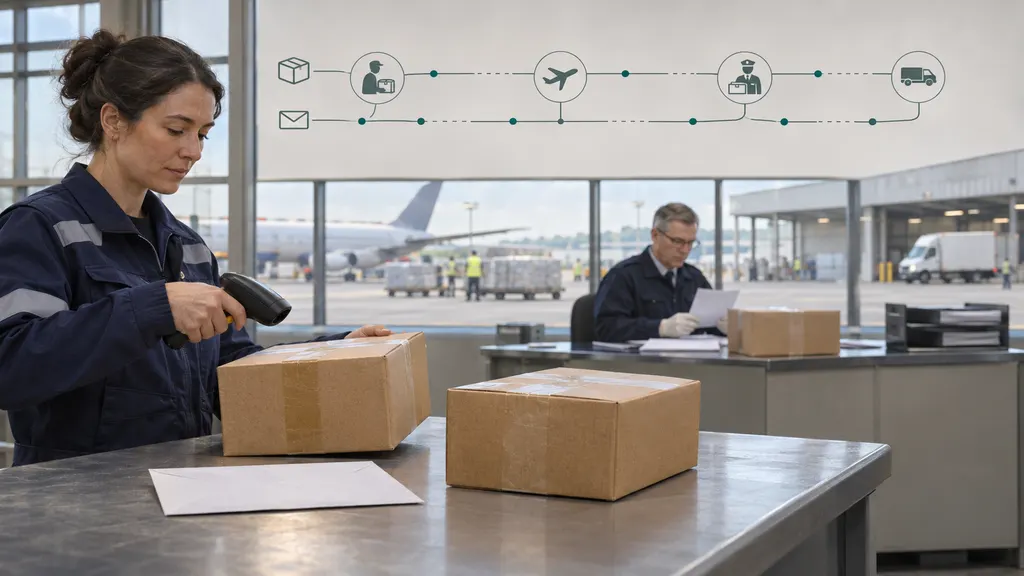
If you are waiting for an item already sent, the most useful details are its acceptance date, service name, destination and latest tracking event. A seller’s dispatch email or a shipping-label creation date alone does not establish when postal transit began.
What delivery times should you expect?
International delivery estimates belong to specific services, not to international mail as a whole. For example, USPS lists the following general delivery times for two outbound international parcel services. These are examples from one postal operator, not worldwide averages.
| Mail or service type | Timing guidance | How to interpret it |
|---|---|---|
| Ordinary international letters | Check the origin post’s destination-specific guidance. | There is no universal letter delivery window, and ordinary postage may not include tracking. |
| Economy or surface services, where offered | Use the named service’s published estimate. | Do not apply an air or express delivery estimate to a slower transport service. |
| USPS Priority Mail International | Generally 6–10 business days. | USPS notes that actual delivery can vary with origin, destination and customs delays. |
| USPS Priority Mail Express International | Generally 3–5 business days. | Check destination availability and any applicable guarantee terms rather than assuming every shipment has a guaranteed arrival date. |
The practical distinction is between an estimate and a guarantee. An estimate describes an expected delivery window. A guarantee applies only under the service’s stated conditions and exclusions. Neither should be treated as proof that a particular item will arrive on a particular day without checking the route and terms.
Before using any published timeframe, check current service alerts. Transport disruptions, suspended services and destination-specific restrictions can make a normal estimate unsuitable for a new shipment.
When does the delivery clock start?
For an online purchase, the order date, dispatch date and postal acceptance date may be different. A merchant might prepare a label before handing over the parcel. A collection partner may also move it before it reaches the postal operator whose service estimate you are reading.
Use a physical acceptance or collection event as the strongest practical starting point, while checking the service’s own rules. A status such as “label created” usually establishes that shipment information exists, not that the operator has possession.
Business days are not the same as calendar days. Weekends and public holidays may be excluded from a delivery estimate, even if a shipment moves during part of that period. Posting after a collection cutoff can also affect when processing begins. For a deadline-sensitive item, ask the postal operator to confirm the expected delivery date from the actual posting date rather than simply adding a number to today’s date.
Why letters and parcels can take different amounts of time
Ordinary letters may have little or no tracking
A document letter can be simpler to prepare than a parcel containing goods, but that does not make every letter faster. Routing and service class still matter. Ordinary international letter postage may provide no item-level tracking, so an absence of updates does not itself indicate a delay.
If you need proof of posting, a signature or delivery visibility, check what the selected letter service actually includes. Registered, tracked and signed services are not interchangeable, and their features can differ by destination. Adding registration or a signature requirement does not automatically turn a letter into an express shipment.
Parcels containing goods need additional information
International parcels containing merchandise commonly require customs information. Missing or inconsistent descriptions, values or recipient details can create questions that must be resolved before delivery proceeds. A shipment marked as a gift is not automatically exempt from destination import rules.
The contents matter more than the packaging label. Putting merchandise in an envelope does not necessarily make it eligible for document-only treatment. Before posting, confirm how the operator classifies the contents and which declarations are required.
For either letters or parcels, choose the service around the consequence of late arrival. A flexible personal mailing and an original document needed for an appointment have different risk profiles. For irreplaceable documents, confirm that the service accepts them and review the available proof, delivery and compensation terms.
How customs affects international mail delivery
There is no dependable universal customs clearance time. A shipment may be released without a request to the recipient, or it may need inspection, valuation checks, payment or supporting documents. Customs release and final delivery are also separate steps: an item can be cleared but still need sorting and transport within the destination country.
For U.S.-bound purchases, U.S. Customs and Border Protection explains that imported goods can be subject to duties and other import requirements. Other destinations apply their own rules. Do not assume that a tax threshold or exemption described for one country applies elsewhere.
If tracking indicates a customs-related hold, first determine whether anyone needs to act:
- Payment requested: Verify the request through the postal operator’s or authorized delivery provider’s official website before paying.
- Documents requested: Provide the specific invoice, proof of payment or other information requested through the official channel.
- Inspection or processing only: Check for instructions, but do not assume that every processing event requires a response.
- Restriction or return notice: Contact the sender and operator to understand the stated reason and available next steps.
The sender is usually best placed to clarify the original declaration or invoice. The recipient may need to provide local import information or settle a legitimate charge. A tracking tool can help reveal a status change, but it cannot release a shipment from customs or override an import decision.
What international tracking can—and cannot—tell you
International mail may pass between an origin postal operator, transport partners and a destination postal operator. Tracking is a record of reported events, not a continuous location signal. A gap between scans can mean the item is moving between facilities or waiting for its next recorded step; it does not prove either movement or loss.
Check the original operator’s website first. Once the shipment reaches the destination network, check the destination post as well. Its tracking page may provide more useful local information, such as an attempted delivery, collection location or delivery instruction.
For a consolidated view, international tracking through 17TRACK can help you check supported postal and carrier tracking numbers. Use the underlying operator’s notices for actions such as payment, collection, redelivery or a formal inquiry. A tracking platform cannot create missing carrier scans or make an untracked letter trackable.
| Tracking event | What it generally indicates | Useful next step |
|---|---|---|
| Label created or information received | Electronic shipment details exist; physical acceptance may not yet be confirmed. | Ask the sender when the item was handed over. |
| Departed an outward facility | The item has completed a reported origin-side processing step. | Do not treat this alone as proof of a specific flight departure or destination arrival. |
| Presented to customs | The item is in a customs-related processing stage. | Look for a specific request rather than assuming payment is due. |
| Released from customs | A customs release event has been recorded. | Watch for destination sorting and delivery updates. |
| Attempted delivery or available for collection | Local delivery action may be needed. | Check the official notice promptly for collection or redelivery instructions. |
Status wording varies between operators. Read the event’s date, location and full description together rather than relying only on a broad label such as “in transit.”
What to do if international mail is late
Do not use an arbitrary number of days without scans as a universal lost-mail threshold. A shipment can be outside its expected delivery window without meeting the operator’s formal inquiry or claim requirements.
- Confirm the service and acceptance date. Ask for the posting receipt or acceptance record if the only evidence is a seller’s dispatch message.
- Check the correct delivery estimate. Use the named service and destination, allowing for the applicable business-day calculation and published alerts.
- Read the latest detailed event. Check for customs requests, address problems, delivery attempts or collection notices.
- Check both postal networks. The destination operator may have local information that is not obvious on the origin operator’s page.
- Contact the right party. Ask the sender about handover or declaration issues; ask the destination operator about a local delivery attempt or collection instruction.
- Start an inquiry when eligible. Follow the origin operator’s process. Eligibility, filing windows and who may initiate the inquiry depend on the service.
- Preserve your purchase protections. For an online order, check the retailer’s or marketplace’s non-delivery procedure and deadlines separately from the postal inquiry.
Keep the tracking number, posting receipt, order invoice, contents description and relevant correspondence together. An inquiry investigates the shipment; a compensation claim is a separate process with its own conditions. USPS, for example, publishes service-specific international inquiry and claim requirements rather than one rule for every international item.
How to plan an international mailing with less uncertainty
If arrival timing matters, choose the service before choosing the postage price. Confirm the destination estimate, tracking availability, any delivery commitment and what happens if the recipient is unavailable. A cheaper service with limited visibility may be reasonable for a flexible mailing, but it is a poor fit when you need to verify each stage or meet a fixed deadline.
Prepare the address in the destination’s accepted format, include any required postal code and supply accurate contact details where requested. For goods, use a specific contents description and an accurate value. Check restrictions before posting rather than hoping a declaration will resolve an eligibility problem later.
For a purchase, ask the seller two separate questions: when will the order be handed over, and which shipping service will be used? This separates order preparation from transit and makes the promised delivery window easier to assess.
FAQ
Can an international letter arrive faster than a parcel?
Yes, but not simply because it is lighter. A letter sent using a faster service may arrive before an economy parcel, while an ordinary letter may arrive after an express parcel. Compare service classes and route estimates, not just item size.
Does “in transit” mean my mail is on a plane?
No. It is a broad status that can cover several processing and transport stages. It does not, by itself, confirm that an item has boarded an aircraft, left the origin country or cleared customs.
Why does my tracking number stop updating after leaving the country?
Possible reasons include a gap between handling scans, a handover between postal networks or limited tracking for the purchased service. Check the destination post’s website and the service’s tracking conditions. A tracking gap alone cannot establish that the item is lost.
Can I add tracking to an ordinary letter after posting it?
Generally, you cannot turn an already-posted untracked letter into a tracked shipment. A receipt reference is not necessarily a tracking number. For future mailings, select a service that explicitly includes the visibility or delivery proof you need.
Should I contact customs or the postal operator first?
For a general delay with no specific customs request, start with the postal operator or sender. If an official notice identifies a customs agency, broker or delivery provider and gives instructions, follow that verified channel. Avoid sending payment or personal documents through an unsolicited link.
Does a missed estimate mean I can claim a refund?
Not automatically. An estimated delivery window is different from a money-back guarantee, and compensation for loss is different from a postage refund for delay. Check the purchased service’s guarantee, exclusions, evidence requirements and filing deadlines.
Sources
- USPS: Priority Mail International — published delivery guidance and service conditions.
- USPS: Priority Mail Express International — published delivery guidance and destination-dependent service terms.
- USPS: First-Class Mail International — international letter service and mailing requirements.
- USPS: International inquiries and claims — service-specific inquiry procedures and claim requirements.
- U.S. Customs and Border Protection: Internet purchases — U.S. import responsibilities and customs considerations.
- 17TRACK: Shipment tracking — tracking-number lookup for supported carriers.