How to Ship Instruments Internationally: Packing, Customs, and Cites Wood Rules
To ship a musical instrument internationally, protect it against movement and climate changes, prepare accurate customs documents, and verify whether any wood or animal-derived material is regulated. The most important distinction is that CITES rules apply to certain protected species and specimens, not to every wooden instrument. Separate rules may also apply to solid-wood crates, pallets, plant material, ivory, shell, leather, batteries, and other components.
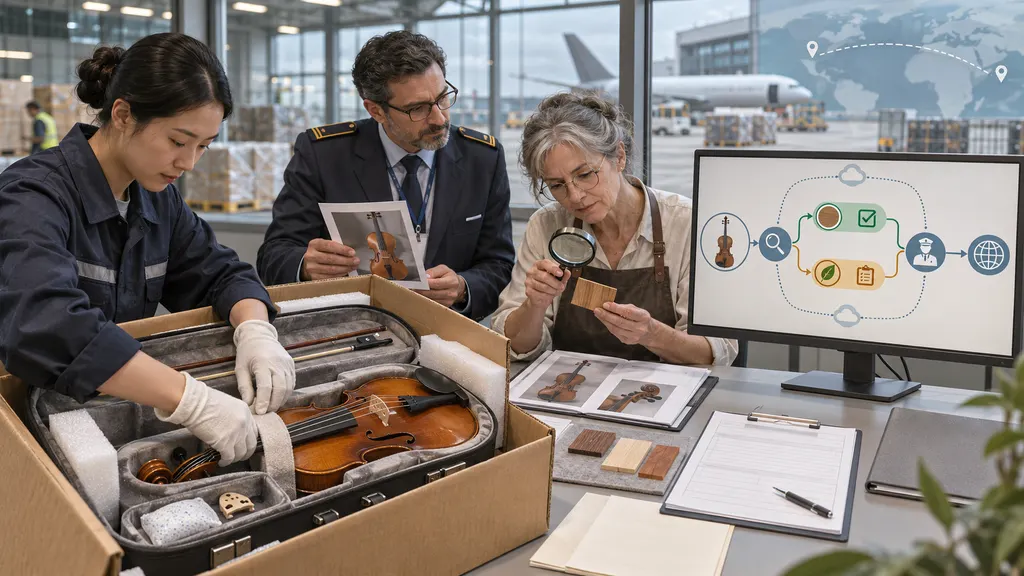
The shipper, exporter, or designated customs representative is responsible for confirming the requirements in both the export country and the destination country. A carrier can transport an eligible package, but it generally cannot replace the permits, declarations, or import approvals required by border authorities.
1. Identify the instrument and every regulated material
Start with a detailed description of the instrument rather than a generic label such as “wooden item” or “music equipment.” Record the instrument type, maker, model, serial number, approximate age, materials, country of manufacture if known, and reason for shipment.
Inspect the instrument and its case for materials that can affect customs clearance:
- Solid wood used in the body, neck, fingerboard, bridge, bow, keys, or decorative parts.
- Wood species that may be listed under the Convention on International Trade in Endangered Species of Wild Fauna and Flora, commonly called CITES.
- Ivory, tortoiseshell, mother-of-pearl, certain reptile skins, or other animal-derived materials.
- Electronic components, removable batteries, or accessories that may have separate transport restrictions.
- Solid-wood crates, braces, pallets, or dunnage used to protect the shipment.
Do not identify a species from appearance alone when the answer affects export or import authorization. A luthier, manufacturer, qualified appraiser, or relevant national authority may be needed to confirm the material. Keep photographs and any supporting records, including an original invoice, certificate of authenticity, repair documentation, or manufacturer statement.
2. Understand what CITES does—and does not—cover
CITES controls international trade in specimens of species listed in its Appendices. A wooden instrument is not automatically a CITES shipment simply because it is made of wood. The requirement depends on the actual species, the relevant listing, the amount and form of the material, the countries involved, and the purpose of the movement.
Some musical instruments have historically included protected timber or animal-derived materials. The same instrument may therefore require a different process from an instrument made with common, documented materials. A species can also be subject to listing annotations or country-specific implementation rules, so a broad statement such as “rosewood is always prohibited” or “personal instruments never need permits” is unsafe.
Before booking the shipment, determine:
- The scientific name of each potentially regulated species.
- Whether that species is listed in the CITES Appendices or controlled under a national rule.
- Whether the material is covered by an applicable annotation, exemption, or finished-product provision.
- Whether the movement is a sale, gift, repair, loan, exhibition, return, or temporary personal movement.
- Whether the exporter and importer need permits, a certificate, or another form of authorization.
Use the CITES Management Authority in the exporting country and the relevant authority in the destination country as the final decision-makers. CITES permits are normally issued by national authorities, not by the carrier. Apply well before dispatch because an application may require proof of legal acquisition, species identification, ownership records, and details about the shipment.
3. Do not confuse CITES documents with customs documents
A CITES permit or certificate addresses protected-species controls. It does not replace a commercial invoice, export declaration, import declaration, or other customs paperwork. Customs authorities still need to understand what the item is, who owns it, what it is worth, and why it is moving across the border.
A practical document pack may include:
- A commercial invoice for a sale, or a pro forma invoice for a non-sale movement when accepted by the destination process.
- A precise description, quantity, declared value, currency, country of origin, and reason for export.
- The instrument’s make, model, serial number, and condition.
- The correct Harmonized System classification, confirmed with a broker or customs authority where necessary.
- Export and import permits or certificates for regulated species, if required.
- Evidence of ownership, legal acquisition, or prior importation where relevant.
- Repair, loan, exhibition, or temporary-export documentation when the instrument is not being sold.
- Any required certificate of origin, import license, or tax documentation.
Use a realistic customs value even when the instrument is used, gifted, or being returned. “No commercial value” does not necessarily mean “zero customs value.” A customs authority may assess duties or taxes using its own valuation rules, and a low or vague declaration can create delays, reassessment, or penalties.
4. Temporary travel is different from a permanent shipment
Musicians who travel with an instrument for a concert, tour, competition, recording session, or exhibition may have a different customs objective from a seller sending an instrument to a buyer. The instrument may need to return to its original country rather than enter the destination market permanently.
An ATA Carnet can be relevant for some temporary movements of professional equipment, but eligibility and acceptance depend on the countries, the goods, and the purpose of travel. A CITES document, when required, is a separate issue. Do not assume that a carnet removes a species-control requirement.
For repeated international travel, ask the national customs and CITES authorities whether a specific certificate for musical instruments or personal effects is available. Carry the original documents with the instrument and keep digital copies separately. Border officials may need to match the document to the instrument’s serial number, description, and materials.
5. Pack the instrument for shock, pressure, and climate changes
Good packing protects both the instrument and the paperwork. A hard case is usually a better starting point than a soft bag, but the case should not be allowed to move freely inside the outer carton or crate.
Prepare the instrument
- Photograph the instrument, case, serial number, and visible condition before packing.
- Remove loose accessories that can move and cause impact damage.
- Secure keys, bridges, bows, detachable necks, pedals, or other fragile parts according to the maker’s guidance.
- Reduce string tension only when appropriate for the instrument and recommended by a qualified technician; excessive adjustment can also cause damage.
- For electronic instruments, remove batteries when the manufacturer and transport rules allow it, and pack spare batteries separately as required.
- Use clean, non-abrasive materials that will not transfer moisture, dye, or residue to the finish.
Pack the case and outer container
Fill empty spaces inside the case with suitable cushioning so that the instrument cannot shift, but avoid compressing delicate surfaces. Wrap the closed case with shock-absorbing material and place it in a strong double-wall carton or a purpose-built crate with clearance on all sides. The outer container should not bear directly on the instrument.
For high-value or unusually shaped instruments, use a professional packing service familiar with musical equipment. A custom crate may be appropriate, but a crate made from solid wood introduces separate wood-packaging considerations. Ask the packer whether plywood or another processed material can meet the protection requirement while reducing the risk associated with untreated solid wood.
6. Apply the correct wood-packaging rules
ISPM 15 is an international standard for wood packaging material, including many solid-wood pallets, crates, cases, skids, and dunnage used in international trade. It is not a blanket rule that every wooden product, including every guitar or violin, must carry an ISPM 15 mark.
When solid wood is used as packaging, the destination country may require treatment and an official mark showing that the material complies with the applicable standard. The exact enforcement process is set by the importing country. Plywood and other processed wood products may be treated differently, but the material and construction should be confirmed before packing.
Do not place an unofficial stamp on a crate or assume that a heat-treatment claim is enough. Use a packaging supplier that can provide compliant material and documentation where required. If a shipment arrives with non-compliant wood packaging, authorities may order treatment, removal, re-export, or destruction of the packaging, depending on local rules.
7. Choose the transport service around the instrument’s risk
Compare services using more than transit time. Ask whether the provider accepts the instrument’s size, value, battery configuration, and destination; whether it offers collection and delivery records; and how it handles customs documentation.
For valuable instruments, check the carrier’s liability limits and exclusions before purchase. A standard shipment charge does not necessarily provide full-value protection. Insurance may require professional packing, proof of value, photographs, and a claim made within a specific period. Some policies exclude scratches, changes caused by humidity, inherent vice, or inadequate packing.
Use tracking to monitor acceptance, export clearance, arrival, import inspection, and final delivery. Tracking can show that a parcel is delayed, but it does not itself clear a CITES or customs issue. If the status indicates a documentation hold, contact the carrier’s customs team and provide the requested records promptly.
8. A practical pre-shipment checklist
- Identify all materials, including wood species and animal-derived components.
- Confirm the instrument’s value, serial number, ownership, and purpose of movement.
- Check CITES and national import rules with the authorities in both countries.
- Obtain required permits or certificates before handing the shipment to a carrier.
- Confirm the HS classification and prepare a complete invoice or accepted equivalent.
- Check whether the outer crate, pallet, or dunnage is subject to ISPM 15 requirements.
- Confirm carrier acceptance, insurance terms, size limits, and battery rules.
- Photograph the packed instrument and keep copies of all documents.
- Place document copies where the customs broker can access them, while retaining originals when required.
- Track the shipment and respond quickly to any customs or carrier request.
Common mistakes to avoid
- Calling the contents “wooden goods” without identifying the instrument or species.
- Assuming a used instrument has no customs value.
- Sending a potentially CITES-listed instrument before the permit is issued.
- Confusing a CITES certificate with an export declaration or certificate of origin.
- Using an untreated solid-wood crate without checking the destination’s packaging rules.
- Relying on a retailer’s old paperwork when the instrument has changed ownership or country.
- Underinsuring the shipment or ignoring exclusions for poor packing and climate-related damage.
- Assuming that a carrier’s tracking status proves customs compliance.
FAQ
Does every wooden musical instrument need a CITES permit?
No. CITES applies to specimens of listed species and to the conditions defined by the relevant rules. A wooden instrument made from a non-listed species may not need a CITES document, while an instrument containing a listed material may require authorization. Confirm the species and route with the responsible authorities.
Can I ship a guitar or violin with rosewood without paperwork?
Do not rely on the common name alone. Requirements can depend on the scientific species, the amount and form of the material, the countries involved, and whether the movement is temporary or commercial. Obtain a documented determination before shipping.
Does ISPM 15 apply to the instrument itself?
ISPM 15 primarily concerns regulated solid-wood packaging material such as crates, pallets, and dunnage. It should not automatically be interpreted as a requirement for every wooden instrument. The destination’s plant-health authority can confirm whether a particular packaging material is exempt or must be treated and marked.
What should I declare if the instrument is a gift or is being sent for repair?
Describe the instrument accurately, state the true reason for the movement, and declare a defensible value in the required currency. A gift or repair shipment may still be subject to customs procedures, taxes, valuation rules, and species controls.
Can an ATA Carnet replace a CITES permit?
Not necessarily. A carnet may support temporary customs admission for eligible goods, while CITES controls protected species. When both systems apply, separate documents or approvals may be required.
Who should make the final decision about a regulated instrument?
The relevant CITES Management Authority, customs authority, plant-health authority, and—where needed—the carrier or customs broker. Ask before dispatch and retain written guidance when the material or route is uncertain.
Sources
- CITES, “What is CITES?”
- CITES, permits and certificates information
- CITES, national authorities and country information
- USDA APHIS, wood packaging material
- International Plant Protection Convention, ISPM standards
- U.S. Customs and Border Protection, importer and exporter guidance
- World Customs Organization, Harmonized System overview