How to Help International Customers Choose the Right Size before Ordering
The most reliable way to help international customers choose the right size is to show a measurement-based size guide before checkout, explain how to measure, support the units and sizing conventions your customers use, and describe the garment’s fit in plain English. A country-to-country conversion chart can be useful as a starting point, but it should not replace measurements because size labels and grading systems vary between brands and products.
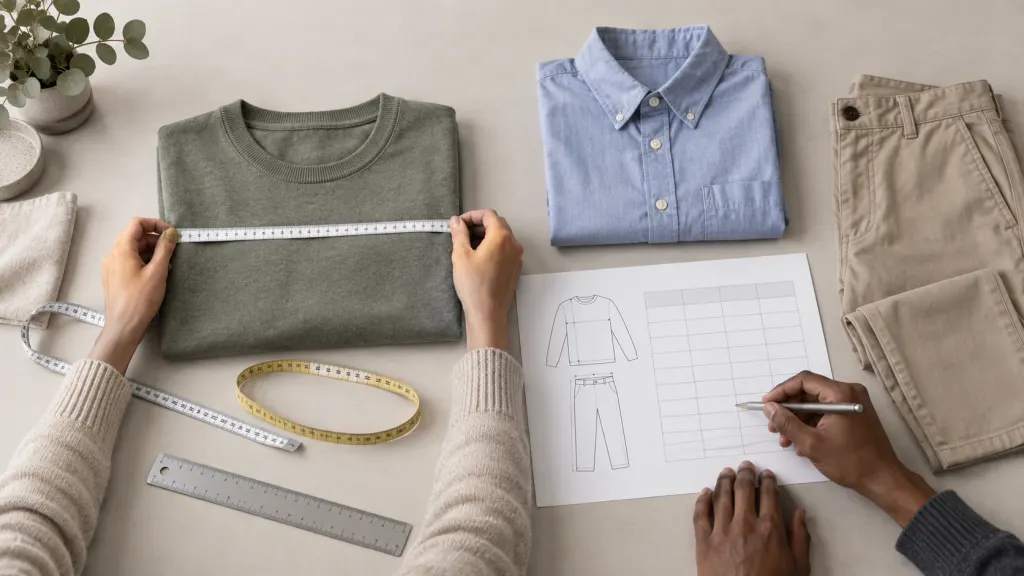
For cross-border sellers, this is both a customer-experience task and an operations task. A clearer size-selection process can reduce uncertainty before purchase, while accurate fit information gives customers a more realistic expectation of what they will receive. It cannot eliminate returns, but it can help prevent avoidable size-related orders and make customer support more effective.
Why international sizing creates confusion
The same letter or number does not guarantee the same physical dimensions across countries, brands, product categories, or collections. A “medium” may be cut differently for a fitted shirt, an oversized sweatshirt, and a pair of trousers. Even when a seller offers a US, UK, EU, or Asian conversion, the conversion may describe a general market convention rather than the exact measurements of that product.
Customers may also use different measurement systems. Some shoppers are familiar with centimeters, while others expect inches. A customer who normally buys by waist size may not know whether a product’s listed waist measurement refers to the wearer’s body or the garment measured flat. These ambiguities are often more damaging than the absence of a conversion table.
Build a product-specific size guide
A useful size guide should describe the item being sold, not only the label attached to it. Create a separate guide when measurements or fit differ materially between product types, collections, or cuts.
Include the measurements customers actually need
The right measurements depend on the product. A top may require chest or bust, waist, shoulder, sleeve, and body length. Trousers may require waist, hip, inseam, rise, and outseam. Shoes generally need foot length and sometimes width. Do not add measurements that you cannot define or measure consistently.
State whether each number describes the customer’s body or the finished garment. If you measure the garment, explain the method. For example, a flat garment measurement should not be presented as the same thing as a body circumference.
| Product type | Measurements customers may need | Useful fit information |
|---|---|---|
| Tops and dresses | Bust or chest, waist, hip, shoulder, sleeve, and length | Fitted, regular, relaxed, oversized, stretch, and intended ease |
| Trousers and skirts | Waist, hip, rise, inseam, and garment length | High, mid, or low rise; stretch; straight, slim, wide, or relaxed cut |
| Shoes | Foot length and, where relevant, foot width | Narrow or wide fit, toe-box shape, and whether the item runs differently from the seller’s usual fit |
| Rings and accessories | Finger circumference, internal diameter, or relevant body measurement | Adjustability, intended position, and measuring conditions |
Show a clear measurement method
Use short instructions supported by an image or diagram when possible. Tell customers to use a flexible tape measure, keep it level where appropriate, and avoid pulling it tightly. For garments, tell them whether they should measure their body or compare the chart with a similar item that fits well. For shoes, explain whether the measurement is taken from the heel to the longest toe and whether both feet should be checked.
A measurement guide should also say what to do when a customer falls between sizes. The answer depends on the product. Customers may choose the larger size for a non-stretch garment that needs room, but that is not a universal rule. Give product-specific advice and mention whether the item is designed to be close-fitting or loose.
Use conversions carefully
Place body or product measurements at the center of the guide, then add local size labels and approximate conversions if they genuinely help. Label conversions clearly as approximate rather than treating them as an exact interchangeability system.
Avoid presenting one global conversion table for every product. A conversion that works reasonably well for one category may mislead customers in another. If your catalog includes different brands or suppliers, keep each brand’s original measurements and explain any known differences instead of forcing all items into one standardized chart.
Offer both centimeters and inches where your customer base justifies it. Keep the values consistent after rounding, and check that the unit label is visible on mobile. Do not rely on a customer to infer whether a number is in centimeters or inches.
Make fit information part of the buying decision
Numbers answer only part of the sizing question. Add concise fit notes near the size selector and repeat them on the product page, rather than hiding them in a general help center.
- Cut: Explain whether the item is slim, regular, relaxed, oversized, or designed for a particular silhouette.
- Fabric: State whether the material has stretch, structure, or limited give.
- Construction: Mention adjustable waists, elastic panels, removable insoles, or other features that affect fit.
- Model or product reference: If you provide a model’s measurements and worn size, make sure the information is accurate for that specific image and product.
- Variation: Note that handmade, washed, knitted, or natural-fiber products may have limited measurement variation where that is relevant.
Avoid vague statements such as “true to size” unless your store defines what that means. “True to size” does not tell an international customer which measurement to compare or how the product is intended to fit.
Design the size-selection experience for international shoppers
Ask for the shopper’s market only when it improves clarity
A country selector can display familiar labels, but it should not hide the underlying measurements. If you use a recommended local size, explain the basis for the recommendation and let customers switch units or sizing systems. Do not infer a customer’s size from country alone; body proportions, brand preferences, and product fit still matter.
Keep the guide close to the size selector
Customers should be able to open the guide without losing their product choices. On mobile, use a readable panel or expandable section with large unit labels and enough spacing. Test the guide on the same device types used by your international customers, because a chart that is readable on desktop may be difficult to use on a narrow screen.
Make the content accessible and easy to translate
Use descriptive labels, plain language, sufficient contrast, and text alternatives for essential instructions in images. Avoid idioms and abbreviations that translate poorly. If you localize the guide, have the translated terminology reviewed by someone familiar with apparel or footwear sizing in that market. Keep measurement units and decimal formatting consistent with the displayed market.
Connect sizing guidance with returns and customer support
A size guide should not promise that every customer will select correctly. Instead, make the next step clear when uncertainty remains. Explain which measurements support a recommendation, whether customers can contact support before ordering, and what the applicable return or exchange conditions are.
Train support agents to ask for the same information used by the size guide. A useful response may request body measurements, the customer’s preferred fit, the product style, and the size they usually wear in a comparable item. Avoid recommending a size solely from a customer’s height or weight unless your business has a documented method that supports that recommendation.
Review size-related returns by product, supplier, market, and selected size. A high return rate may reflect inaccurate product measurements, inconsistent grading, unclear fit descriptions, or a genuine mismatch between the product and its intended audience. Return data can identify where the guide needs improvement, but it should be interpreted alongside customer messages and product-level checks.
A practical pre-order checklist
- Measure the actual product or obtain a reliable measurement specification for every size offered.
- Decide whether the chart uses body measurements, garment measurements, or both.
- Add centimeters and inches where appropriate, with visible unit labels.
- Explain the measurement method and what to do between sizes.
- Describe fit, stretch, cut, and any product-specific exceptions.
- Use local labels or approximate conversions only as supporting information.
- Place the guide beside the size selector and test it on mobile.
- Make pre-order support and return or exchange information easy to find.
- Compare product measurements with actual size-related returns and update the guide when evidence supports a change.
FAQ
Should an international store use one universal size chart?
Usually not. A universal chart can hide differences between products, brands, and cuts. Use product-specific measurements, then add carefully labeled local conversions when they are useful.
Are US, UK, and EU size conversions exact?
No. They are commonly used reference systems, but labels can vary by product category, brand, and market. Customers should compare measurements rather than relying only on a converted label.
Should a seller show body measurements or garment measurements?
That depends on the product and the customer’s decision process. Body measurements can help customers choose a size, while garment measurements help them compare the item with clothing they already own. If both are shown, label them distinctly and explain how each was taken.
What should customers do if they are between sizes?
Follow the product-specific recommendation. Consider the garment’s stretch, cut, intended ease, and the customer’s preferred fit. There is no single larger-size or smaller-size rule that applies to every product.
Can a size guide eliminate international returns?
No. It can reduce uncertainty and help customers make a better-informed choice, but fit is personal and measurements may vary. A clear returns policy and responsive pre-order support remain necessary.
Sources
- ISO 8559-1:2017, Size designation of clothes — Part 1: Anthropometric definitions for body measurement — reference for standardized concepts and terminology related to body measurements.
- Regulation (EU) No 1007/2011 on textile fibre names and related labelling — official European Union text relevant to textile product information and labeling obligations.
- Google Merchant Center: Size [size] — guidance on submitting apparel and footwear size information for product listings.
- W3C Web Content Accessibility Guidelines: Non-text Contrast — accessibility guidance relevant to charts, controls, and visual sizing instructions.