How Overseas Warehouses Can Use Tracking APIs to Monitor Local Deliveries
Overseas warehouses can use tracking APIs to monitor local deliveries by connecting each outbound parcel to its carrier and tracking number, bringing tracking events into their warehouse or order management system, and turning delivery exceptions into assigned tasks. The most useful setup distinguishes label creation from carrier acceptance, preserves shipment history, and tells operations teams which parcels need action—not simply which parcels have a new status.
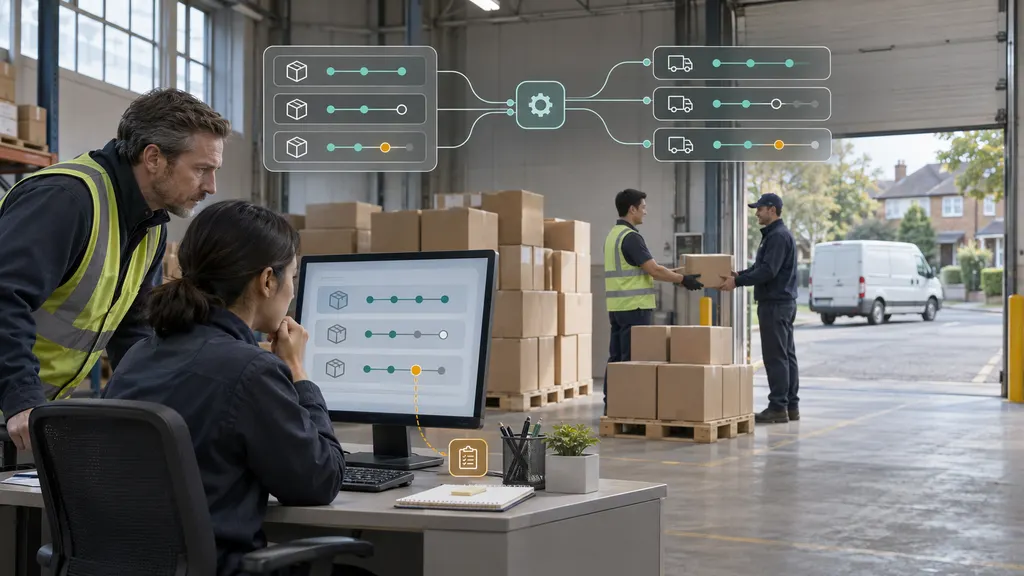
This guide focuses on warehouses holding inventory outside a merchant’s home market and dispatching orders to customers in that destination market. For these teams, overseas tracking needs to connect warehouse dispatch records with the local carrier’s delivery journey. That connection helps warehouse managers, transport coordinators, and merchant support teams work from the same shipment record.
Define where warehouse visibility ends and carrier visibility begins
A warehouse management system can record that an order was picked, packed, labeled, and placed in a dispatch area. Those records do not, by themselves, prove that the carrier accepted the parcel. A tracking API adds carrier-reported events, but it cannot replace a warehouse handover record or create a physical scan that never occurred.
Keep three milestones separate: ready for collection, handed over according to the warehouse’s records, and accepted according to the carrier’s tracking events. This separation makes it easier to investigate parcels that appear dispatched internally but have no carrier movement.
For example, if a parcel appears on a collection manifest but has no acceptance event, the next step is to check loading records and contact the collection carrier. It is premature to classify the parcel as lost. If the carrier has already reported an unsuccessful delivery attempt, the appropriate action is different: investigate the reason and coordinate the next step with the merchant or authorized recipient contact.
Build the shipment record before connecting the API
The foundation is a reliable relationship between the customer order, the physical parcel, and the carrier tracking identifier. Do not use an order number as a substitute for a parcel identifier. One order may leave the warehouse in several packages, and a replacement shipment needs its own record.
| Record | Recommended fields | Operational purpose |
|---|---|---|
| Shipment identity | Internal shipment ID, order ID, parcel ID, merchant account | Keep split shipments and different clients separate. |
| Carrier identity | Carrier identifier, tracking number, service where known | Submit the correct tracking request and route investigations. |
| Warehouse handover | Warehouse, dispatch time, collection reference, manifest reference | Compare physical dispatch evidence with carrier events. |
| Tracking history | Raw event, mapped status, event time, receipt time, location when supplied | Preserve evidence and distinguish event timing from reporting delays. |
| Exception workflow | Issue type, owner, next action, review deadline, resolution | Turn tracking information into accountable work. |
Store tracking numbers as text so formatting is preserved. Where the warehouse already knows the carrier from label generation, pass that identity through the integration rather than relying solely on number recognition. Also retain relationships between original, replacement, return, and onward-delivery parcels without overwriting their individual histories.
Choose an integration that fits the warehouse’s carrier mix
A warehouse can integrate directly with its carriers or use a multi-carrier tracking API. Direct integration may be practical for a stable operation using a small number of carriers, particularly when it requires carrier-specific data. A multi-carrier API is worth evaluating when the warehouse needs a shared tracking interface across several delivery networks.
17TRACK’s Tracking API is a relevant option for this integration model. Use its official API documentation to assess how shipment registration, tracking retrieval, and tracking updates would fit your system. Confirm the exact carrier and service combinations used by each warehouse rather than treating general carrier availability as proof that every required event will be returned.
Evaluate the connection against actual operational requirements:
- Can your system reliably register the parcels generated during dispatch peaks?
- Which events are returned for the local delivery services you actually buy?
- How are unsuccessful requests, duplicate registrations, and invalid carrier identifiers handled?
- How are updates delivered or retrieved, and how can missed updates be reconciled?
- What usage limits, retention terms, security controls, and commercial conditions apply to your account?
A tracking connection should not be assumed to include label purchasing, address correction, delivery rescheduling, or claims submission. Treat those as separate workflows unless the relevant product documentation explicitly confirms otherwise.
Connect dispatch, tracking updates, and exception handling
1. Register parcels at a controlled dispatch milestone
Choose a consistent registration trigger, such as label confirmation or dispatch confirmation. Registering at label creation can expose parcels that remain uncollected, but it also requires handling canceled labels. Registering only after dispatch reduces unused registrations but can hide the interval between label creation and physical handover.
Whichever trigger you choose, save the registration result against the parcel. Failed registrations should enter a retry or correction queue rather than disappear into application logs. Use a stable internal identifier to prevent repeated processing from creating duplicate business records.
2. Receive updates without making the dashboard the source of truth
Depending on the API’s documented options, updates may be retrieved through requests or received through webhook notifications. A webhook is a message sent to your system when the provider has an update; polling means your system requests the information.
For webhook-based implementations, validate incoming messages using the provider’s documented verification method. Save accepted messages durably before acknowledging them, then process them asynchronously. Design for duplicate messages and events that arrive out of sequence. Follow the documented response and retry requirements rather than assuming every provider behaves identically.
For polling, prioritize active shipments and unresolved exceptions while staying within applicable usage limits. Where supported, use reconciliation requests to check shipments whose update history appears incomplete. Record ingestion failures separately from carrier delivery exceptions: a broken connection is not evidence that a parcel has stopped moving.
3. Normalize statuses while preserving the original evidence
Create a small set of operational categories, such as awaiting acceptance, in transit, out for delivery, delivery attempted, delivered, and return movement. These are suggested warehouse categories, not a promise that every carrier supplies matching events.
Preserve the original description alongside the mapped category. “Available for collection” should not silently become “delivered,” and “return initiated” should not become “received back at warehouse.” Allow an unknown or unmapped state so unfamiliar events remain visible for review.
Store both the event timestamp and the time your system received it. Preserve the original timezone or offset when supplied, and use a consistent internal time standard. A late-arriving event should not automatically move a shipment backward simply because it was received last; apply explicit sequencing rules and retain the history.
4. Assign action owners to exceptions
An alert is useful only when someone can act on it. Route missing acceptance scans to the warehouse dispatch team, delivery attempts requiring recipient input to the merchant’s support team, and persistent carrier movement issues to the transport coordinator. These are recommended starting points; responsibilities should reflect the warehouse’s contracts and operating model.
Attach the tracking history, handover reference, last event, investigation notes, and next review time to each case. Group repeated alerts under the same open issue so one stalled parcel does not generate a fresh task after every synchronization.
Set alerts around service expectations, not arbitrary timers
There is no universal interval after which a parcel with no new scan becomes late or lost. Configure alert thresholds around the carrier service, collection schedule, operating days, destination, and merchant commitment. Keep an internal investigation threshold separate from a customer-facing delivery promise.
- No acceptance after handover: Check the collection record and carrier acknowledgment before escalating.
- No movement beyond the expected interval: Review the last event, service expectations, and known operating interruptions.
- Unsuccessful delivery attempt: Read the reason before deciding whether the next action belongs to the carrier, merchant, or recipient.
- Return movement: Prepare the returns workflow, but do not increase sellable inventory until physical receipt and required inspection.
- Delivered but disputed: Open an investigation and seek available delivery evidence; do not treat the status alone as resolution of the complaint.
Tracking reflects reported shipment events, not continuous parcel location. Showing a last-update timestamp helps staff understand the freshness of the information without implying live GPS visibility.
Give each team a usable view
Warehouse supervisors need dispatch-to-acceptance exceptions. Transport coordinators need carrier-specific queues and aging cases. Merchant support teams need a clear shipment timeline and the next agreed action. A shared data model can support these views without giving every user access to every merchant’s shipments.
For a multi-client warehouse, enforce merchant-level access on the server, not just through dashboard filters. Keep API credentials out of browser code, restrict access to recipient information, and define retention and deletion rules. Avoid placing unnecessary personal data in tracking references or diagnostic logs.
Useful measurements include the share of dispatched parcels successfully registered for tracking, the share with carrier acceptance events, dispatch-to-acceptance time, unresolved exception age, and integration processing failures. Define each denominator and time basis. If measuring on-time delivery, compare against a documented promise or service commitment rather than a generic delivery duration.
Pilot the workflow before expanding it
Start with a clearly defined warehouse, carrier set, and merchant group. Include ordinary deliveries as well as difficult records: canceled labels, split orders, missing first scans, unsuccessful delivery attempts, duplicate notifications, out-of-order events, and returns. Use authorized test data or historical records where appropriate; do not invent carrier events in production.
Agree on acceptance criteria before launch. Every dispatched parcel should either have a successful registration record or an owned failure case. Replayed messages should not produce duplicate tasks. Tracking events should remain traceable to their source, and users should not see another merchant’s records.
Expand only after operations staff can work the exception queue reliably and technical staff can recover failed updates. The practical goal is not a dashboard full of statuses. It is a traceable connection from warehouse dispatch to carrier delivery, with clear ownership whenever that journey needs attention.
FAQ
Can a tracking API replace a warehouse management system?
No. A tracking API supplies shipment visibility. The warehouse system remains responsible for activities such as inventory control, picking, packing, and physical dispatch records. Connect the two through parcel identifiers so carrier events add context without replacing warehouse evidence.
Does a tracking API provide real-time GPS location?
Do not assume so. Parcel tracking commonly consists of reported events and locations. Update timing depends on the carrier and integration. Continuous vehicle or parcel location requires a separately verified capability.
What should staff do when a parcel has no tracking updates?
First check registration success, carrier identity, and tracking-number accuracy. Then compare the last event with warehouse handover evidence and the expected service timeline. Investigate integration failures separately from missing carrier scans before deciding which team should escalate.
Can tracking events automatically trigger refunds or inventory updates?
They can inform a workflow, but consequential actions need additional controls. A delivery exception does not necessarily establish refund eligibility, and return movement does not establish physical warehouse receipt. Apply merchant policies, authorization checks, and receiving procedures before changing money or stock records.
How should split orders appear to merchant support teams?
Show each parcel separately under the parent order. One package being delivered should not mark the entire order complete when another package remains in transit. Keep replacement and return shipments linked but distinguishable.
Sources
- 17TRACK Tracking API — official product reference for the tracking API integration option.
- 17TRACK API Documentation — technical reference for validating registration, tracking requests, update handling, and implementation requirements. Operational workflows and alert rules in this guide are recommendations, not guarantees of provider or carrier behavior.