Conveyors
What Are Conveyors?
Conveyors are mechanical handling devices that move goods or materials along a defined path. In logistics, warehousing, and ecommerce fulfillment, they transport items such as cartons, parcels, totes, and pallets between work areas, processing equipment, or loading points. A conveyor may use powered belts, powered rollers, gravity, or another mechanism to move its load. Conveyors also handle loose materials, such as grain or minerals, although parcel and unit-load handling is the main context for ecommerce operations.
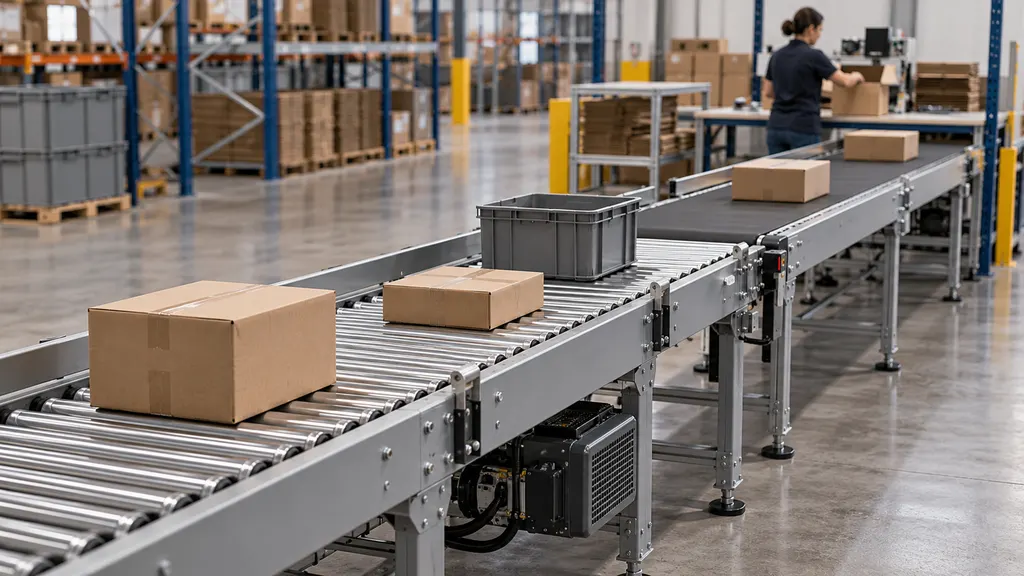
The term conveyor system usually refers to an arrangement of conveyor sections and the equipment needed to operate them together. Depending on the installation, this may include drives, sensors, controls, transfers, merges, diverters, and protective devices. A conveyor moves physical goods; it does not, by itself, manage inventory, identify an order, or provide shipment tracking.
Role in Logistics and Ecommerce
Conveyors connect activities within warehouses, fulfillment centers, parcel sorting facilities, and other material-handling sites. Their role is primarily internal movement: carrying goods between operations rather than providing the road, air, rail, or sea transport that connects separate locations.
In an ecommerce fulfillment center, a conveyor may carry picked items in totes to packing stations and then move sealed cartons toward weighing, labeling, sorting, or dispatch areas. In a parcel facility, conveyors may feed packages into identification and sorting equipment. In returns processing, they may move received parcels toward inspection stations, but the inspection result determines what happens to the merchandise.
Conveyors can support cross-border shipments in the same way they support domestic shipments. They may move export parcels through packing and dispatch operations or transport imported parcels within a handling facility. They do not determine customs classification, assess duties, or grant customs clearance. Those are separate documentary, regulatory, and operational processes.
Main Conveyor Types
Conveyors can be described by their carrying mechanism, power source, or operating function. These dimensions overlap: a roller conveyor, for example, can be powered or gravity-fed. The following table distinguishes common carrying mechanisms without treating every operating feature as a separate equipment class.
| Type | How it moves the load | Relevant applications and limitations |
|---|---|---|
| Belt conveyor | A moving belt supports and carries the load. | Used for parcels, cartons, and other items that need a continuous supporting surface. Suitability depends on belt material, load characteristics, and route geometry. |
| Roller conveyor | A series of rollers supports the load; movement comes from powered rollers, gravity, or external force. | Used for cartons, totes, and other loads with suitable supporting surfaces. Small, soft, or irregular items may need a tray or another handling method. |
| Wheel conveyor | Rows of small wheels support loads that move by gravity or external force. | Used for suitable flat-bottomed loads. Load rigidity and wheel spacing affect compatibility. |
| Chain conveyor | Moving chains carry or engage the load. | Used in some pallet and industrial unit-load applications. The load base must be compatible with the chain arrangement. |
| Screw conveyor | A rotating helical screw moves material through a trough or tube. | Associated with bulk materials rather than ordinary ecommerce parcels. |
Gravity conveyors are not necessarily horizontal. An inclined section can use the weight of the load to produce movement, but its slope and any speed-control arrangements must suit the goods being handled. Powered conveyors use a drive mechanism to produce movement, although this does not mean that every powered section independently controls each item.
How a Parcel Conveyor System Works
A conveyor installation is designed around a particular handling process. The following sequence is illustrative rather than a requirement for every warehouse or parcel facility.
- Loading or induction: An operator or another machine places a parcel onto the conveyor. The item must fall within the equipment's permitted dimensions, weight, and handling characteristics.
- Transport: Conveyor sections carry the parcel toward the next operation. Transfers between sections must accommodate the parcel's base, orientation, and stability.
- Detection and identification: Sensors may detect an item's presence, while barcode readers or other identification devices may associate it with an order or shipment record. Presence detection and identification are different functions.
- Accumulation: Where the system includes this capability, designated sections temporarily hold goods when downstream equipment is occupied. Accumulation capacity is finite.
- Routing: A diverter, transfer, or sorting mechanism may direct the parcel toward a selected destination using instructions from the control system.
- Discharge: The parcel leaves the conveyor at a workstation, collection lane, loading area, or another machine.
Not every conveyor performs all these steps. A short gravity roller section may simply connect two work areas, while an integrated installation may coordinate many sections with scanning and sorting equipment. Missing or unreadable identification can require an exception-handling route rather than normal automated routing.
Load Compatibility and System Design
Choosing a conveyor requires more than matching its width to a carton. The physical load, movement requirements, operating environment, and surrounding process all affect whether an arrangement is suitable.
- Dimensions and supporting surface: The smallest and largest intended items matter. A package that cannot bridge roller gaps or transfer points may become unstable or stop moving.
- Weight and weight distribution: Equipment ratings must accommodate the load. An off-center load may behave differently from a uniformly loaded carton of the same weight.
- Packaging condition: Loose straps, projecting labels, damaged cartons, and flexible packaging can create handling problems. Some items may need a tote or tray.
- Route: Curves, inclines, declines, and changes in elevation affect stability and the required equipment. A load suitable for a straight section is not automatically suitable for every transfer.
- Operating environment: Dust, moisture, temperature, and cleaning requirements can affect component and material selection.
- Downstream capacity: Packing stations, scanners, sorters, and loading operations must be considered alongside conveyor capacity.
Conveyor speed is not the same as facility throughput. Throughput also depends on item spacing, loading consistency, equipment availability, routing decisions, and the capacity of connected operations. Increasing belt speed alone does not establish that more orders can be completed.
A practical acceptance check should use representative loads, including difficult but permitted items, rather than only uniform test cartons. Checks can include transfer stability, barcode readability at the intended operating conditions, accumulation behavior, exception routing, and access for approved maintenance procedures. Acceptance criteria should follow the equipment specification and the facility's operational and safety requirements.
Related Terms and Important Distinctions
| Related term | Relationship to conveyors | Important distinction |
|---|---|---|
| Conveyor belt | The moving carrying surface in a belt conveyor. | A belt is a component or carrying element; not all conveyors use belts. |
| Sortation system | Directs items toward selected destinations and may incorporate conveyors. | Transporting items does not necessarily involve sorting them. |
| Accumulation | Temporarily holds items within a suitably designed conveyor arrangement. | It provides a process buffer, not unlimited storage or a substitute for inventory control. |
| Warehouse management system | Software that manages warehouse information and activities, potentially exchanging instructions or status with other systems. | It is not the physical conveyor or necessarily the controller responsible for individual motors and sensors. |
| Shipment tracking | Records or communicates shipment events and status. | Conveyor movement becomes a recorded shipment event only when a relevant identification and information process captures it. |
Conveyors also differ from mobile handling equipment. A conveyor follows an installed or configured path, whereas a forklift or mobile robot can move between locations within its operating constraints. These methods can coexist; using conveyors does not mean that every movement in a facility must follow a fixed route.
Safety and Operating Limitations
Conveyors introduce hazards around moving components, including locations where a person or object could become caught between moving parts. Safe operation requires an assessment of the actual installation, appropriate guarding, suitable operating procedures, and maintenance controls. Safety provisions must account for accessible drives, rollers, transfer points, and other relevant hazards rather than treating the carrying surface as the only concern.
In the United States, OSHA's general machine-guarding requirements and control-of-hazardous-energy requirements provide relevant regulatory frameworks where applicable. Their applicability depends on the workplace and task. Other jurisdictions have their own requirements; a general description of conveyors is not a substitute for the standards and legal duties governing a particular site.
An emergency stop is not a substitute for isolating hazardous energy before servicing when isolation is required. Workers should not reach into moving equipment or clear jams through improvised methods. Maintenance and jam-clearing procedures need to address possible unexpected startup and stored energy, using the applicable site procedures and equipment instructions.
Conveyors also impose operational constraints. A blocked discharge point can interrupt upstream movement, and a fixed route may be difficult to adapt when a facility changes its layout. These constraints do not make conveyors unsuitable, but they explain why equipment selection must consider the whole material flow rather than a single transport segment.
QA
Are all conveyors powered?
No. Gravity roller and wheel conveyors can move suitable loads without a powered drive. Powered conveyors use a drive mechanism, while other arrangements rely on gravity or external force.
What is the difference between a conveyor and a conveyor belt?
A conveyor is the handling device. A conveyor belt is the moving carrying element used in a belt conveyor. Roller, chain, and screw conveyors use different mechanisms.
Can conveyors handle every ecommerce package?
No. Compatibility depends on dimensions, weight, packaging, supporting surface, and the design of transfers and other sections. Some flexible or irregular items may require a tote, tray, or separate handling route.
Does a conveyor automatically track parcels?
No. Physical movement alone does not identify a parcel or update its shipment record. Tracking requires identification equipment and an information process that captures and associates relevant events.
Sources
- Encyclopaedia Britannica: Conveyor — Reference description of conveyors, carrying mechanisms, and material-handling applications.
- OSHA: General requirements for all machines, 29 CFR 1910.212 — U.S. machine-guarding requirements relevant to hazards from moving machinery.
- OSHA: The control of hazardous energy, 29 CFR 1910.147 — U.S. requirements concerning hazardous-energy control during applicable servicing and maintenance activities.