USPS Large Flat Rate Box Size: Dimensions, Weight Limits, and Best Uses
The USPS Large Flat Rate Box measures 12 1/4 inches long by 12 1/4 inches wide by 6 inches high, based on the dimensions listed by the U.S. Postal Service. For domestic Priority Mail, the package can weigh up to 70 pounds, and the postage is determined by the Large Flat Rate Box service rather than the package’s distance or weight within the permitted limit. The box is most useful for compact, relatively heavy shipments that fit securely inside without forcing the flaps or distorting the package.
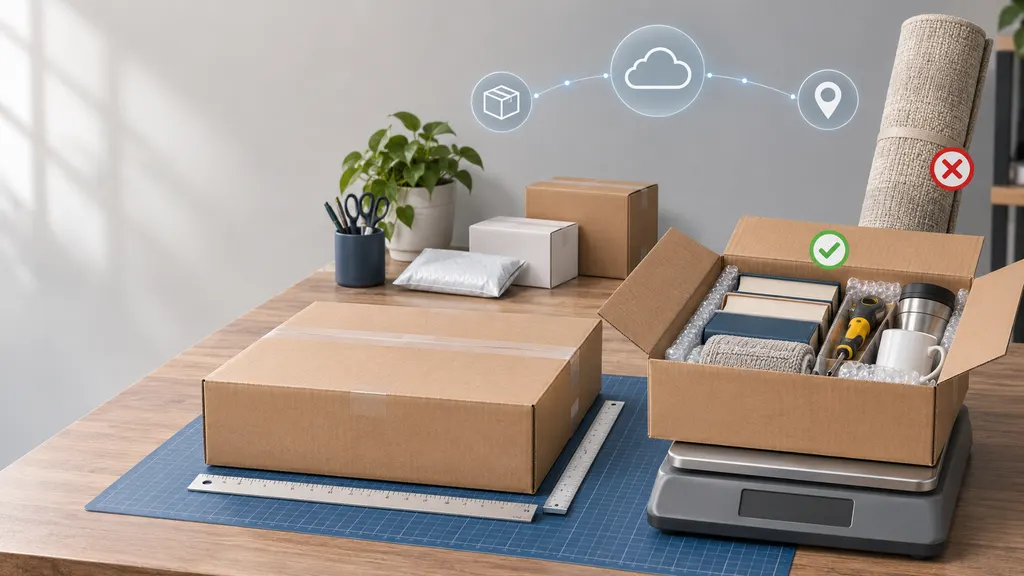
The key decision is not simply whether the contents fit. You also need to account for cushioning, the box’s usable interior space, the total packed weight, and whether a different USPS service or package size would cost less for your shipment.
USPS Large Flat Rate Box dimensions
The standard USPS Large Flat Rate Box dimensions are:
| Specification | Details |
|---|---|
| Length | 12 1/4 inches |
| Width | 12 1/4 inches |
| Height | 6 inches |
| Approximate external volume | About 900 cubic inches, or 0.52 cubic feet |
| Domestic maximum weight | 70 pounds, including packaging |
The dimensions above describe the box as listed by USPS. The usable interior is slightly smaller than the external measurements because of the corrugated material and the box’s construction. For a tight fit, measure the product and the cushioning together rather than relying on the nominal outside dimensions.
How the flat-rate limit works
A flat-rate service uses a designated USPS package type and a corresponding postage category. For domestic Priority Mail, the Large Flat Rate Box price does not change simply because the destination is farther away. It also does not increase as the package becomes heavier, provided the packed shipment remains within the applicable maximum weight and USPS acceptance rules.
That does not mean every item weighing less than 70 pounds should go in this box. A light item may be cheaper in a smaller package or under a different pricing method. Flat rate is generally more attractive when the contents are dense, the destination is relatively far away, or the shipment would otherwise be priced according to weight and distance.
The 70-pound limit applies to domestic Priority Mail shipments. International shipments have destination-specific requirements, service restrictions, and maximum weights. Do not assume that the domestic limit applies when mailing the same box abroad. Check the destination and service in the USPS international mailing tools before preparing the shipment.
Best uses for the Large Flat Rate Box
Dense and moderately heavy products
The box is a practical option for items that are heavy for their size but do not require much vertical space. Examples may include books, tools, small hardware, household goods, packaged food that is permitted for mailing, and multiple retail products packed together. The savings potential comes from separating the postage decision from the shipment’s exact weight and zone, not from the box being suitable for every heavy product.
Multiple small orders shipped together
A seller or household shipper can use the box to consolidate several compact items into one shipment. Each product should be protected from contact with the others, and the combined package should not become so tightly packed that the box bulges. Consolidation can reduce the number of labels and packages to handle, but it may not be the best choice when customers need separate tracking numbers or when one item has special mailing requirements.
Flat or low-profile goods
The six-inch height makes the box better suited to broad, low-profile merchandise than to tall objects. Folded clothing, craft supplies, board games, household accessories, and similar goods may fit well when packed with limited cushioning. Before selecting the box, check the item’s longest dimension and allow room around fragile edges.
When the box is not a good fit
The Large Flat Rate Box is not ideal when the product is tall, unusually shaped, fragile enough to require thick cushioning, or light enough to ship more economically in a smaller package. It is also a poor choice when the contents fill the box only after being forced into place. A package that is difficult to close may be damaged during handling, and an overfilled box can create problems at acceptance.
The box is also not a substitute for specialized packaging. Liquids, perishables, hazardous materials, batteries, valuables, and other regulated items may have additional USPS requirements. The service packaging does not remove the sender’s responsibility to comply with applicable mailing rules.
- Choose a smaller package when the contents leave substantial unused space.
- Choose a different package when the item needs more than six inches of height.
- Consider weight-based Priority Mail or another USPS service when the flat-rate box does not produce a useful price advantage.
- Use a stronger or specialized container when the item’s shape, fragility, or handling requirements call for it.
How to pack the box correctly
- Measure the packed product. Place the item in the box with the planned cushioning and confirm that the flaps can close naturally.
- Protect corners and surfaces. Use suitable cushioning to prevent movement and reduce the chance of impact damage. Fragile items should not touch the box walls directly.
- Distribute weight evenly. Keep dense items from concentrating all the weight in one corner. Heavy products should be surrounded by material that limits shifting.
- Check the closure. The flaps should meet without being stretched, bent, or held down by excessive force. Bulging sides indicate that the contents or cushioning need to be rearranged.
- Weigh the complete package. Include the box, cushioning, labels, and contents. For domestic Priority Mail, the total must remain within the applicable 70-pound maximum.
- Remove conflicting markings. If reusing a box, cover or remove old barcodes, addresses, postage, and service markings that could confuse processing.
- Apply the correct label. The label should be placed on the largest flat surface and remain readable. Keep the barcode away from seams, corners, and heavy tape.
USPS packaging and mailing requirements can change by service, destination, and item type. For a business shipping repeatedly, create a packing specification that records the product dimensions, cushioning method, packed weight, label placement, and acceptance requirements. This makes it easier to identify mistakes before a package enters the mailstream.
Large Flat Rate Box versus a regular package
The practical comparison is between flat-rate postage and postage calculated from the package’s weight, dimensions, destination, and service. The Large Flat Rate Box removes some of that pricing variability, while a regular box provides more flexibility in shape and size. Neither option is automatically cheaper.
| Situation | Likely better starting point | Reason |
|---|---|---|
| Dense contents that fit the box | Large Flat Rate Box | The flat-rate structure may be useful when weight would otherwise raise the price. |
| Light, compact contents | Smaller or regular package | A large flat-rate container can provide more capacity than needed. |
| Tall or irregular product | Regular package | A custom size may protect the item better and avoid forcing it into a six-inch-high box. |
| International shipment | Check the destination-specific option | International limits and availability can vary by country and service. |
The most reliable comparison uses the actual packed weight, dimensions, origin, destination, and desired delivery service. Businesses should also include packaging labor, dimensional constraints, damage risk, and the cost of sending a replacement if an item is poorly protected.
A practical selection checklist
Before choosing the box, confirm all of the following:
- The contents and cushioning fit within approximately 12 1/4 by 12 1/4 by 6 inches of listed box space.
- The flaps close flat without compression or bulging.
- The complete domestic shipment weighs no more than 70 pounds.
- The contents are eligible for the selected USPS service.
- The destination and service are compatible if the package is being mailed internationally.
- The current postage is better than the available regular-package alternatives for this specific shipment.
For occasional shipments, a single rate comparison is usually enough. For ecommerce operations, test representative orders rather than relying on one example. Compare light, medium, and heavy orders across nearby and distant destinations, then document which package type should be used for each product group.
FAQ
What are the dimensions of a USPS Large Flat Rate Box?
USPS lists the Large Flat Rate Box at 12 1/4 inches long, 12 1/4 inches wide, and 6 inches high. Treat these as listed box dimensions and allow for the space taken by the cardboard and cushioning.
What is the weight limit for a domestic Large Flat Rate Box?
The domestic Priority Mail maximum is 70 pounds, including the contents and packaging. Weigh the fully sealed package rather than estimating from the product weight alone.
Is the Large Flat Rate Box always the cheapest USPS option?
No. The box can be useful for dense shipments, but a smaller package or a non-flat-rate service may be less expensive for light or compact contents. Compare the actual shipment details before buying postage.
Can I use a Large Flat Rate Box for international shipping?
International eligibility, maximum weight, service availability, and customs requirements depend on the destination and selected service. Verify the shipment in USPS international tools rather than applying the domestic 70-pound rule automatically.
Can the box be overfilled if it still weighs less than 70 pounds?
No. Weight is only one requirement. The box should close securely without bulging, excessive pressure, or damage to the contents. If the item does not fit naturally, select a different package.
Sources
- USPS Store: Priority Mail Large Flat Rate Box — listed package dimensions and product information.
- USPS: Priority Mail — domestic Priority Mail service information and weight guidance.
- USPS: International Mail and Shipping Services — international service options and destination-specific considerations.