Twenty-Feet Equivalent Unit(Teu)
What Is a Twenty-Foot Equivalent Unit (TEU)?
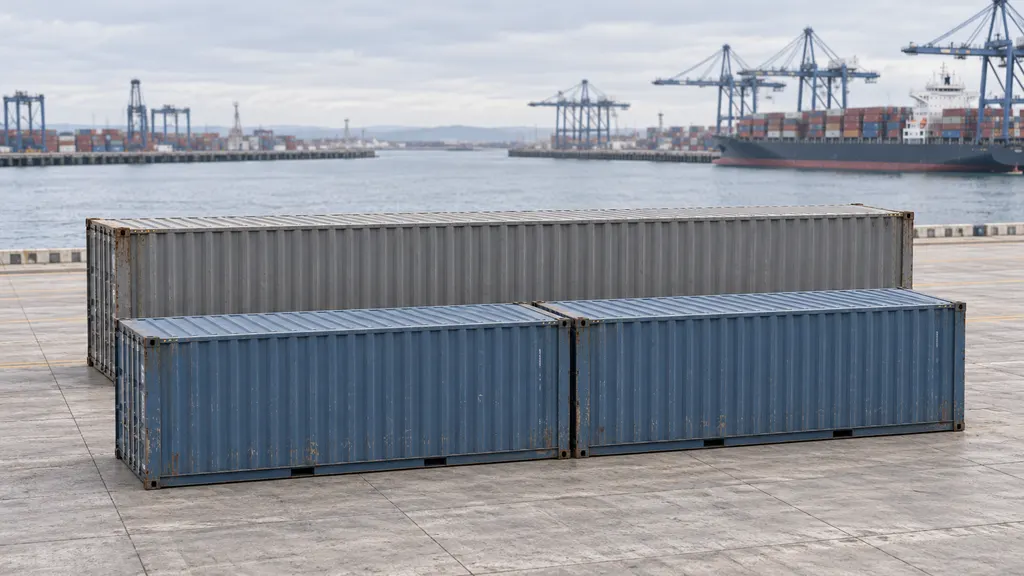
A twenty-foot equivalent unit (TEU) is a standardized unit used to express container transport capacity and container traffic in terms of a twenty-foot freight container. One standard twenty-foot container represents one TEU, while one standard forty-foot container represents two TEUs. The unit is widely used in maritime shipping, port statistics, freight forwarding, and supply chain planning.
TEU is a measure of container-equivalent capacity or activity, not a measure of cargo weight, merchandise value, or the number of individual products shipped. It allows organizations to combine containers of different lengths into a common reporting unit. The conventional English term is twenty-foot equivalent unit, rather than “twenty-feet equivalent unit.”
How TEU Is Calculated
For a group consisting of standard twenty-foot and forty-foot containers, the calculation is straightforward:
Total TEU = number of twenty-foot containers + (2 × number of forty-foot containers).
The conversion applies to container size, not to how much cargo is inside. A partially loaded forty-foot container still represents two TEUs. An empty forty-foot container also represents two TEUs when empty containers are included in the reporting scope.
| Illustrative container group | Physical containers | Calculation | Total TEU |
|---|---|---|---|
| One twenty-foot container | 1 | 1 × 1 | 1 |
| One forty-foot container | 1 | 1 × 2 | 2 |
| Three twenty-foot containers and two forty-foot containers | 5 | 3 + (2 × 2) | 7 |
| Ten forty-foot containers | 10 | 10 × 2 | 20 |
These examples show why a container count and a TEU count are not interchangeable. Five physical containers may represent more than five TEUs when some of those containers are forty feet long. For containers of other lengths or specialized equipment, users should follow the conversion rules specified by the relevant statistical system, terminal, or carrier rather than assume a universal treatment.
What TEU Measures—and What It Does Not
TEU provides a common denominator for containerized transport. Its meaning depends on whether a document describes vessel capacity, containers handled, or another operational measure. The unit alone does not explain the reporting boundary.
| Measure | What it describes | Important limitation |
|---|---|---|
| TEU | Container-equivalent capacity or traffic | Does not specify cargo weight or actual internal volume |
| Physical container count | Number of individual containers | Does not account for differences in container length |
| Forty-foot equivalent unit (FEU) | A unit based on a forty-foot container | One FEU equals two TEUs, but this does not establish a freight-rate relationship |
| Cubic metres | Volume of cargo or available space | Does not directly indicate container count or weight limits |
| Cargo weight | Mass of the goods being transported | Cannot be inferred from TEU alone |
A forty-foot high-cube container is normally counted as two TEUs, just as a standard-height forty-foot container is. Its greater height can provide additional internal space, but that difference is not reflected in the TEU figure. Consequently, equal TEU totals do not necessarily mean equal usable cargo volume.
Likewise, TEU does not establish a fixed payload. Actual loading is affected by the equipment's rated limits, the cargo's density and distribution, and applicable transport restrictions. Converting TEUs directly into tonnes or cubic metres requires additional information and clearly stated assumptions.
Where TEU Is Used in Logistics
Container vessel capacity
Container ship capacity is commonly expressed in TEUs. This provides a standardized way to describe the scale of vessels designed to carry containers. A stated capacity should not be read as a guarantee that the vessel can carry that number of fully loaded twenty-foot containers under every operating condition.
Actual loading depends on factors such as cargo weight, stowage arrangements, vessel stability, and operational restrictions. The mix of container sizes also matters. A vessel's TEU capacity is therefore distinct from the number of containers or the cargo tonnage carried on a particular voyage.
Port and terminal throughput
Ports and container terminals use TEUs to report container traffic over a defined period. Throughput describes activity handled, rather than the maximum capacity of a vessel or facility. A throughput figure can include loaded and empty containers, depending on the statistical definition.
Counting rules are especially important for transshipment, where a container is transferred between vessels. Under reporting methods that count both unloading and loading, the same transshipment container contributes to throughput more than once. A TEU throughput total should therefore not automatically be interpreted as the number of unique containers, import shipments, or export orders.
Freight forwarding and transport planning
Freight forwarders and shippers can use TEU totals to summarize planned container movements across routes, customers, or reporting periods. The common unit makes a mixed group of twenty-foot and forty-foot containers easier to aggregate.
However, a transport booking needs more detail than a TEU total. Equipment size and type, cargo weight, loading requirements, and shipment routing remain necessary. A request to move ten TEUs does not, by itself, identify whether the shipment requires ten twenty-foot containers, five forty-foot containers, or another combination.
TEU in Cross-Border Ecommerce
In cross-border ecommerce, TEU is most relevant to containerized inventory movements, such as transporting merchandise from an overseas supplier to a destination distribution centre. It is less useful for describing individual customer parcels or last-mile delivery activity.
For example, a retailer may import goods in three forty-foot containers before distributing the inventory to regional fulfillment facilities. That ocean movement represents six TEUs. The number of ecommerce orders eventually fulfilled from the goods cannot be determined from the TEU figure: product dimensions, packaging, inventory allocation, and order quantities are separate variables.
Similarly, a seller whose goods occupy only part of a consolidated container should not confuse the carrying container's TEU size with the seller's own booked cargo quantity. Less-than-container-load shipments are commonly described using cargo volume and weight. The container transporting several shippers' goods may represent one or two TEUs, but that does not mean each participating shipper has booked that whole capacity.
TEU also does not replace customs information. A container-equivalent total does not identify the goods, their tariff classification, customs value, or origin. Those details must be established through the applicable commercial and customs documentation.
How to Interpret a TEU Figure
Before comparing TEU figures or using them for planning, establish what each number represents. The following checks help prevent comparisons between measures that share a unit but describe different things.
- Identify the measure. Determine whether the figure describes vessel capacity, actual containers carried, terminal throughput, or planned transport demand.
- Check the reporting period. A vessel capacity is not a flow over time, while annual throughput represents activity during a particular year.
- Check the boundary. Establish whether the figure covers one terminal, an entire port, one voyage, or a wider transport network.
- Check container coverage. Determine whether empty containers, loaded containers, and transshipment movements are included.
- Check conversion conventions. Confirm how container sizes outside the standard twenty-foot and forty-foot categories are treated.
- Obtain cargo-level information separately. Use actual equipment specifications, cargo dimensions, and weight when deciding whether goods will fit or meet loading limits.
For instance, comparing a port's annual throughput with a vessel's capacity does not directly show how many vessel visits occurred. Such a calculation would require information about the containers actually exchanged at each call, not merely the vessel's nominal capacity.
Common Misunderstandings
- “One TEU means one container.” This is true for a twenty-foot container, but a forty-foot container represents two TEUs while remaining one physical container.
- “Two TEUs always provide the same usable space.” TEU does not capture every equipment dimension or internal loading constraint. A high-cube container and a standard-height container can have the same TEU value.
- “A higher TEU total means more merchandise was sold.” TEU measures container-equivalent activity or capacity. Empty movements, cargo density, and different loading levels prevent it from directly measuring sales or product quantities.
- “A forty-foot container must cost twice as much as a twenty-foot container.” The two-to-one TEU conversion is not a pricing formula. Freight charges depend on the relevant quotation and shipment conditions.
QA
How many TEUs is a forty-foot container?
A standard forty-foot container represents two TEUs. A forty-foot high-cube container is also normally counted as two TEUs, despite its greater height.
Is TEU a measure of weight?
No. TEU measures container-equivalent capacity or traffic. Cargo weight must be obtained separately and cannot be calculated reliably from TEU alone.
What is the difference between TEU and FEU?
TEU is based on a twenty-foot container, while FEU is based on a forty-foot container. One FEU equals two TEUs. This equivalence does not imply that transport prices follow the same ratio.
Does port throughput in TEUs count unique shipments?
Not necessarily. Throughput counts container activity under a defined statistical method. It can include empty containers and multiple handling events involving the same container, rather than unique commercial shipments.
Sources
- Eurostat: Twenty-foot equivalent unit (TEU) — Definition, standard container equivalents, and treatment of high-cube containers.
- World Bank: Container port traffic (TEU: 20 foot equivalent units) — Statistical use of TEU for port traffic, including empty containers and the counting of transshipment movements.