Traffic Hub
What Is a Traffic Hub?
A traffic hub is a location where transport flows converge and are connected, transferred, or redistributed to other routes. In logistics, it refers to a point in a freight network where goods or transport services move between incoming and outgoing connections. Depending on the context, it may describe an airport cargo facility, a rail terminal, a parcel sorting center, or a wider transport complex connecting several facilities.
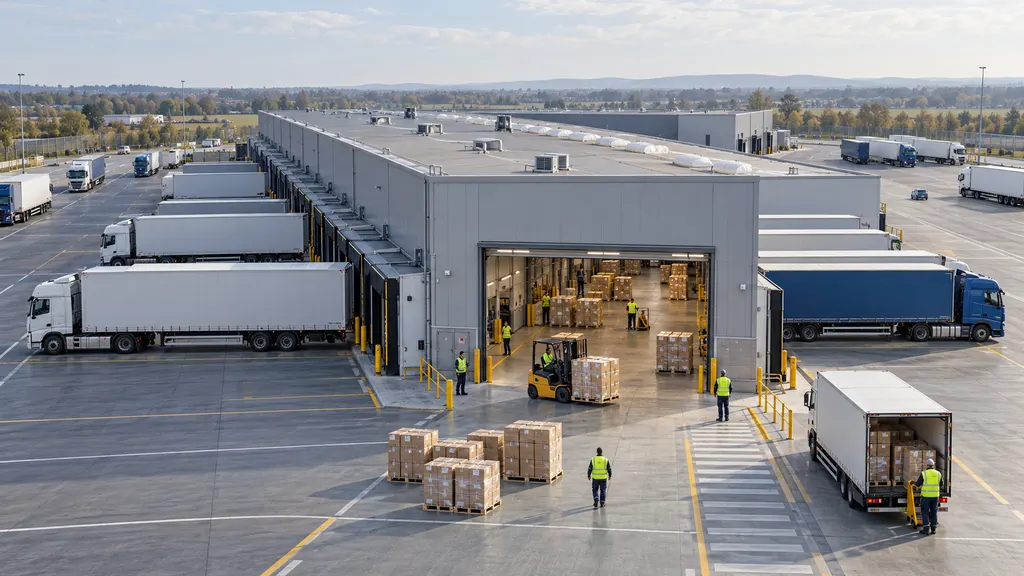
The expression is broad rather than a precise description of one facility type. A passenger interchange may also be called a traffic hub, while ecommerce marketing may use similar language for a source or concentration of website visitors. In shipping and supply-chain documents, however, the relevant meaning is normally a physical transport node. The surrounding text should establish whether the term concerns freight, passengers, or digital traffic.
Role in a Logistics Network
A traffic hub connects movements within a transport network. Its role depends on the routes it serves and the operations performed there. Some hubs bring smaller shipment flows together for onward transport. Others divide an arriving load into shipments bound for different destinations. A facility may perform both functions at different stages of its operating cycle.
In a hub-and-spoke network, services connect outlying locations, or spokes, through a central hub rather than providing a separate direct connection between every origin and destination. This arrangement allows shipments from several origins to share an onward service. It also introduces transfers and makes connections dependent on the hub's processing capacity and departure schedule.
Not every transport node is a hub. A loading point serving one shipper may be a node without connecting multiple routes. Likewise, a busy road intersection can carry substantial traffic without handling freight transfers. Describing a location as a logistics hub therefore requires attention to its network function, not merely its size, traffic volume, or name.
What Happens at a Freight Traffic Hub?
The following sequence illustrates possible hub activities. It is an explanatory workflow, not a mandatory procedure: actual operations differ by transport mode, facility design, cargo requirements, and customs status.
- Arrival and identification: An incoming vehicle, container, pallet, or parcel is associated with transport records and its next planned movement.
- Unloading or connection: Cargo may be unloaded for handling, or a transport unit may transfer between services without its contents being unpacked.
- Sorting and routing: Shipments are assigned to onward destinations, services, or handling areas. Routing can depend on destination, service commitment, available connections, and handling restrictions.
- Consolidation or separation: Smaller shipments may be combined into a larger outbound load, while an inbound consolidated load may be separated for different routes.
- Temporary holding: Goods may wait for an onward departure, documentation, inspection, or available handling capacity. This does not necessarily make the facility an inventory-storage warehouse.
- Outbound dispatch: Cargo or transport units leave on the next service. Relevant movement records may be updated to reflect the transfer.
A hub can connect services using the same transport mode, such as truck-to-truck movements, or different modes, such as rail-to-road movements. Intermodal operations involve the movement of goods in the same loading unit or road vehicle across successive transport modes without handling the goods themselves when changing modes. A facility should not be described as intermodal simply because several modes exist nearby; the relevant transfer capability must actually be present.
Traffic Hub and Related Terms
Several terms overlap with traffic hub, but they emphasize different functions. A single site can fit more than one description.
| Term | Main emphasis | Relationship to a traffic hub |
|---|---|---|
| Transport node | A point within a transport network. | A hub is a node with a connecting or redistributing role; not every node serves that role. |
| Terminal | A facility where transport services begin, end, or exchange passengers, cargo, or loading units. | A terminal may function as a hub when it connects multiple transport flows. |
| Sorting center | Separating and routing parcels or other consignments. | It can serve as a hub within a parcel network, but sorting alone does not describe every hub activity. |
| Distribution center | Receiving, holding, and dispatching goods for distribution. | It may connect transport flows, but its role can also include inventory handling and order fulfillment. |
| Warehouse | Storage and related handling of goods. | A warehouse is not automatically a hub; connecting routes may be secondary or absent. |
| Gateway | An entry or exit point linking a region or network with another. | A gateway can also be a hub, but entry and exit functions differ from redistribution functions. |
| Transshipment | The transfer of goods between means of transport. | It describes an activity that may occur at a hub, rather than the location itself. |
These distinctions are functional rather than rigid naming rules. Facility names do not always reveal the full range of activities performed. An operational description, route map, or terminal specification is more informative than the word “hub” alone.
Use in Ecommerce and Cross-Border Shipping
For an ecommerce shipment, a traffic hub can sit between collection, long-distance transport, and destination delivery. It need not hold the seller's available inventory or prepare individual customer orders. Those activities may take place at a separate fulfillment facility before the shipment enters the transport network.
For example, a retailer may dispatch parcels from a fulfillment center to a regional sorting hub. Parcels bound for the same destination region may then travel together on a longer-distance service. At another hub, they may be separated for onward movement to local delivery facilities. This is an illustrative route, not a universal sequence: some shipments use direct services or pass through a different number of transfer points.
In cross-border shipping, a hub may also connect an international service with domestic transport. Transport transfers and customs procedures must nevertheless be distinguished. Arrival at an airport cargo hub does not, by itself, establish that import formalities are complete. Whether goods can proceed depends on the applicable procedure, required documentation, and any relevant controls.
A hub's geographical location also does not establish its legal status. A facility is not automatically a customs office, customs warehouse, or free zone merely because international cargo passes through it. Those descriptions depend on the relevant legal and administrative arrangements.
Interpreting a Hub Reference in Shipment Tracking
A tracking message mentioning a hub should be read as a location or processing event, not as a complete explanation of the shipment's status. The useful question is what happened there: arrival, sorting, transfer, departure, or a reported exception.
- Identify the event: An arrival record does not establish that the shipment has departed on its next connection.
- Check the network stage: An origin hub, international gateway, and destination sorting facility can occupy very different positions in the route.
- Separate movement from customs status: A handling scan alone is not evidence of customs release.
- Look for an explicit exception: A hub location by itself does not establish loss, damage, or a missed connection.
- Use shipment-specific evidence: Published service information and subsequent tracking events are more useful than assuming every hub has the same processing time.
The distance between a hub and the delivery address does not necessarily indicate how soon delivery will occur. The parcel may still require sorting, another scheduled connection, or transfer to the delivery network. Conversely, a route that appears indirect on a map may reflect how the carrier connects its services rather than a routing error.
Operational Considerations
Evaluating a traffic hub requires more than counting incoming routes. Relevant questions include whether outbound services connect with arrivals, whether handling equipment suits the cargo, and whether the site can accommodate required transfer activities. Available storage, access arrangements, documentation processes, and restrictions on particular goods can also affect its suitability.
Concentrating flows can support shared transport services, but it also creates dependencies. If an incoming service misses an outbound connection, cargo may need to wait for another departure. Congestion, equipment unavailability, or disrupted access can affect transfers. These are operational possibilities, not evidence that every hub has the same risks or that hub-based transport is inherently less reliable than direct transport.
For a particular shipment, the most useful assessment is therefore specific: identify the facility's function, the planned connection, the cargo's requirements, and the applicable transport and customs conditions. The label “traffic hub” alone cannot establish delivery speed, service quality, or regulatory compliance.
QA
What does traffic hub mean in logistics?
It means a location where transport flows connect and goods or transport services are transferred, consolidated, separated, or redirected to onward routes.
Is a traffic hub the same as a warehouse?
No. A warehouse emphasizes storage, while a traffic hub emphasizes connections within a transport network. One facility can perform both functions.
Does arrival at a hub mean a parcel has cleared customs?
No. Hub arrival describes a transport event. Customs release is a separate matter and requires relevant confirmation.
Does every shipment pass through a traffic hub?
No. Some shipments use direct services, while others pass through one or more connecting facilities. The route depends on the transport arrangement.
Sources
- The Geography of Transport Systems: The Function of Transport Terminals — Educational reference supporting the explanation of terminal functions, transport connections, and freight handling.
- UNECE, European Conference of Ministers of Transport, and European Commission: Terminology on Combined Transport — Reference for intermodal transport, loading units, terminals, and related transport terminology.
- World Customs Organization: Revised Kyoto Convention — Customs framework supporting the distinction between physical transport operations and customs procedures, including clearance, transit, and transshipment.