Cold Chain
What Is a Cold Chain?
A cold chain is a coordinated system for storing, handling, and transporting temperature-sensitive goods within specified temperature conditions throughout their movement through a supply chain. It combines suitable facilities, transport equipment, packaging, monitoring, and operating procedures to protect products from unacceptable temperature exposure. In logistics and commerce, cold chains support products such as chilled and frozen foods, vaccines, medicines, and certain biological materials.
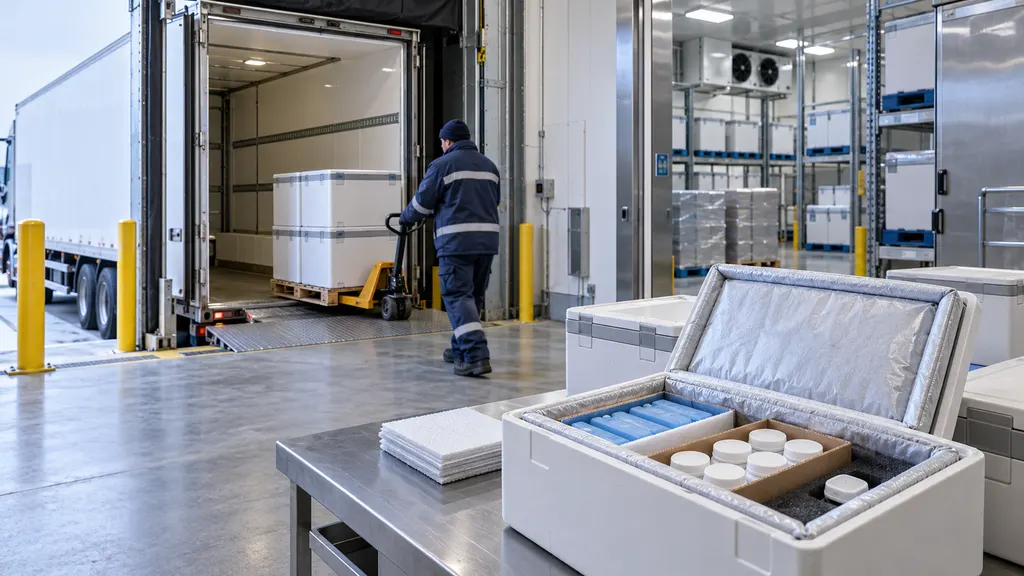
The word chain emphasizes continuity. A refrigerated warehouse or delivery vehicle is only one link; loading, sorting, temporary storage, border inspections, and final delivery also need appropriate controls. The required conditions depend on the product. A cold chain does not mean that every shipment must be frozen, nor does it describe a single temperature range that applies to all goods.
What a Cold Chain Controls
The central objective is to preserve the conditions needed for product safety, quality, stability, or usability. Excessive heat may accelerate deterioration, while excessive cooling or accidental freezing may damage products that must remain refrigerated but unfrozen. Different goods can therefore require incompatible handling conditions even when both are described as cold-chain products.
Temperature requirements should come from applicable product specifications, labeling, stability information, and regulatory requirements. A transport setting should not be selected solely because it is convenient for a carrier or shared by another product. Depending on the goods, other factors—including humidity, light exposure, contamination, and physical damage—may also need control.
A temperature excursion is an exposure outside the specified temperature conditions. Whether an excursion makes a product unusable depends on factors such as its temperature sensitivity, the severity and duration of exposure, and available stability or safety evidence. Returning a shipment to the required conditions does not by itself demonstrate that the product remains acceptable.
How a Cold Chain Works
Cold-chain management begins before dispatch and continues through receipt. The following stages describe a practical logistics workflow rather than a mandatory sequence for every product or jurisdiction.
| Stage | Main control | Potential failure point |
|---|---|---|
| Product and route planning | Identify required conditions, transit stages, responsibilities, and contingency arrangements. | Choosing a service that cannot maintain the product's conditions. |
| Storage and order preparation | Use suitable storage areas and limit exposure during picking and packing. | Leaving goods in an uncontrolled staging area. |
| Packaging and dispatch | Prepare the approved packaging configuration and monitoring equipment. | Incorrect coolant preparation or missing insulation. |
| Transportation and transfers | Maintain specified conditions during movement, loading, and unloading. | Uncontrolled exposure between vehicles or facilities. |
| Border processing | Plan for documentation, inspection, and temperature-controlled holding where needed. | A delay that exceeds the shipment's protective capacity. |
| Delivery and receipt | Check shipment condition, review relevant records, and transfer goods promptly into suitable storage. | Unattended delivery or delayed unpacking. |
| Exception handling | Separate affected stock and arrange an evidence-based assessment. | Releasing goods before an excursion has been evaluated. |
Facilities and transportation equipment
Cold rooms, freezers, refrigerated vehicles, and temperature-controlled containers provide controlled environments for storage and movement. Their suitability depends on the operating conditions and the goods involved. Air circulation, loading patterns, door openings, equipment condition, and ambient weather can affect temperature distribution.
A vehicle's set point is not necessarily the temperature experienced by every product inside it. Likewise, a reading from one location may not represent all locations within a warehouse. Temperature mapping and equipment qualification can help establish where monitoring is needed and whether a system performs adequately under defined conditions.
Packaging and thermal protection
Packaging can provide protection during transport or supplement refrigerated equipment. Insulation, phase-change materials, gel packs, and dry ice may be used where appropriate. Their selection depends on the required temperature conditions, product compatibility, expected journey, and applicable transport restrictions.
Protective performance depends on the complete packing configuration, not just an insulated box. Payload size, coolant preparation, placement, ambient conditions, and shipment duration all matter. A packaging system demonstrated to work under one set of conditions should not automatically be assumed suitable for another. Dry ice also introduces handling and transport considerations beyond temperature control.
Monitoring and records
Temperature data loggers, probes, indicators, and connected sensors can provide evidence about shipment conditions. Some devices store readings for later download; others can transmit data during parts of the journey. Sensor placement, calibration, recording intervals, and access to records affect how useful the evidence will be.
Monitoring detects or documents conditions; it does not itself keep goods cold. An alarm is useful only when responsibilities and response procedures are defined. Records should allow a relevant reading to be associated with the shipment, time period, and handling stage it represents.
Cold Chains in Ecommerce and Cross-Border Trade
In ecommerce, cold-chain requirements affect inventory allocation, order cutoffs, packaging, service selection, delivery arrangements, and returns. A retailer selling temperature-sensitive goods needs to consider the whole journey from storage to customer receipt, rather than treating refrigeration as a feature of the main transport leg alone.
For example, a retailer may dispatch chilled food in an insulated parcel using a packaging configuration assessed for the planned journey. If delivery is delayed or the recipient is unavailable, the parcel may remain outside controlled storage longer than expected. Delivery planning therefore needs to account for handover conditions and the limits of the packaging, not only the advertised transit time.
Cross-border shipments introduce additional handovers and possible delays. Export documentation, import eligibility, inspections, and product-specific controls can affect the route and time in transit. Temperature-sensitive status does not remove customs or other regulatory requirements. Required permits, certificates, and procedures depend on the product and the jurisdictions involved.
A shipment plan may therefore need to identify suitable holding facilities, arrangements for inspection, and actions to take if clearance is delayed. These are operational planning considerations, not guarantees that a shipment will receive priority treatment or immediate release.
Returns require separate attention. A returned item may lack reliable evidence of its storage conditions after delivery. An intact package or acceptable appearance does not establish that temperature requirements were maintained. Decisions about restocking, further assessment, or disposal should follow product-specific procedures and applicable rules.
Related Terms and Important Distinctions
| Term | Meaning and relationship to cold chain |
|---|---|
| Temperature-controlled logistics | A broader expression for logistics that maintains specified temperature conditions. Depending on usage, it can include controlled conditions that do not require refrigeration. |
| Refrigerated transport | A transport activity using refrigeration. It is one possible component of a cold chain, rather than the complete system. |
| Cold storage | Storage in a refrigerated or frozen environment. It covers a stationary stage, not every movement or handover. |
| Active temperature control | Uses powered equipment to maintain conditions, such as a refrigeration unit. |
| Passive thermal packaging | Uses insulation and thermal materials to protect a payload without a powered refrigeration unit in the package. |
| Shipment tracking | Provides information about shipment location or logistics events. It does not necessarily include temperature measurements. |
| Temperature monitoring | Measures or records temperature conditions. It complements shipment tracking but answers a different question. |
Active and passive approaches are not necessarily alternatives for an entire shipment. A package with passive thermal protection may travel in a refrigerated vehicle. The appropriate combination depends on the product, route, handling conditions, and supporting performance evidence.
Assessing Cold-Chain Integrity
Cold-chain integrity refers to maintaining the required conditions and having sufficient evidence to assess whether those conditions were preserved. It cannot be established from a delivery scan, an undamaged carton, or a single arrival-temperature reading alone. Those observations may be useful, but they do not necessarily describe the shipment's earlier exposure.
Before dispatch or acceptance, the responsible parties can use the following questions to identify gaps:
- Requirements: Are the product's permitted conditions documented, including any restrictions on freezing?
- Route suitability: Have transfers, non-working days, potential delays, and final delivery conditions been considered?
- Equipment and packaging: Is there evidence that the selected configuration is suitable for the intended conditions and duration?
- Monitoring: Are devices appropriate, correctly positioned, and linked to the relevant shipment records?
- Handover responsibilities: Is it clear who maintains control during loading, storage, inspection, and receipt?
- Exception response: Are there instructions for delayed shipments, equipment failures, and out-of-range readings?
- Release decisions: Is an authorized person responsible for evaluating questionable stock before it is used or distributed?
For medicines and vaccines, excursion assessment may require consultation with the manufacturer or another appropriate authority using the available exposure information. For food, decisions must address the relevant safety and quality requirements. An assessment method suitable for one product category should not be transferred automatically to another.
Common Misunderstandings
Colder is always safer
Some temperature-sensitive products are damaged by freezing. The objective is to maintain the specified conditions, not to achieve the lowest possible temperature.
A refrigerated delivery guarantees an intact cold chain
Refrigeration during the final journey does not prove that earlier storage, packing, or transfers were controlled. Cold-chain performance depends on the connected process.
A normal arrival reading rules out earlier exposure
A shipment can return to an acceptable temperature after an excursion. A point-in-time reading must therefore be interpreted alongside available monitoring records and handling information.
Every excursion means automatic disposal
An excursion requires assessment, not an unsupported assumption of either safety or failure. The decision depends on product-specific evidence and applicable procedures. Affected goods may need to be held separately while that assessment is completed.
QA
What is the difference between a cold chain and refrigerated shipping?
Refrigerated shipping controls conditions during a transport stage. A cold chain includes the connected storage, handling, packaging, transportation, monitoring, and handover arrangements needed to protect the goods throughout their journey.
What temperature should a cold chain maintain?
There is no universal temperature for all cold-chain products. Required conditions depend on the product's specifications, labeling, stability information, and applicable regulatory requirements.
Does parcel tracking prove that goods stayed cold?
No. Location updates and delivery scans do not establish temperature history unless suitable temperature information is also collected and associated with the shipment.
Can a cold-chain product be sold after a temperature excursion?
That cannot be decided from the term alone. The product should be assessed under the relevant procedures using exposure records, product-specific evidence, and applicable requirements before release.
Sources
- World Health Organization: Model guidance for the storage and transport of time- and temperature-sensitive pharmaceutical products — Pharmaceutical cold-chain systems, storage, transport, qualification, monitoring, and operational controls.
- Centers for Disease Control and Prevention: Vaccine Storage and Handling Toolkit — Vaccine cold-chain practices, temperature monitoring, freezing risks, and responses to temperature excursions.
- U.S. Food and Drug Administration: FSMA Final Rule on Sanitary Transportation of Human and Animal Food — U.S. food-transport context, including equipment, operational responsibilities, and temperature controls where necessary for food safety.