Shipping from China to Canada: Transit Times, Customs, and Carrier Handoffs
Shipping from China to Canada can take days or weeks, depending on the service, customs processing, and final-mile delivery. Express parcels generally move faster than economy shipments, but there is no reliable country-to-country delivery promise without a specific service and destination. For a parcel already in transit, the most useful checks are whether the carrier has physically received it, whether Canadian customs has released it, and which carrier will deliver it locally.
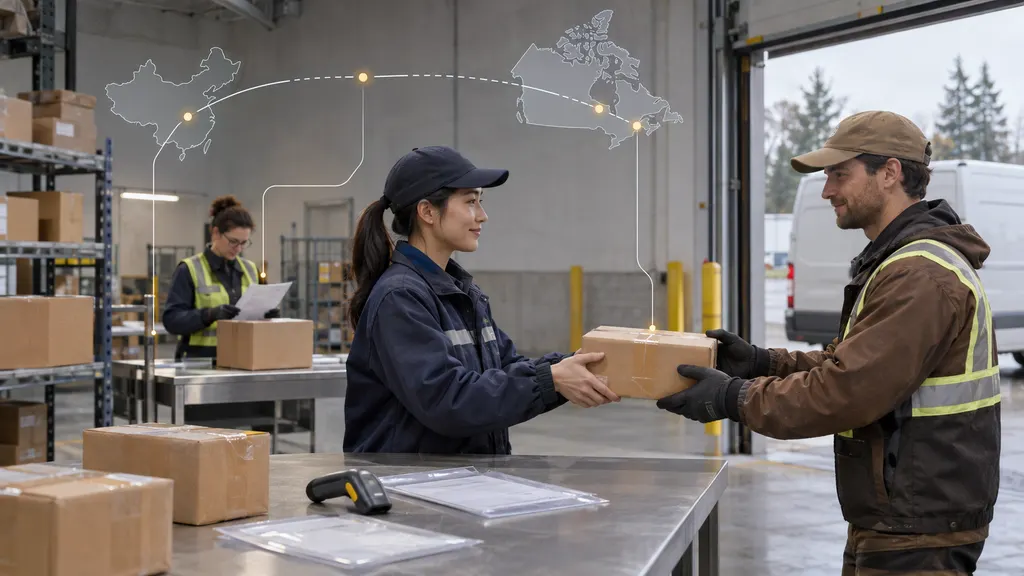
This guide focuses on parcels and online purchases, with a short explanation of how freight shipments differ. It explains how to interpret delivery estimates, prepare for Canadian import charges, and investigate a package that appears to stop moving between carriers.
How long does shipping from China to Canada take?
A shipping estimate is only useful when you know what it measures. A seller may quote time after dispatch, while a carrier may measure transit from physical acceptance. Neither necessarily includes the seller's order processing, and customs or remote-area delivery may fall outside the advertised estimate.
Use the following distinctions to assess a quote. These are service characteristics, not guaranteed transit windows.
| Shipping method | What to expect | What to confirm |
|---|---|---|
| International express | Generally the fastest parcel option, with more closely connected transport and delivery operations. | The service-specific estimate, acceptance cutoff, customs exclusions, and destination coverage. |
| Tracked postal or ecommerce air service | May combine collection, consolidated international transport, and a separate Canadian delivery network. | Whether the estimate includes consolidation, customs processing, and the final-mile handoff. |
| Economy or surface service | A longer planning horizon, potentially with fewer visible tracking events between transport stages. | The actual transport mode, delivery window, and availability of destination tracking. |
| Air or ocean freight | Transport time is only one part of a shipment involving cargo handling, clearance, and delivery arrangements. | Whether the quote is airport-to-airport, port-to-port, or door-to-door. |
For a time-sensitive purchase, request a delivery estimate for the Canadian postal code and the exact service name. “Air shipping” alone is not enough: a parcel can travel by air and still spend time waiting for consolidation, export processing, or destination delivery.
Practical judgment: choose a service with a clear delivery commitment when the arrival date matters. Do not use an economy shipment's best-case estimate as the deadline for an event, replacement part, or business launch.
Separate processing time from transit time
Think of the journey as five separate stages:
- Seller preparation: stock allocation, packing, and label creation.
- Origin acceptance: physical collection, sorting, and export preparation in China.
- International transport: movement to Canada, potentially through an intermediate hub.
- Canadian import processing: presentation to customs, any document checks, and release.
- Domestic delivery: transfer to a local network, sorting, and delivery to the address.
A tracking number created during the first stage does not prove the shipment has reached the second. If the only event is “shipment information received,” ask the seller for the physical acceptance date before treating the package as delayed in international transit.
What happens at Canadian customs?
Goods arriving from China are subject to Canadian import requirements. The Canada Border Services Agency (CBSA) determines admissibility and any applicable duties and taxes. The postal operator, courier, or customs representative may handle presentation and clearance, but a tracking platform does not make customs decisions.
For ordinary purchases mailed to Canada, CBSA states that goods valued at CAN$20 or less are generally exempt from duty and taxes, subject to exceptions. Above that threshold, applicable duty and taxes may be assessed on the full value, not just the portion above CAN$20. Certain goods, including alcohol and tobacco products, have different treatment. See CBSA's guidance on importing by mail for the conditions.
Do not apply higher thresholds associated with qualifying courier shipments from the United States or Mexico to a shipment from China simply because it passes through another country. A routing scan is not, by itself, evidence that a different exemption applies.
Duty, tax, and clearance fees are different charges
- Customs duty depends on the goods' classification, origin, and applicable tariff treatment. A purchase price alone cannot establish the duty rate.
- Import taxes depend on the applicable Canadian rules, including the goods and destination.
- Carrier or clearance charges can be separate from government duties and taxes. Ask the carrier what its charge covers rather than assuming every collection request is a customs tax.
“Free shipping” normally describes the transport charge offered by the seller; it does not establish that import charges are prepaid. Before ordering, ask whether the checkout total includes Canadian duties, taxes, and any clearance-related charges, and who pays if an additional amount is assessed.
CBSA's duty and taxes estimator can help with preliminary budgeting. An estimate is not a binding assessment and should not be treated as a complete quotation for carrier fees.
What information helps clearance?
The seller should provide an accurate description, quantity, value, and other required shipment information. Vague descriptions such as “accessories” may be less useful than a description identifying what the item actually is. Keep the order confirmation and payment record in case the carrier requests evidence of the transaction.
Food, plants, animal products, health products, and other regulated goods may require additional checks or documentation. Confirm admissibility before shipping; an inexpensive item is not automatically unrestricted. Never ask a seller to understate the value or describe a commercial purchase as a gift to avoid charges.
Why the carrier can change before delivery
A China-to-Canada parcel does not always travel through one company's network from collection to the doorstep. A seller's logistics provider may arrange origin pickup and international transport, then pass the parcel to a Canadian postal or courier network.
For postal shipments, the destination operator may be Canada Post. Other ecommerce shipping arrangements can use different Canadian delivery providers. Do not assume Canada Post has the package solely because tracking says it has arrived in Canada; confirm the named delivery partner and any destination tracking number.
A handoff may involve:
- The same tracking number becoming recognizable in the destination carrier's system.
- A separate local tracking number linked to the international shipment.
- A gap between the international provider's dispatch event and the local provider's first physical scan.
Electronic information is not the same as physical possession. A Canadian carrier can receive shipment data before receiving the parcel. Conversely, a package can be between facilities without a new public scan appearing immediately.
How to check the handoff
- Read the full tracking history, not just the headline status.
- Look for a named delivery partner or an additional tracking number.
- Check that number on the destination carrier's official website.
- If no local number appears, ask the seller or originating provider who is responsible for Canadian delivery.
- If the destination carrier shows only electronic information, ask the origin provider whether physical handover has occurred.
A multi-carrier tracking page such as 17TRACK can be a useful starting point for checking an international tracking number. For a delivery dispute, payment request, or investigation, confirm the details with the responsible carrier. A tracking service cannot release customs holds or arrange delivery on a carrier's behalf.
What common tracking messages actually tell you
Wording varies by provider, and translated status labels can obscure the difference between a planned movement and a completed one. Read each event alongside its location, timestamp, and preceding events.
| Tracking message | What it usually indicates | Best next step |
|---|---|---|
| Label created / information received | Shipment data exists; physical acceptance is not established by this message alone. | Ask the seller when the parcel was handed over. |
| Departed origin / airline departure | An international transport milestone, not confirmation of Canadian customs release. | Watch for destination arrival and import-processing events. |
| Arrived in destination country | A destination arrival event, not necessarily possession by the final-mile carrier. | Check for customs processing and the delivery partner. |
| Customs clearance completed | An import milestone; transfer and domestic sorting may still be required. | Look for the next carrier's acceptance scan. |
| Out for delivery | The parcel is in the local delivery process, subject to delivery exceptions. | Check access, delivery instructions, and any subsequent notice. |
Who to contact when the package stops moving
A tracking gap alone does not prove a parcel is lost. The useful question is whether it has passed the service's expected delivery window or encountered an actionable exception.
- No physical acceptance scan: contact the seller. Ask for proof of dispatch and the actual carrier service.
- Moving internationally but overdue: ask the seller or originating carrier to investigate. The sender may need to initiate the formal inquiry.
- Customs information requested: respond through the verified carrier or broker channel and provide the requested documents.
- Customs released, but no Canadian acceptance: ask the originating provider to confirm the destination partner and physical transfer.
- Accepted by the Canadian carrier: use that carrier's support process for local delays, address issues, or delivery attempts.
- Marked delivered but missing: check the delivery location and available proof, then contact the delivering carrier and notify the seller promptly.
Keep the order number, both tracking numbers if applicable, the last physical scan, and the promised delivery window together. Check the seller or marketplace's dispute deadlines while an investigation is ongoing; do not assume a carrier inquiry extends purchase protection.
If you receive a payment message, open the carrier's official website independently rather than relying on an unfamiliar text-message link. Verify that the tracking number and requested charge match your shipment.
Before ordering: a short checklist
- Get the actual service name, not just “standard” or “priority.”
- Confirm processing time separately from the delivery estimate.
- Ask whether the estimate applies to your Canadian postal code.
- Confirm who pays import duties, taxes, and clearance charges.
- Check any restrictions affecting the product.
- Ask whether tracking continues through Canadian delivery.
- Keep the invoice, product description, and purchase-protection deadlines.
For commercial freight, also confirm the named importer, customs representation, delivery terms, and which destination charges are excluded. A port-to-port price should not be compared directly with a door-to-door parcel price: they cover different work and leave different responsibilities with the buyer.
FAQ
Why has my package arrived in Canada but not updated?
It may still be awaiting import processing, transfer, or its first local scan. Arrival in Canada does not establish that the final-mile carrier has received it. Check for customs release and a destination carrier acceptance event before deciding where to raise an inquiry.
Will Canada Post deliver every parcel shipped from China?
No. The final-mile provider depends on the shipping arrangement. Check the tracking history or ask the seller for the Canadian carrier and local tracking number. A postal shipment and a private ecommerce logistics service can have different delivery arrangements.
Can I contact CBSA to make a delayed parcel move faster?
Start with the carrier or seller to establish the parcel's location and whether any information is missing. A generic “customs” tracking label does not explain the cause of a delay. If an official request requires your response, follow the instructions through a verified channel.
Does customs clearance mean delivery will happen the same day?
No. Release permits the shipment to proceed, but carrier collection, domestic transport, sorting, and delivery can remain. The destination carrier's subsequent scans are more useful for judging the final delivery stage.
Should I reorder if tracking has not changed?
Not solely because of a tracking gap. Compare the shipment with the promised window, ask the seller to investigate, and check refund or dispute deadlines. Reordering before resolving the first shipment can leave you with two purchases and two possible import assessments.
Sources
- Canada Border Services Agency: Importing by mail — postal import procedures, duties, taxes, and exemptions.
- Canada Border Services Agency: Estimate duty and taxes — preliminary import-cost estimation and its limitations.
- 17TRACK: Package tracking — tracking-number lookup as an aid to checking shipment progress.