Package Tracking Technology: How Barcodes, Scans, and Gps Update Your Package
Package tracking works by connecting a shipment’s identifier to digital events recorded along its journey. A barcode helps a carrier identify the parcel, a scan or system event records a milestone, and tracking software makes that information available to you. GPS can support vehicle location and delivery records, but an ordinary shipping barcode does not transmit a location. Most tracking pages show the latest reported event, not a live signal coming from your package.
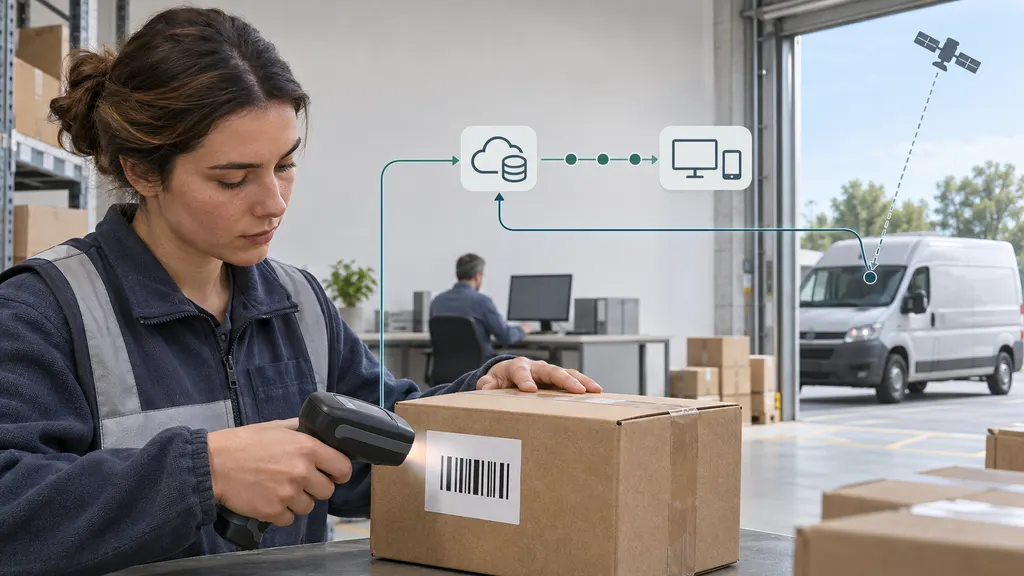
That distinction explains why a parcel can be moving while its tracking appears unchanged, why “label created” does not mean a carrier has collected it, and why a delivery map is not necessarily a precise view of the parcel itself.
What each part of the tracking system actually does
Barcodes, scanners, GPS receivers, and tracking software have different jobs. They work together, but none provides complete shipment visibility on its own.
- The shipment identifier connects the records. A tracking number or another logistics identifier lets systems associate events with a particular shipment or handling unit.
- The barcode makes the identifier machine-readable. Equipment can read it without an operator typing the characters manually.
- A scan or operational event records a milestone. This might be acceptance, sorting, departure, arrival, or delivery.
- GPS supplies positioning information to equipped devices. A delivery vehicle or handheld device may use it, depending on the carrier’s operation.
- The tracking platform presents the information. It turns carrier records into a timeline, status messages, and sometimes an estimated delivery date.
The most useful way to read a tracking page is as a shipment history with varying levels of detail, rather than as a continuous location feed.
How a barcode identifies your package
A shipping label can contain several machine-readable codes. Some identify the shipment; others may support routing, service selection, or internal handling. The exact contents depend on the carrier and label format. Not every barcode simply reproduces the tracking number printed beside it.
GS1, the organization responsible for widely used identification standards, defines the Serial Shipping Container Code, or SSCC, as an identifier for a logistics unit such as a parcel, case, or pallet. This illustrates an important principle: a code identifies the physical unit so that information about it can be stored and exchanged electronically. It does not need to contain the unit’s entire travel history.
When a scanner reads a label, the carrier’s software can use the decoded identifier to find or create the relevant shipment record. The surrounding system supplies the operational context, such as which facility handled the parcel and what activity occurred.
Why a barcode is not a location transmitter
A printed barcode has no battery, satellite receiver, or mobile connection. It cannot report where it is between scans. Its value comes from being read at known points in a logistics network.
A damaged, folded, or obscured label can make automated reading harder. A carrier may need another handling attempt or manual intervention. However, a missing public update alone does not prove that the label is damaged; it can have several other explanations.
How a scan becomes a tracking update
A tracking event usually passes through several systems before it appears on a website or in an app. The precise architecture varies, but the following sequence explains the basic process:
- The shipment is identified. A handheld scanner, fixed reader, or automated sorting system reads a code.
- The operation is recorded. The carrier associates the shipment with an activity, such as arrival at a facility or loading for delivery.
- The event reaches the carrier’s systems. The record is transmitted and processed. Some records may be uploaded later rather than immediately.
- The event becomes customer-facing information. Internal event codes are translated into messages such as “in transit” or “out for delivery.”
- The tracking page refreshes. A carrier website or a connected tracking service displays the information it has received.
Not every public update comes from someone scanning an individual parcel at that moment. Some updates are electronic shipment information, administrative changes, or events associated with a larger handling unit. Operational systems can link a parcel to a bag, pallet, or container and use that relationship when recording movement. Practices vary, so a status message should not automatically be interpreted as proof of an individual physical scan.
Event time and publication time are different
The time shown beside an event may describe when the activity happened, not when the website first displayed it. Processing, synchronization, connectivity, and time-zone differences can make an update appear late or make a timeline look confusing.
Read the event description together with its date, location, and surrounding entries. A newly visible record with an earlier timestamp does not necessarily mean the parcel has moved backward.
Where GPS helps—and where it does not
GPS receivers use signals from satellites to calculate position and time. As GPS.gov explains, GPS satellites transmit signals that receivers use for positioning; the satellites do not track individual parcels on behalf of a delivery company.
In a delivery operation, a GPS-enabled vehicle system or handheld device can provide location information. A separate communications connection is needed to send that information to the carrier’s systems. Receiving a GPS position and publishing it to a customer are two different functions.
Depending on the service, location information may support route management, delivery records, or a customer-facing map. None of those features should be assumed for every carrier or shipment.
- A vehicle position is not automatically a parcel position. The system also needs a reliable association between the parcel and that vehicle.
- A delivery-device position is not continuous parcel tracking. It may describe where an event was recorded, rather than every point along the parcel’s route.
- A map may show an approximation or a delayed update. Its meaning depends on the carrier’s explanation of that feature.
- GPS does not establish who received a parcel. A delivery investigation may also need a photograph, signature, delivery note, or other records.
Continuous tracking of the package itself requires additional hardware and a way to transmit its readings. That is different from ordinary barcode-based tracking and should not be assumed unless the shipping service explicitly provides it.
Reading the main milestones correctly
Label created or shipment information received
This generally means that shipment details have entered a system. It does not, by itself, establish that the carrier physically possesses the parcel. USPS makes this distinction in its tracking guidance: pre-shipment information and possession-related statuses represent different stages.
If this is the only event and the seller’s stated dispatch window has passed, ask the seller whether the parcel has actually been handed over. Refreshing the page cannot confirm a handover that has not yet been recorded.
Accepted, received, or picked up
An acceptance-related event is stronger evidence that the parcel has entered the carrier’s handling network. The wording and significance vary by carrier, so use the detailed event rather than relying only on a broad status label.
In transit or processed at a facility
“In transit” is a broad category. The parcel may be traveling between facilities, being sorted, or waiting for its next transport connection. A named facility usually describes the location associated with a recorded event, not a guaranteed current position.
Out for delivery
This normally indicates that the parcel has entered the local delivery stage. It is not a promise of an exact arrival time. Route changes, access issues, operational interruptions, or unsuccessful delivery attempts can affect the outcome.
Delivered
A delivered status reports that the carrier has recorded delivery. Check any available delivery details before concluding that a missing parcel is lost. The event may refer to an authorized reception point, parcel locker, household member, or another location permitted by the service.
If the details do not match what happened, contact the carrier and seller promptly. The status alone cannot resolve a disputed delivery.
Why tracking can pause while the shipment continues
A quiet timeline means that no newer customer-facing event is visible. It does not, on its own, prove either normal progress or a problem.
Long transport legs can have fewer reporting points than sorting operations. International shipments can also pass between organizations whose systems publish different levels of detail. Customs-related processing may not produce a new public event for each internal step.
Another possibility is delayed data transmission or publication. A parcel may reach the next stage before an earlier event appears online. Conversely, an unchanged timeline can reflect a genuine operational delay. Tracking history alone may not distinguish these cases.
The useful checks are contextual:
- What was the last meaningful event, and when did it occur?
- Has the carrier’s or seller’s stated delivery window passed?
- Does the timeline mention an exception, address problem, attempted delivery, or action required?
- Has a destination carrier or additional tracking number been identified?
- Is there a service-specific instruction for starting an inquiry?
There is no universal number of hours after which an unchanged tracking record proves a parcel is lost. Follow the applicable carrier’s inquiry process and protect any seller or marketplace claim deadlines.
How to use tracking tools without overreading them
Start with the tracking number supplied by the sender, rather than assuming that a store order number is also a carrier tracking number. Check that the number has been copied completely and that the carrier selection is correct when manual selection is required.
A package tracking page such as 17TRACK offers another place to look up shipment updates. When interpreting any tracking service, distinguish the information displayed from the physical events that generated it. A tracking website is not a substitute for a carrier investigation and cannot create a missing physical scan.
If two pages disagree, compare the detailed event wording and timestamps before treating the difference as a shipping problem. One page may have refreshed later, or the pages may summarize the same event differently. For a delivery dispute or a request requiring operational action, contact the responsible carrier and the seller rather than relying on repeated lookups.
FAQ
Can I find my package’s exact location using its tracking number?
Usually, the number retrieves recorded shipment events rather than a live position. Exact or map-based location information is available only when the particular carrier and service provide it. A facility name on a timeline is not necessarily where the parcel is now.
Does every parcel have a GPS tracker inside it?
No. An ordinary shipping label does not provide GPS tracking. A shipment can be tracked through barcode events without carrying a GPS device. Dedicated location hardware is a separate arrangement.
Can a package arrive without every scan appearing online?
Yes. A public timeline does not necessarily include every handling event, and information may be published late. Missing intermediate updates do not prevent delivery, although an overdue shipment may still require an inquiry.
Why does my tracking show only “label created”?
The sender may have submitted the shipment details before handing over the parcel, or a possession-related update may not yet be visible. Ask the sender to confirm dispatch if its stated handover window has passed.
Does a delivery GPS record prove the package reached my door?
Not by itself. It can help establish where a device recorded an event, but delivery evidence must be interpreted in context. Ask the carrier to review the available location record alongside any photograph, signature, delivery instructions, and driver notes.
Sources
- GS1: Serial Shipping Container Code — identification of logistics units such as parcels, cases, and pallets.
- GPS.gov: Global Positioning System — satellite signals, receivers, and positioning.
- USPS: USPS Tracking—The Basics — tracking information and interpretation of shipment statuses.
- 17TRACK: Tracking page — shipment lookup entry point.