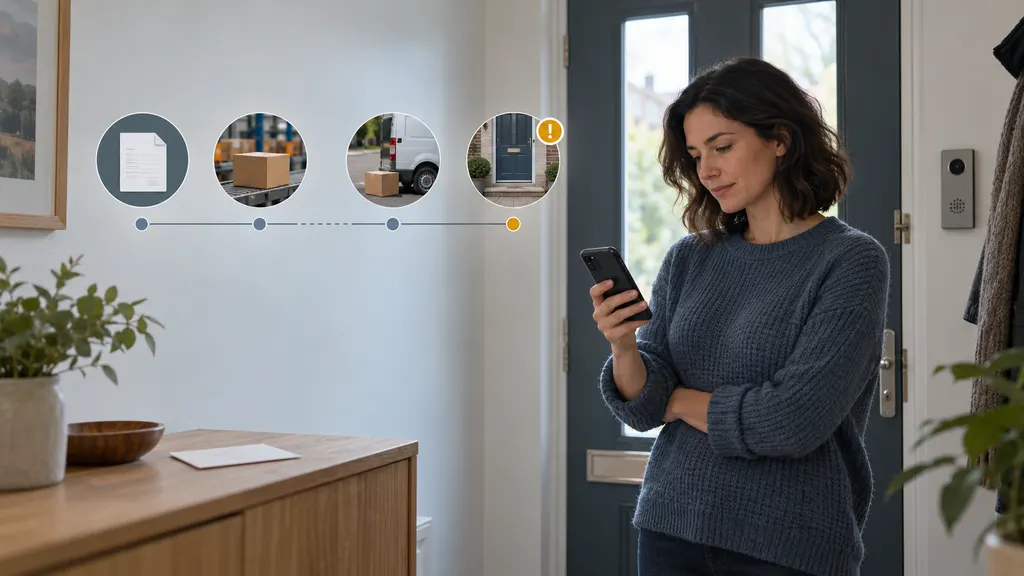
Poste Italiane Tracking in English: How to Read Italian Status Updates (Giacenza, in Lavorazione & more)
On Poste Italiane tracking, in lavorazione means your shipment is being processed, in transito means it is moving through the delivery network, and in giacenza means it is being held. Giacenza deserves particular attention: check the accompanying message or delivery notice to find out whether collection or another action is required. The English translation is a starting point; the full event, location, and timestamp tell you what to do next.
This guide explains common Italian tracking terms in plain English and helps you distinguish routine processing from a missed delivery, customs issue, or return. Exact wording can vary by postal service and delivery partner, so the phrases below are a reading guide rather than a complete list of official status labels.
How to check Poste Italiane tracking in English
- Find the shipment tracking number. Use the code on the posting receipt, shipping confirmation, or seller’s shipment details. A shop order number is not necessarily a postal tracking number.
- Open Poste Italiane’s official tracking search. Look for Cerca spedizioni, meaning “Search shipments,” and enter the code carefully.
- Read the latest event and the event before it. The sequence often explains more than the latest short label alone.
- Check the location and timestamp. A processing event abroad means something different from a delivery attempt near the recipient.
- Translate the message if needed. Browser translation can help, but keep the original Italian wording when contacting support.
You can also use 17TRACK’s English-language tracking page as an additional place to check your tracking number. For a collection address, a holding deadline, or instructions after an unsuccessful delivery, confirm the details in the postal operator’s tracking record or delivery notice. A tracking website cannot release a held shipment or authorize redelivery.
Italian tracking statuses translated into plain English
Some expressions describe a shipment’s progress; others describe an exception or a required action. Do not assume that every unfamiliar Italian phrase means a delay.
| Italian wording | English meaning | What to check or do |
|---|---|---|
| Presa in carico / Accettato | Taken in charge / Accepted | Check the full event to understand whether it records physical acceptance rather than shipment information alone. |
| In lavorazione | Being processed | Usually monitor for the next event; the phrase alone does not establish a problem. |
| In transito | In transit | Check the recorded location; this does not mean delivery is happening today. |
| In consegna | Out for delivery | Be ready to receive the shipment, but do not treat the label as a guaranteed delivery time. |
| Mancata consegna / Tentativo di consegna | Delivery not completed / Delivery attempt | Read the reason and look for a notice explaining the next step. |
| Destinatario assente | Recipient absent | Check whether the instructions specify another attempt or collection. |
| In giacenza | Being held / In storage | Identify the holding location, availability, deadline, and any action required. |
| Disponibile per il ritiro | Available for collection | Follow the collection instructions and check identification requirements. |
| In attesa di sdoganamento | Awaiting customs clearance | Check for a separate request for documents or payment; the status alone is not a payment demand. |
| Consegnato | Delivered | If you cannot find it, check the delivery details and contact the responsible operator. |
| Restituzione al mittente / Reso al mittente | Return to sender / Returned to sender | Read the full sentence to distinguish a return in progress from one already completed, then contact the sender. |
What does giacenza mean, and should you collect the shipment?
Giacenza means a holding or storage situation. In a postal tracking context, it can indicate that an item is being kept pending collection or another next step. It does not, by itself, identify the collection office, explain why the item is held, or tell you how long it will remain there.
A missed delivery followed by in giacenza is a reason to check the collection instructions promptly. However, do not travel to the nearest post office simply because the word appears. The shipment may be assigned to a different location, or the record may not yet confirm that it is available for pickup.
Before leaving to collect an item
- Confirm the exact collection location and opening hours.
- Check that the item is available for collection, not merely being transferred.
- Read the deadline on the delivery notice or service-specific instructions.
- Check which identification and shipment documents you need.
- If another person will collect it, verify the authorization requirements first.
There is no safe universal holding period to apply to every Poste Italiane shipment. Parcels, registered mail, and other postal services can have different rules. Use the instructions for your particular item rather than a deadline quoted for an unrelated service.
Be especially careful with formal notices and legal correspondence. The legal effect of an uncollected item is a separate question from the parcel’s physical location. A tracking translation should not be treated as legal advice about notification or deadlines.
Does in lavorazione mean the shipment is stuck?
No. In lavorazione means “being processed,” not “lost” or “stuck.” It can describe handling at a postal facility before the next stage. The phrase alone does not tell you whether processing is unusually slow, whether customs is involved, or when delivery will occur.
To judge whether you need help, compare the event history with the delivery estimate or service commitment for the shipment. Check whether the location has changed, whether a new exception has appeared, and whether the sender has supplied an expected delivery window.
Repeated processing entries are not enough to prove that the item is moving in circles. Different facilities or handling steps can produce similar wording. Equally, a lack of new public events does not prove that the shipment has not moved. Tracking is an event record, not continuous live location reporting.
Contact the sender or postal operator when the shipment is beyond its applicable delivery expectation, when an explicit problem appears, or when the tracking record asks you to act. Avoid using a fixed number of days for every domestic and international service.
Read the full event, not just the headline
Location gives a status its context
A processing event in an international exchange facility does not mean the parcel is already at the recipient’s local delivery office. Likewise, arrival in the destination country is not the same as customs release or readiness for delivery. Read each location alongside the event description.
The event timestamp is not a delivery appointment
A timestamp records when an event was logged; it is not automatically an estimated arrival time. Also check the date format. Italian dates commonly use day/month/year, so a date such as 07/08 can mean 7 August rather than July 8. When the format is unclear, use surrounding dates or a written month to resolve it.
A reason code can change your next step
A failed delivery caused by recipient absence calls for different checks from an address problem. Look for wording about an incomplete address, an unknown recipient, or collection instructions. If the address is wrong, contact the operator and sender rather than assuming another attempt will solve it. Whether an address can be corrected depends on the service and shipment stage.
International shipments, customs, and tracking gaps
For an international shipment, more than one postal operator may be involved. If the record identifies a destination delivery operator, check its official tracking page as well. The same shipment can have different levels of event detail across tracking systems, particularly around a handover.
Customs wording requires careful interpretation. In attesa di sdoganamento indicates that clearance is pending; it does not explain the cause or establish that you owe money. Look for a specific instruction requesting documents, information, or payment, and verify that request through an official channel.
If a text message says a parcel is held and asks you to pay through a link, open the official postal website separately and check the shipment there. Do not treat an unsolicited message as authentic merely because it uses a familiar Italian tracking phrase.
Who to contact when the next step is unclear
For collection details, a missed delivery, or a local delivery question, start with the postal operator handling that stage. For a purchase that has not arrived, also contact the seller. The sender may need to initiate an inquiry or claim, depending on the service and the applicable procedure.
Have the tracking number, original Italian status, event date, destination address, and any delivery notice ready. Ask a specific question: “Is this item available for collection, and at which location?” is more useful than “Why is tracking not working?”
If tracking says consegnato but you have not received the shipment, check the recorded delivery details, household members, reception staff, or another authorized receiving point where relevant. If it remains missing, report the discrepancy to the operator and seller. Do not assume the delivered label proves that you personally accepted the item.
FAQ
Can I collect a shipment as soon as giacenza appears?
Only after confirming where it is held and whether it is available for collection. Check the latest event and delivery notice for the location, availability, deadline, and required documents. Giacenza alone is not a complete pickup instruction.
Does in consegna guarantee delivery today?
It generally means “out for delivery,” but it is not an unconditional guarantee. A delivery attempt can still be unsuccessful. Check for a later event before concluding that the shipment has been delivered or returned to the depot.
Why does the seller say shipped when Poste Italiane shows no result?
A seller’s shipping notification is not necessarily evidence of a physical postal acceptance scan. Confirm that you have the correct tracking code and carrier, then ask the seller to verify handover if the record remains unavailable. A missing result alone does not establish loss.
Does a customs status mean I must pay a fee?
Not necessarily. A clearance-related status can describe a processing stage without requesting payment. Follow only a verified, shipment-specific instruction, and confirm any unexpected payment request through the official operator.
Can a tracking website arrange redelivery or stop a return?
A tracking page helps you read shipment events; it does not itself establish authority to change delivery arrangements. Ask the postal operator about available options. If return to sender has started, involve the sender promptly rather than assuming the shipment can still be intercepted.
Sources
- Poste Italiane — shipment search: official starting point for checking the shipment-specific event history and instructions.
- Poste Italiane — assistance: official starting point for support and service-specific questions.
- 17TRACK — English-language tracking page: an additional shipment-tracking interface.