Palletized Unit Implements
What Are Palletized Unit Implements?
Palletized unit implements is an ambiguous expression that may refer, in a warehouse or freight-handling document, to equipment and accessories used to form, secure, move, or store a palletized unit load. The more precise established terms are palletized unit load for the goods assembled on a pallet, load-securing materials for items that hold the goods together, and material-handling equipment for machinery that moves them. The intended meaning should therefore be checked against the document in which the expression appears.
The sources cited in this entry address pallets, lift trucks, load identification, and wood packaging requirements; they do not establish “palletized unit implements” as a formal equipment category. This entry explains the relevant logistics concepts rather than treating the phrase as a standardized technical designation. In an equipment inventory or product description, “implements” might also mean tools or machinery that are themselves packed on pallets, rather than equipment used to handle pallets.
Understanding the Palletized Unit Load
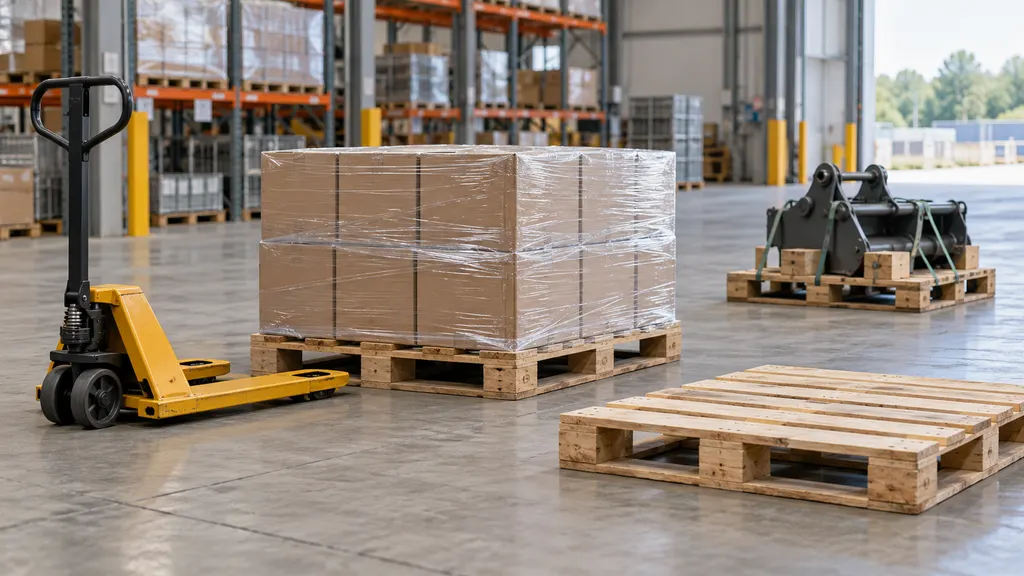
A palletized unit load consists of goods assembled on a pallet so that they can be handled together. Cartons, sacks, drums, or other packages may be arranged on the platform and restrained using materials appropriate to the goods and transport conditions. The pallet provides a handling interface, while the packaging arrangement and restraint help maintain the load's integrity.
The distinction between the load and the equipment is important. A forklift is not part of the palletized goods merely because it moves them. Stretch film may remain with the load during transport, but it is not lifting equipment. A warehouse rack supports stored pallets, yet it is not a substitute for a suitable pallet or a stable load.
In ecommerce logistics, palletized loads may appear during supplier deliveries, transfers between fulfillment facilities, wholesale distribution, or consolidated returns. Individual customer orders may later be picked from those loads and dispatched as parcels. Consequently, a palletized inbound delivery and an outbound consumer parcel represent different handling units, even when they contain the same product line.
Equipment and Materials Associated with Palletized Loads
The following groups describe functions within pallet handling. They are practical distinctions, not a formal classification of “palletized unit implements.” Equipment selection depends on the goods, pallet design, load characteristics, operating environment, and applicable safety instructions.
| Item or group | Primary function | Important boundary |
|---|---|---|
| Pallet | Provides a platform for assembling and mechanically handling goods. | Suitability depends on its design, condition, intended use, and loading conditions. |
| Stretch film and strapping | Help contain or restrain the packages forming a unit load. | They do not automatically make an unstable arrangement safe or secure it to a vehicle. |
| Edge protectors and protective sheets | Protect packaging or distribute contact forces where appropriate. | Their effectiveness depends on placement, material, and the load arrangement. |
| Pallet trucks | Lift pallets sufficiently for movement over suitable surfaces. | Fork access, capacity, floor conditions, and operating instructions still matter. |
| Forklift trucks | Lift and transport compatible loads within their operating limits. | Rated capacity, load position, attachments, and stability must be considered. |
| Wrapping or palletizing machinery | Assists with assembling or containing loads. | Machine operation does not replace assessment of the finished load. |
| Pallet racking | Supports compatible palletized loads in storage. | A pallet suitable for floor use is not automatically suitable for every rack arrangement. |
How Palletized Loads Are Prepared and Handled
1. Establish the load requirements
Preparation begins with the goods rather than the handling equipment. Relevant factors include package strength, weight distribution, fragility, dimensions, and any restrictions on orientation or stacking. The planned movement also matters: a load may encounter warehouse floors, rack storage, loading docks, vehicles, or several transfers before delivery.
A practical specification should distinguish the weight of the goods from the total weight of the assembled load, including its pallet and packaging. It should also identify the overall dimensions and any special handling restrictions. These details help the parties select compatible equipment without relying on an imprecise expression such as “palletized unit implements.”
2. Select and inspect the pallet
The pallet must be suitable for the intended load and handling method. Inspection should consider visible damage, missing or displaced components, and conditions that could impair support or safe handling. The UK Health and Safety Executive's pallet guidance emphasizes pallet selection, inspection, and the relationship between pallet design and use.
There is no single universal capacity that can safely be assigned to all pallets. How a pallet is supported can affect its performance. A load resting on a floor presents different support conditions from one supported in a rack or carried on forks. A capacity statement should therefore be interpreted with its specified conditions rather than copied into every operating situation.
3. Arrange and secure the goods
The load arrangement should maintain stability and avoid damaging the packages below. Depending on the goods, this may require attention to alignment, support, gaps, and pressure from restraint materials. Overhanging packages can be exposed to impact or inadequate support; an arrangement that fits within the pallet footprint can still be unstable if the goods shift or the packaging fails.
Stretch wrapping, strapping, and protective accessories should be selected for the actual load. Their presence alone is not evidence of adequate containment. Equally, containing the packages on the pallet does not establish that the palletized load is adequately restrained inside a truck or freight container. Unit-load containment and transport restraint address related but different risks.
4. Match the load to handling equipment
Operators need to consider pallet entry points, fork dimensions, equipment capacity, and the load's position. For powered industrial trucks in the United States, OSHA's requirements address matters including stable loads, rated capacity, and operator training. These are jurisdiction-specific requirements, not a universal certification system for every pallet-handling device.
Attachments require particular attention because they can affect a truck's capacity and operating characteristics. Equipment should be used within the manufacturer's instructions and the requirements applicable to the workplace. A load that can physically be lifted is not necessarily a load that can be handled safely throughout the planned route.
5. Identify and verify the handling unit
Physical handling and inventory identification serve different purposes. A warehouse may record the products and quantities on a pallet while also assigning an identifier to the assembled logistics unit. Under the GS1 system, a Serial Shipping Container Code, or SSCC, identifies a logistics unit, which may be a palletized load.
An identifier does not certify pallet strength, packaging quality, or regulatory compliance. Its purpose is identification. Receiving staff still need to check the physical load, reconcile the contents with the relevant records, and note discrepancies or visible damage.
Cross-Border Shipping Considerations
International movements introduce packaging requirements that are separate from warehouse handling. ISPM 15 addresses phytosanitary measures for wood packaging material used in international trade. Depending on the material and applicable implementation, wooden pallets may fall within its scope. The standard contains exclusions, including specified processed wood materials, so not every packaging item made from wood-based material should be treated identically.
An ISPM 15 mark concerns the phytosanitary treatment framework. It is not a pallet load-capacity rating, a declaration of product origin, or confirmation that an entire shipment meets customs requirements. Shippers should check the destination's applicable requirements and the actual packaging material instead of assuming that a pallet's appearance establishes compliance.
Palletization also does not change the identity of the goods for commercial documentation. Product descriptions, quantities, values, and other required shipment information remain relevant. A pallet identifier can help connect a physical handling unit to records, but it does not replace the information required for the goods themselves.
Related Terms and Common Misunderstandings
| Term | Meaning | Distinction |
|---|---|---|
| Palletization | The process of arranging goods on pallets for handling. | Describes an activity rather than a piece of equipment. |
| Palletized unit load | Goods assembled on a pallet to be handled together. | Describes the physical load, not the machinery moving it. |
| Material-handling equipment | Equipment used to move, lift, or otherwise handle materials. | A broader category that includes equipment unrelated to pallets. |
| Load containment | Measures that help keep the packages together as a unit. | Does not by itself establish adequate restraint within a vehicle. |
| Shipment | Goods dispatched under a particular shipping arrangement. | A shipment may contain multiple pallets; one pallet is not automatically the entire shipment. |
Another misunderstanding is that “palletized” means ready for any transport network. Acceptance depends on the relevant service conditions, physical dimensions, weight, packaging, and handling requirements. Palletization describes how goods are assembled; it does not promise acceptance by a carrier or compatibility with every warehouse.
Interpreting the Phrase in Operational Documents
If “palletized unit implements” appears in a purchase order, packing specification, translated manual, or equipment list, the following checks can help resolve its meaning:
- Identify the object: Determine whether the document concerns goods on pallets, handling machinery, restraint materials, or tools shipped as cargo.
- Check the stated function: Words such as lifting, wrapping, storing, or transporting usually indicate which equipment or material is intended.
- Request a precise description: A model designation, drawing, material specification, or photograph may clarify an unclear label.
- Separate specifications: Record pallet requirements, load dimensions, equipment limits, and packaging requirements independently.
- Resolve ambiguity before use: Do not infer lifting capacity, compatibility, or regulatory status from the phrase alone.
For example, a retailer may receive cartons of household goods assembled on pallets. The cartons and pallets form the palletized loads; wrapping helps contain the cartons; a forklift unloads them; and a warehouse system records their identities. Describing all these elements as “implements” would obscure the separate responsibilities of packaging, handling, and inventory control.
QA
Is “palletized unit implements” a standard logistics term?
The references used here do not establish it as a formal term. Its meaning should be confirmed from context. “Palletized unit load,” “load-securing materials,” or “material-handling equipment” may be more precise, depending on what is intended.
Is a palletized unit load the same as a pallet?
No. The pallet is the supporting platform. The palletized unit load includes the goods assembled on it and the associated packaging or restraint materials.
Does stretch wrapping make a pallet safe to ship?
Not by itself. Pallet condition, package strength, load arrangement, containment, handling compatibility, and transport restraint must also be considered.
Does an ISPM 15 mark confirm a pallet's carrying capacity?
No. The mark relates to the phytosanitary treatment framework for wood packaging material. It does not state the pallet's load capacity or confirm that the complete shipment meets every import requirement.
Sources
- Health and Safety Executive: Pallet safety, Guidance Note PM15 — Guidance on pallet selection, inspection, handling, and suitability for intended use.
- Occupational Safety and Health Administration: 29 CFR 1910.178, Powered industrial trucks — United States requirements concerning powered industrial truck operation, loading, capacity, and training.
- International Plant Protection Convention: ISPM 15, Regulation of wood packaging material in international trade — Scope, exclusions, treatment, and marking framework for regulated wood packaging material.
- GS1: Serial Shipping Container Code — Identification of logistics units, including palletized loads.