Drop and Pull Transport
Definition
Drop and pull transport is a trucking operating method in which a tractor leaves, or “drops,” one trailer at a facility and then “pulls” another trailer for the next movement. The replacement trailer may be loaded, empty, or assigned to a different leg of the journey. The term is used mainly in road freight and trailer operations, but it is not a universally standardized technical expression. In some businesses, it is used broadly for the same basic operating pattern as drop-and-hook transport; in others, it describes a particular scheduled exchange of trailers.
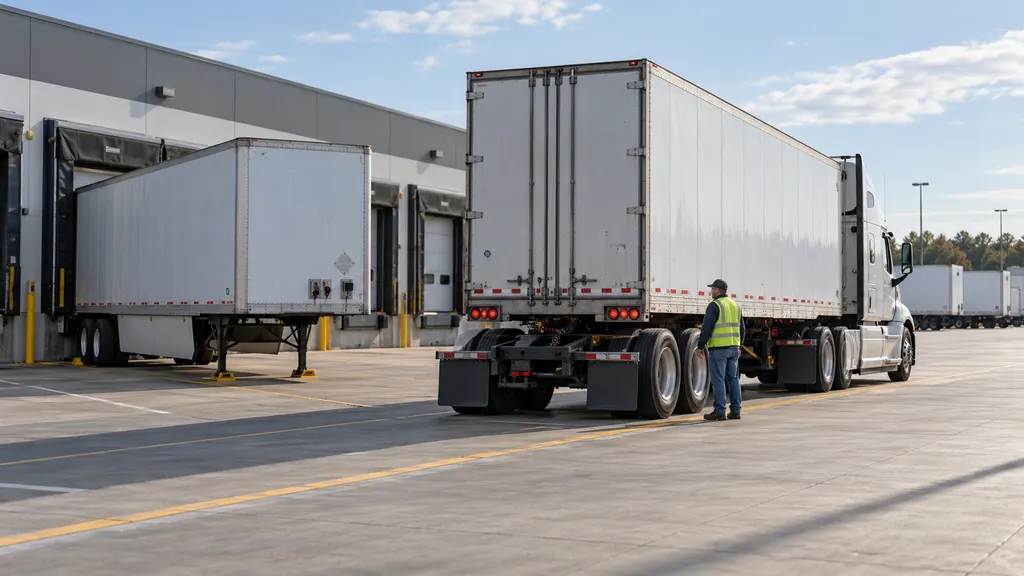
The central idea is that the tractor and driver do not necessarily remain with the same trailer during loading, unloading, or a handoff. A trailer can be left at a shipper, warehouse, distribution center, rail terminal, or cross-dock while the tractor continues with another trailer. This differs from a live-load or live-unload movement, where the driver and tractor normally wait while cargo is loaded or unloaded.
Because terminology varies by carrier, shipper, and region, an operating instruction should identify the required trailer, location, appointment, seal status, and paperwork rather than relying on the phrase alone.
How Drop and Pull Transport Works
A typical movement follows a sequence similar to the one below. The exact process depends on the shipper’s yard rules, the carrier’s dispatch system, and the legal and safety requirements in the relevant jurisdiction.
- Trailer assignment: A carrier or logistics operator assigns a tractor and driver to a trailer, route, or planned trailer exchange.
- Arrival at the facility: The driver checks in and follows the facility’s instructions for parking, loading, unloading, or trailer exchange.
- Drop: The driver disconnects the tractor from the designated trailer in an approved yard position. The trailer may remain on the property while it is loaded, unloaded, inspected, staged, or collected by another tractor.
- Pull: The driver connects to another approved trailer and checks that the tractor-trailer combination is safe and legally ready to move.
- Verification: The driver or carrier verifies the trailer number, cargo condition, seal, lights, tires, brakes, registration documents, and shipping paperwork as applicable.
- Line-haul or local movement: The replacement trailer moves to the next facility, terminal, customer, or border point.
- Record update: The carrier or shipper records the trailer exchange, status event, departure, and any exceptions in a transportation management system or other operational record.
The phrase does not by itself specify whether the trailer being pulled is loaded. It also does not state who owns the trailer, who is responsible for the cargo, or whether the movement is domestic or international. Those matters must be established by the transport agreement, operating instructions, and applicable law.
Role in Logistics
Drop and pull transport separates tractor utilization from trailer dwell time. A trailer can wait for loading or unloading while the tractor performs another assignment. This may help a carrier plan driver time and equipment use, particularly where a facility can prepare trailers in advance. It can also support scheduled trailer pools, relay operations, cross-docking, and repeated movements between a warehouse and a regional terminal.
The method does not eliminate waiting from the supply chain. Instead, it can move some waiting time from the tractor to a trailer or yard position. Its effectiveness therefore depends on accurate trailer preparation, sufficient yard capacity, clear identification, and reliable dispatch information. If the replacement trailer is not ready, correctly positioned, or correctly documented, a drop-and-pull plan can create additional handling and delay.
| Operational element | Relationship to drop and pull transport | Control point |
|---|---|---|
| Tractor | Moves between trailers and may perform more than one trip or assignment. | Confirm coupling, brake connections, lights, and vehicle inspection requirements. |
| Trailer | May remain at a facility while the tractor is used elsewhere. | Record trailer identity, condition, location, and status. |
| Cargo | Remains inside the trailer during a handoff unless a separate loading or unloading operation occurs. | Check seal, visible condition, documents, and custody instructions. |
| Yard | Provides the approved location for staging and exchanging trailers. | Use designated spaces and follow site safety rules. |
| Dispatch system | Links the tractor, trailer, route, shipment, and status event. | Update the exchange promptly to avoid inaccurate tracking. |
Drop and Pull in Ecommerce and Cross-Border Shipping
In ecommerce logistics, this operating method may appear behind the customer-facing shipment. An online order can be consolidated at a fulfillment center, placed in a trailer, moved to a parcel or freight terminal, and then transferred to another trailer for a later leg. The consumer may see only a tracking status such as “departed facility,” while the underlying transport plan includes one or more trailer exchanges.
For cross-border freight, a trailer exchange may occur before a border crossing, at a bonded or customs-controlled facility, or after clearance. The exchange itself does not constitute customs clearance. Customs declarations, commercial invoices, permits, security filings, inspections, and release decisions remain separate processes. A shipper should also establish whether the cargo stays sealed, whether the trailer can be changed without changing the customs documentation, and which party must report an exception.
For parcel ecommerce, the term is less likely to describe the final delivery vehicle. It is more relevant to truckload, less-than-truckload line-haul, intermodal support, or middle-mile movements in which trailers are staged and exchanged. A delivery promise should therefore not be inferred from the phrase alone.
Characteristics and Operating Conditions
- Trailer-based movement: The method depends on a trailer that can be safely parked, identified, and connected to another tractor.
- Planned handoff: The exchange is normally scheduled or authorized rather than being an informal change of equipment.
- Separation of activities: Loading, unloading, staging, and line-haul driving can occur at different times and may involve different personnel.
- Equipment compatibility: The tractor, trailer, air-brake system, electrical connection, coupling equipment, and legal dimensions must be compatible.
- Document continuity: Shipment identifiers and transport records must remain linked to the correct trailer and movement.
- Yard dependence: The operation requires suitable parking space and a process for locating ready, occupied, empty, damaged, or held trailers.
- Exception sensitivity: A missing seal, wrong trailer, damaged equipment, inaccessible yard, or inaccurate status can interrupt the movement.
These are operating characteristics rather than a formal legal classification. A carrier’s contract, safety procedures, and local regulations determine the precise responsibilities of the driver, carrier, shipper, consignee, and facility.
Comparison With Related Terms
| Term | Main meaning | Difference from drop and pull transport |
|---|---|---|
| Drop-and-hook | A driver drops one trailer and hooks to another without waiting for the trailer to be loaded or unloaded at that moment. | Often used as a synonym, although some operators use “drop and pull” for a narrower or locally defined exchange. |
| Live load or live unload | The tractor and driver wait while cargo is loaded into or removed from the trailer. | The tractor remains associated with the trailer during the handling operation. |
| Power-only service | A carrier supplies a tractor and driver to move a trailer supplied by another party. | Power-only describes the equipment arrangement; it does not necessarily specify whether a trailer is dropped and another is pulled. |
| Trailer pool | A group of trailers staged for use by an authorized carrier or network. | A trailer pool can support drop and pull movements, but the terms are not interchangeable. |
| Drayage | Short-distance movement, often involving containers between ports, terminals, rail facilities, and nearby locations. | Drayage may use trailer or container exchanges, but drop and pull describes the operating action rather than the transport market. |
| Drop shipment | An ecommerce or distribution arrangement in which goods are sent directly from a supplier to a customer. | It concerns order fulfillment and distribution structure, not the exchange of a truck trailer. |
Advantages and Limitations
Potential operational benefits include reduced tractor waiting at a loading facility, greater flexibility in assigning tractors, easier staging of preloaded trailers, and better separation of loading work from road movement. These benefits are not automatic. They depend on a facility having enough trailers, yard space, labor, accurate appointment information, and a process for releasing equipment.
Limitations include additional yard handling, possible trailer congestion, inaccurate equipment records, cargo-security risks, and confusion over who has custody of the shipment. A trailer that is ready in the system may not be physically ready in the yard. Conversely, a trailer that appears available may contain freight, be under customs control, have a maintenance defect, or be assigned to another movement.
Drop and pull can also complicate tracking. A shipment may remain in the same trailer while the tractor changes, or it may move to a different trailer during consolidation. Tracking records should distinguish the shipment, trailer, tractor, driver assignment, and facility event. A trailer-exchange event is not necessarily proof that the cargo has reached its destination or passed customs.
Practical Checks for Shippers and Carriers
- Define whether the instruction means a drop-and-hook exchange, a trailer pickup, or another local procedure.
- Use a unique shipment, trailer, and appointment reference where possible.
- Specify the approved drop location and the identity of the trailer to be pulled.
- Confirm whether the replacement trailer must be loaded, empty, sealed, temperature-controlled, or equipped for a particular cargo type.
- Record the seal number and investigate any discrepancy before departure.
- Check trailer condition and required safety equipment before accepting the trailer.
- Clarify responsibility for cargo custody, damage reporting, customs documents, and detention or storage events.
- Update tracking records when the trailer is dropped, when the replacement is pulled, and when the movement departs.
- For international freight, confirm how a trailer change affects transport documents, security filings, and customs procedures.
Common Misunderstandings
It does not mean that cargo is physically pulled from one trailer to another. In the usual trucking sense, the tractor is disconnected from one trailer and connected to another. The freight may remain inside its original trailer.
It is not automatically the same as a delivery. A trailer exchange is an equipment and transport event. It does not by itself confirm unloading, receipt by the consignee, final-mile delivery, or completion of an ecommerce order.
It is not a customs procedure. A cross-border trailer handoff may occur in a customs-related movement, but customs declaration, inspection, release, and duty treatment are governed by separate rules and documents.
The wording may not be consistent across companies. Some organizations use drop and pull as a synonym for drop-and-hook, while others define it in dispatch instructions or carrier contracts. The local operating definition should control.
QA
What does drop and pull mean in logistics?
It usually means that a tractor drops one trailer and pulls another trailer for the next movement. The replacement trailer may be loaded or empty, depending on the operating plan.
Is drop and pull the same as drop-and-hook?
Often, but not always. Many operators use the terms interchangeably, while some use drop and pull for a specific local trailer-exchange procedure. The carrier’s instructions should be checked.
Does drop and pull reduce delivery time?
It can reduce the time a tractor waits at a facility when another trailer is ready, but it does not guarantee faster delivery. Yard congestion, trailer availability, documentation, and other transport stages can still cause delay.
Does a trailer exchange change customs clearance?
Not by itself. Customs status depends on the applicable declarations, documents, controls, and release procedures. A cross-border trailer change should be coordinated with the parties responsible for those requirements.
Sources
- Wikipedia, “Drop and hook” — reference for the related trucking operating concept and terminology.
- U.S. Federal Motor Carrier Safety Administration, “Cargo Securement Rules” — safety and cargo-securement context for commercial road transport.
- World Customs Organization, “SAFE Framework of Standards” — cross-border supply-chain security and customs context.
- United Nations Economic Commission for Europe, UN/CEFACT resources — reference context for standardized trade and transport information exchange.