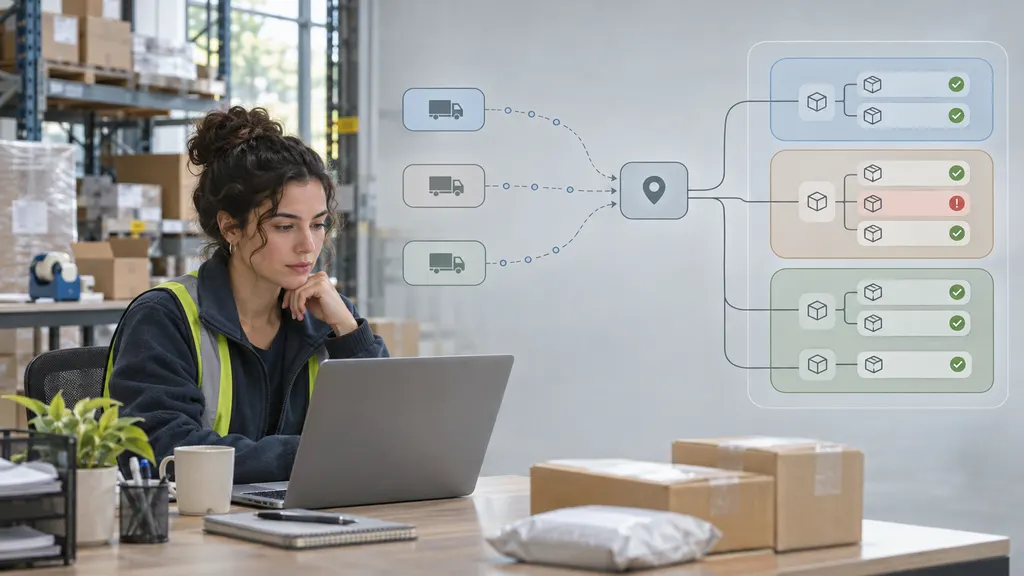
Storing
What Is Storing?
Storing is the act of keeping goods, materials, products, or information in a designated place for later use, sale, processing, transport, or disposal. In logistics and ecommerce, storing usually refers to placing inventory in a warehouse, fulfillment center, distribution center, stockroom, or another controlled location while it is between stages of the supply chain. The more formal noun is usually storage, while storing describes the activity or process of putting items into storage and keeping them there.
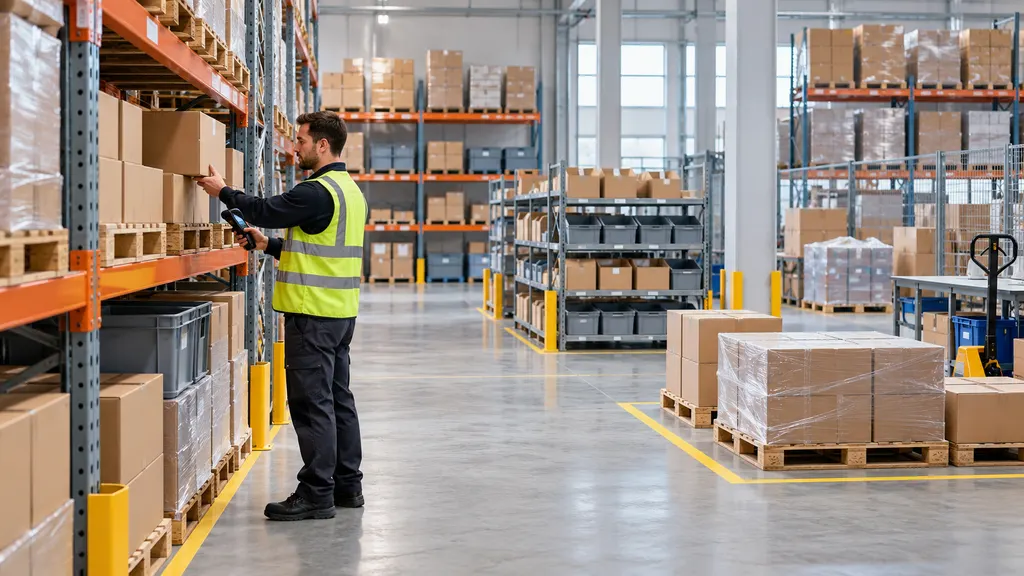
Storing is different from transporting, because the primary purpose is temporary or long-term retention rather than movement. It is also different from inventory management, which includes the broader control of stock levels, records, replenishment, allocation, and availability. Storing is one operational activity within warehousing and inventory management.
Storing in Logistics
In a supply chain, storing connects inbound receiving with later activities such as order fulfillment, manufacturing, distribution, or returns processing. A shipment may arrive at a facility, be checked against its documents, and then be stored in an assigned location until it is needed. The location may be a shelf, bin, pallet position, cage, rack, yard area, temperature-controlled room, or another storage zone.
The storing process normally involves more than placing an item on a shelf. It may include identifying the stock, recording its quantity and location, applying handling rules, protecting it from damage, and making it retrievable. The exact process depends on the product, facility, order system, regulatory requirements, and expected storage duration.
| Supply chain activity | Purpose | Relationship to storing |
|---|---|---|
| Receiving | Accept goods arriving at a facility and check them against available information. | Usually occurs before goods are stored. |
| Storing | Keep goods in an assigned location until a later operation requires them. | The central activity described by the term. |
| Picking | Collect items for an order, production requirement, transfer, or other task. | Usually removes goods from their storage location. |
| Dispatching | Prepare and release goods for transportation or delivery. | Usually occurs after storage and order processing. |
| Returns processing | Inspect and decide what to do with goods sent back. | Returned goods may be stored temporarily before disposition. |
How Storing Works
Although warehouse procedures differ, storing can be understood as a sequence of decisions and controls:
- Identify the goods. The facility identifies the stock using information such as a product code, description, batch or lot reference, serial number, quantity, or order association. Reliable identification helps distinguish one stock item from another.
- Check the condition and quantity. Staff may inspect packaging, count units, and record visible damage or discrepancies. The goods may be placed on hold if they require inspection, documentation, or a decision before becoming available for sale or use.
- Assign a storage location. The location may be selected according to product characteristics, available capacity, handling requirements, picking efficiency, security, or the operating rules of the facility. In a system-directed warehouse, software may recommend or assign the location.
- Move the goods to the location. Employees or material-handling equipment move the goods using an appropriate method. The method may depend on weight, dimensions, packaging, fragility, and workplace safety controls.
- Record the storage event. A warehouse management system, inventory record, paper document, barcode process, or another control records where the goods were placed and how much was stored. The record should support later retrieval and reconciliation.
- Maintain the goods while stored. The facility monitors the stock according to its characteristics. This can include protecting goods from unauthorized access, contamination, moisture, temperature variation, crushing, misplacement, or other relevant risks.
- Release the goods when required. A picking request, production instruction, transfer order, dispatch plan, or returns decision may trigger removal from storage. The recorded quantity and location are then updated.
This sequence is not a universal legal or technical standard for every facility. It is a practical description of common warehouse controls. A small stockroom may perform these activities informally, while a large fulfillment center may automate many of them.
Types of Storing
Storing can be described using several different classification dimensions. These dimensions should not be treated as one single official classification system. They describe different aspects of the activity.
| Classification basis | Examples | What the distinction explains |
|---|---|---|
| Storage duration | Short-term, seasonal, or long-term storing | How long goods are expected to remain in the location. |
| Product condition | Ambient, chilled, frozen, hazardous, or secure storing | Environmental or safety controls required by the goods. |
| Handling unit | Piece, carton, case, tote, pallet, or bulk stock | The physical unit used to move and record the goods. |
| Operational purpose | Reserve stock, forward-pick stock, cross-dock staging, or returns holding | The role of the location within a warehouse process. |
| Ownership or status | Available stock, customer-owned stock, quarantined stock, or damaged stock | Whether goods may be sold, used, transferred, or released. |
For example, a pallet of saleable products may be stored in a reserve location, while a smaller quantity of the same product is stored in a forward-pick location. The distinction is operational rather than a change in the product itself. Similarly, goods awaiting quality inspection may be physically inside the facility but should not necessarily be treated as available inventory.
Storing in Ecommerce
In ecommerce, storing is closely connected with fulfillment. An online retailer or fulfillment provider keeps products in stock until an order is accepted and the required units are picked, packed, and dispatched. The storage record helps the operator determine whether a product is available and where it can be found.
Storing decisions can affect order processing without determining every part of the customer experience. A well-organized storage process can help reduce search time, location errors, stock discrepancies, and avoidable handling. However, storing alone does not guarantee fast delivery or accurate inventory. Order allocation, picking, packing, carrier handoff, transportation, and delivery also affect the result.
A retailer may store different products in different areas because they have different dimensions, demand patterns, handling instructions, or security requirements. An example is a warehouse that keeps small standard products in bins, large products on pallet racks, and returned products in a separate area until they are inspected. This is a general operational example, not a claim about how all retailers operate.
Storing in Cross-Border Ecommerce
Cross-border ecommerce adds documentation, ownership, customs, and destination considerations to storing. Goods may be stored before export, while awaiting an international transport leg, after arrival in the destination country, or while a return is being assessed. The physical act of placing goods in a location may be similar to domestic warehousing, but the legal and commercial status of the goods can be different.
For example, an operator may need to distinguish goods that are available for domestic sale from goods that are held for export, awaiting customs-related action, or associated with a return shipment. The exact requirements depend on the countries involved, the type of goods, the facility, and the applicable customs and tax rules. Storing goods in a country does not by itself determine their customs status, tax treatment, or legal ownership.
Cross-border operators should therefore keep records that can connect the physical stock with relevant commercial and transport information. Depending on the operation, this may include product identifiers, quantities, origin information, import or export documentation, shipment references, and the status of returned or held goods. These are operational considerations rather than a universal checklist for every jurisdiction.
Storing and Inventory Accuracy
Inventory accuracy means that recorded stock information corresponds sufficiently with the stock that is physically present and available under the relevant rules. Storing affects accuracy because a misplaced item, incorrect quantity, duplicate location, or unrecorded movement can make later inventory decisions unreliable.
Common controls include location labels, barcode scanning, stock counts, cycle counting, movement records, exception handling, and separation of stock with different statuses. A system can show that goods are present while still failing to show whether they are damaged, reserved for another order, awaiting inspection, or physically inaccessible. For that reason, quantity and status are both important parts of a useful storage record.
Storing Compared With Related Terms
| Term | Meaning | Key difference from storing |
|---|---|---|
| Storage | The condition, space, or activity of keeping goods for later use. | Storage is the usual noun; storing emphasizes the action. |
| Warehousing | The broader operation of receiving, holding, controlling, handling, and dispatching goods. | Storing is one activity within warehousing. |
| Inventory management | The broader control of stock quantities, locations, status, replenishment, and availability. | Storing concerns physical retention; inventory management also concerns planning and records. |
| Fulfillment | The process of preparing and completing an order, often including picking, packing, and dispatch. | Storing happens before or between fulfillment activities. |
| Staging | Temporarily positioning goods for an immediate next step, such as loading or picking. | Staging is normally linked to a planned movement, whereas storing may last longer. |
| Stockpiling | Accumulating a substantial quantity of goods, often as a precaution or for future need. | Stockpiling describes an accumulation strategy, not every ordinary storage activity. |
Common Misunderstandings
- Storing does not mean shipping. Goods may be stored before shipment, but storing itself does not involve handing the goods to a carrier.
- Stored inventory is not always available inventory. Goods can be held because they are reserved, damaged, quarantined, awaiting inspection, or subject to another restriction.
- Storage and warehousing are not exact synonyms. Storage focuses on keeping goods, while warehousing normally includes a wider set of facility and inventory activities.
- Storing does not automatically establish customs treatment. The customs or tax status of goods depends on the applicable rules and facts of the transaction, not simply on the existence of a physical storage location.
- The term is not always used as a formal process name. In operational documents, companies may use terms such as put-away, storage, inventory holding, or warehouse handling. Their exact meanings can depend on the organization.
Practical Checks for a Storing Process
When reviewing a storing process, an operator can ask whether each item has a clear identity, a recorded quantity, an assigned location, and a defined inventory status. It is also useful to check whether the location is suitable for the product, whether movement records are updated promptly, and whether staff can retrieve the item without relying on undocumented knowledge.
For cross-border operations, the review may also consider whether physical stock can be linked to relevant shipment or commercial records and whether held, returned, damaged, or restricted goods are separated from saleable inventory. These checks do not replace legal, safety, customs, or product-specific requirements, but they help identify gaps between physical handling and inventory records.
QA
What does storing mean in logistics?
In logistics, storing means keeping goods in an assigned facility or location until they are needed for picking, production, transport, sale, transfer, or another supply chain activity.
What is the difference between storing and warehousing?
Storing is the activity of keeping goods. Warehousing is broader and can include receiving, storing, inventory control, picking, packing, staging, dispatch, and returns handling.
Are stored goods always available for sale?
No. Goods may be stored while reserved, damaged, awaiting inspection, quarantined, returned, or subject to another operational or legal restriction.
Is storing the same as storage?
They are closely related. Storing is the action of keeping goods, while storage is the usual noun for the activity, condition, space, or arrangement used to keep them.
Sources
- Cambridge Dictionary: “Store” — supports the general meaning of keeping something for future use.
- Encyclopaedia Britannica: “Warehouse” — provides reference context for warehouses and the holding of goods.
- GS1: Traceability Standards — supports the relevance of identifying and tracing products and inventory through supply-chain processes.
- World Customs Organization: Customs Glossary — provides customs terminology and context relevant to goods held in international trade operations.