Attachments of Fork Lift Trucks
What Are Attachments of Fork Lift Trucks?
Attachments of fork lift trucks are devices fitted to a forklift's carriage, forks, or other approved mounting points to change how the truck supports, grips, positions, or moves a load. Also called forklift attachments, they are used in warehouses, distribution centers, freight terminals, and production facilities to handle goods that standard forks alone cannot handle conveniently or appropriately. Examples include side shifters, fork positioners, carton clamps, rotators, and fork extensions.
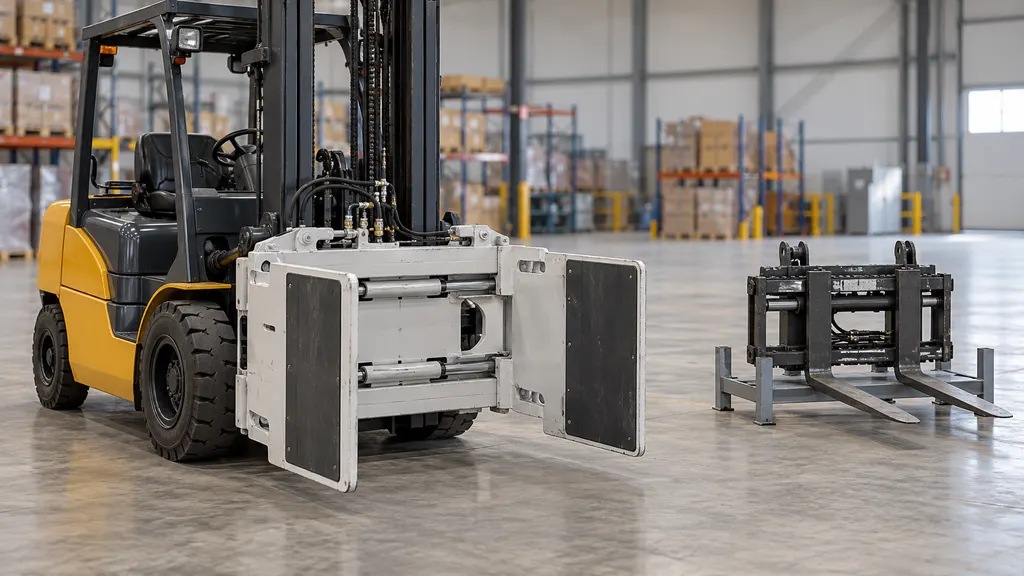
An attachment forms part of the truck's load-handling arrangement rather than functioning as an independent lifting machine. Its suitability depends on the particular forklift, mounting system, load, and operating conditions. Fitting an attachment can change the truck's available lifting capacity, load center, visibility, and operating behavior. Physical fit alone does not establish that a combination is safe or approved.
Role in Warehousing and Logistics
Standard forklift forks support a load from underneath, usually through openings in a pallet or another suitable load carrier. Attachments extend that basic function: they may move the forks sideways, adjust fork spacing, grip a load without a pallet, rotate a container, or support goods with an unusual shape.
In a fulfillment warehouse, an attachment may be used during receiving, put-away, replenishment, or dispatch. In a returns operation, it may help move suitable containers of returned goods or packaging material. At a freight terminal, attachment selection depends on the physical cargo and handling arrangement, not simply on whether the movement is domestic or international.
For example, a retailer receiving palletized inventory may use a side shifter to align the forks with pallet openings. A facility handling suitable unpalletized appliances may use a purpose-designed carton clamp. These are illustrative applications, not evidence that either attachment is suitable for every pallet, appliance, or warehouse.
The term appears in equipment specifications, rental agreements, maintenance instructions, operator training, risk assessments, and truck capacity documentation. In each context, the important question is not merely which attachment is available, but which truck–attachment–load combination is authorized and suitable.
Common Attachment Types
The following table groups examples by their principal handling function. It is a practical overview rather than a universal regulatory classification. Some attachments combine more than one function.
| Attachment | Main function | Example application | Important consideration |
|---|---|---|---|
| Side shifter | Moves the forks or load-handling assembly laterally without repositioning the entire truck. | Aligning forks with pallet openings or positioning a pallet. | Lateral movement changes the load's position relative to the truck. |
| Fork positioner | Adjusts the distance between the forks. | Handling pallets with different fork-entry spacing. | Fork positioning does not automatically authorize clamping a load between the forks. |
| Carton clamp | Grips suitable loads between broad clamping surfaces. | Handling certain packaged appliances without a pallet. | Clamping pressure and contact surfaces must suit the goods and packaging. |
| Paper roll clamp | Grips cylindrical paper rolls; some designs also rotate them. | Moving rolls between storage and production areas. | Roll dimensions, weight, orientation, and damage sensitivity affect selection. |
| Rotator | Rotates an approved fork or load-handling assembly. | Emptying a suitable industrial container. | The container and its retention arrangement must be suitable for rotation. |
| Push-pull attachment | Uses a gripper and moving faceplate to pull loads onto supporting platens or push them off. | Transferring suitable unit loads carried on slip sheets. | The slip sheet, gripping edge, load, and receiving surface must be compatible. |
| Fork extensions | Provide additional supporting length over existing forks. | Supporting certain longer loads within an approved arrangement. | Additional length does not increase the truck's rated capacity. |
| Multiple-load handler | Provides additional fork arrangements for carrying more than one compatible unit load. | Moving paired pallet loads in a suitable handling operation. | Combined weight, load width, clearance, and truck capacity require assessment. |
How Attachments Affect Capacity and Stability
Attachment weight and forward offset
A forklift's stated capacity applies under specified conditions. An attachment adds weight to the lifting arrangement and may move the cargo farther forward from the truck. Both effects can reduce the payload the truck can safely handle. The attachment's own load rating therefore does not establish the capacity of the complete truck–attachment combination.
Residual capacity means the capacity available for the payload with a particular truck configuration, including the installed attachment. Applicable capacity information must account for that configuration and its stated operating conditions. Subtracting the attachment's weight from the truck's original capacity is not a reliable substitute for an authorized capacity assessment.
Load center and load distribution
The load center describes the distance from a specified reference point to the load's center of gravity. A longer load or an attachment with substantial forward projection can increase the effective load-center distance. Two loads with the same weight can consequently place different demands on the truck.
Weight distribution also matters. An unevenly packed pallet, a partly filled container, or goods that can shift may behave differently from a compact, evenly distributed load. Rotation and lateral positioning introduce additional operating considerations. Selection must address the actual load rather than relying only on its total weight.
Height, visibility, and clearances
An attachment may obstruct the operator's view or alter the space needed to enter a rack, pass through a doorway, or work inside a trailer. Its dimensions can also affect maneuvering clearance. Capacity information and operating instructions may impose limits associated with lift height or other conditions; an attachment does not remove those limits.
Selection and Compatibility Checks
Attachment selection is a system-level decision. The following checks help identify the information needed before equipment is put into service; they do not replace manufacturer instructions or applicable legal requirements.
- Define the load. Establish its weight, dimensions, center of gravity, packaging strength, support points, and permitted handling method. Identify whether gripping, tilting, or rotation could damage the product or release its contents.
- Confirm the required function. Distinguish between lateral positioning, fork-spacing adjustment, clamping, rotation, and extended support. An attachment designed for one function should not be assumed suitable for another.
- Identify the truck configuration. Record the truck model, carriage or mounting arrangement, mast configuration, and relevant capacity information. Compatibility must be established for the actual equipment combination.
- Check hydraulic and control requirements. Where powered functions are involved, confirm the required hydraulic connections, pressure and flow compatibility, hose routing, and controls. Incorrect connections or unsuitable settings can create unintended movement or load damage.
- Confirm capacity and authorization. Obtain the necessary approval and capacity information for the combination. Ensure that identification plates or other required markings correspond to the installed equipment.
- Assess the workplace. Check aisle widths, racks, floor conditions, trailer access, pedestrian interaction, and visibility. An attachment suitable for a load may still be unsuitable for a particular working area.
- Prepare operators and maintenance personnel. Provide instructions and training for the attachment's functions, limitations, inspections, and foreseeable hazards before use.
Operational Safety and Regulatory Context
Attachment requirements vary by jurisdiction. In the United States, OSHA's powered industrial truck standard, 29 CFR 1910.178, requires prior written manufacturer approval for modifications and additions that affect capacity and safe operation. It also requires capacity, operation, and maintenance instruction plates, tags, or decals to be changed accordingly. For trucks equipped with front-end attachments other than factory-installed attachments, the standard specifies additional truck-marking requirements.
These are United States requirements and should not be presented as a worldwide approval procedure. Elsewhere, users must identify the applicable local requirements and manufacturer instructions. Across jurisdictions, approval, compatibility, and capacity documentation remain separate questions from whether an attachment can physically be mounted.
Before use, inspections should address the truck and the attachment. Relevant checks may include mounting hooks or locking devices, structural damage, fork condition, hydraulic leaks, hoses, clamps, and the operation of controls, as applicable to the equipment. Defects affecting safety should be handled through the required removal-from-service and repair process rather than bypassed to continue work.
Training must cover the handling differences introduced by the attachment. A driver familiar with standard pallet forks may still need instruction in clamping pressure, load retention during rotation, slip-sheet handling, or additional hydraulic controls. In the United States, OSHA's training provisions expressly include fork and attachment adaptation, operation, and use limitations.
Related Terms and Common Misunderstandings
| Term or assumption | Clarification |
|---|---|
| Attachment versus standard forks | Standard forks provide the basic supporting interface on many forklifts. In everyday equipment descriptions, attachments usually mean additional or alternative devices that change that handling arrangement. |
| Attachment capacity versus truck capacity | An attachment's rating describes its own limits under stated conditions. It does not override the limits of the truck or the approved combination. |
| Side shifter versus fork positioner | A side shifter moves the fork assembly laterally. A fork positioner changes spacing between the forks. A combined unit may perform both functions. |
| Fork extensions versus increased capacity | Extensions provide additional supporting length. They do not create additional lifting capacity and can change the effective load center. |
| Load backrest versus clamp | A load backrest extension helps limit rearward movement of a load toward the mast. It does not grip the load in the way a clamp does. |
| Physical fit versus approved compatibility | Matching mounting dimensions alone does not establish hydraulic compatibility, adequate capacity, or authorization to operate. |
Personnel platforms require separate consideration. They are not interchangeable with cargo-handling attachments, and the presence of forks does not make a truck suitable for lifting people. Any personnel-lifting arrangement must meet the applicable equipment, operating, and legal requirements.
QA
What are forklift attachments used for?
They adapt a forklift to tasks such as shifting a load sideways, adjusting fork spacing, gripping suitable goods, rotating containers, or handling slip-sheet loads.
Do attachments reduce forklift lifting capacity?
They can. Attachment weight and forward projection can reduce the payload available. Use capacity information applicable to the actual truck–attachment configuration rather than assuming the original truck rating remains valid.
Can any attachment be installed on any forklift?
No. Mounting, hydraulic requirements, controls, capacity, manufacturer authorization, and workplace conditions must be checked for the specific combination.
Are fork positioners designed to clamp goods?
Not necessarily. Their primary function is to adjust fork spacing. Clamping is appropriate only when the equipment is specifically designed and authorized for that purpose.
Sources
- OSHA: 29 CFR 1910.178 — Powered Industrial Trucks. Primary source for United States requirements concerning modifications, attachment markings, operator training, inspection, and safe operation.
- OSHA Powered Industrial Trucks eTool: Attachments. Technical guidance supporting attachment examples, changes to load-handling characteristics, capacity considerations, and operating precautions.
- UK Health and Safety Executive: Lift Trucks. Official guidance supporting the broader context of equipment suitability, training, maintenance, and workplace risk management.