Fork Lift Truck
What Is a Fork Lift Truck?
A fork lift truck, more commonly written as forklift truck or simply forklift, is an industrial vehicle used to lift, carry, and position loads, usually with two forks that fit beneath a pallet or another suitable load support. In logistics, forklifts move goods within warehouses, distribution centers, freight terminals, and loading areas. They connect storage locations with receiving, order preparation, and dispatch operations.
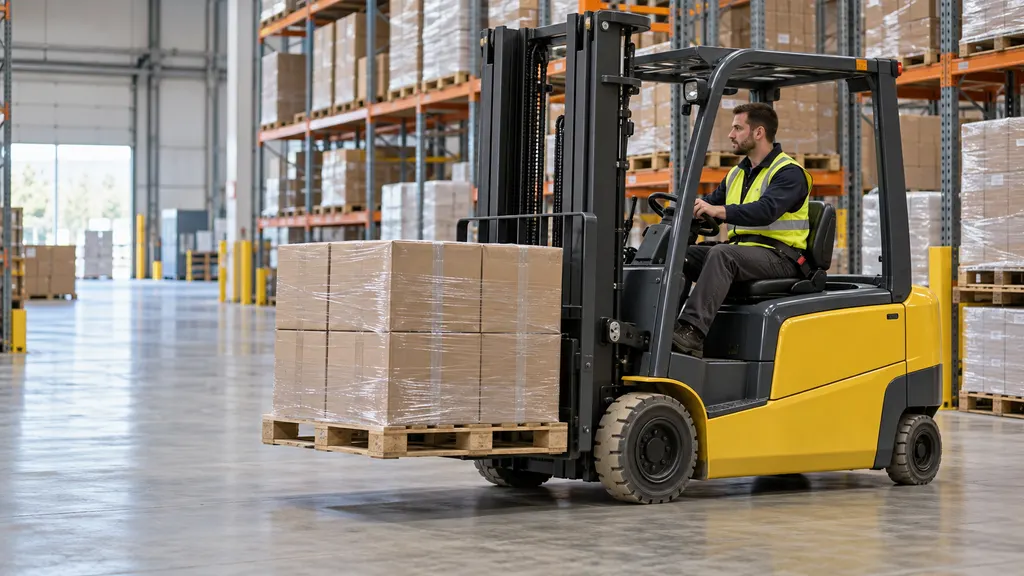
Forklifts belong to the broader category of industrial trucks. Powered industrial truck is a regulatory term used in the United States that also covers equipment other than conventional forklifts. A forklift is material-handling equipment, not a road freight vehicle: its main purpose is to reposition goods within a workplace rather than transport shipments between distant destinations.
Role in Warehousing and Ecommerce Logistics
Forklifts handle the physical movement of inventory. They do not identify an order, maintain inventory records, or provide shipment tracking by themselves, although operators may use scanners or onboard terminals alongside the truck. A warehouse system records the transaction; the forklift performs the associated movement.
Within an ecommerce fulfillment facility, forklift work often takes place around bulk inventory rather than individual parcel packing. For example, a retailer may receive cartons on pallets, place those pallets in storage, and later move them to replenish locations where employees pick individual products. Forklifts may also move consolidated outbound loads or palletized returns.
| Operational stage | Forklift activity | Important condition |
|---|---|---|
| Receiving | Move palletized goods from a suitable unloading position to an inspection or staging area. | The truck, loading surface, and load must be suitable for the operation. |
| Storage | Place and retrieve loads in designated storage locations. | Rack capacity, clearances, and truck capacity must all be respected. |
| Replenishment | Transfer reserve inventory to picking or production areas. | Routes and pedestrian activity require coordination. |
| Dispatch | Move prepared loads to outbound staging areas or suitable transport vehicles. | Vehicle movement, dock edges, and floor condition need control. |
| Returns handling | Move palletized returned goods to inspection, storage, or disposition areas. | Unstable or damaged loads may require additional preparation. |
In cross-border logistics, forklifts may be used at consolidation warehouses, cargo terminals, and import distribution facilities. Their involvement does not determine whether goods have cleared customs. Material handling and customs release are separate processes, even when they occur at the same site.
Main Components and Operating Principles
A conventional mast-equipped forklift has a chassis, a power source, an operator position, a mast, a carriage, and forks. The mast guides the lifting assembly, while the carriage supports the forks or an approved attachment. Hydraulic mechanisms provide lifting and other movements, depending on the truck design.
Different designs support loads in different ways. A counterbalance forklift uses weight behind the front axle to help balance a load carried at the front. Other designs use arrangements such as support legs or a reach mechanism. Consequently, operating limits and handling characteristics cannot be assumed to be identical across trucks.
The complete lifting arrangement matters. A load may be within a truck's stated weight limit but still be unsuitable because it is unusually long, unevenly distributed, insecure, or positioned too far from the fork face. An attachment can also change the truck's capacity and handling characteristics. Operators must use the capacity information applicable to the actual truck and attachment configuration.
Capacity, Load Center, and Stability
Rated capacity is the allowable load under specified conditions, not a promise that the truck can lift that weight in every situation. Relevant conditions can include the load center, lift height, and fitted attachment. The truck's capacity plate and manufacturer instructions provide the applicable limits.
Load center describes the distance from the vertical face of the forks to the load's center of gravity in the relevant direction. Moving the load's center of gravity farther forward increases its overturning effect. This is why two loads of equal weight can create different handling risks.
Stability also changes during operation. Turning, braking, gradients, uneven surfaces, and an elevated load can affect the combined center of gravity of the truck and load. Keeping within the rated capacity is therefore necessary but is not, by itself, sufficient to ensure safe operation.
Common Forklift Designs
Forklifts can be grouped by truck design, power source, tires, or regulatory classification. These are different classification dimensions. The following table describes familiar equipment designs rather than presenting a complete legal or technical classification.
| Design | Distinguishing feature | Typical application |
|---|---|---|
| Counterbalance forklift | Carries the load ahead of the front wheels and uses a counterbalancing arrangement. | General pallet movement, stacking, and suitable loading operations. |
| Reach truck | Uses a reach mechanism to position loads beyond its supporting structure. | Storage and retrieval in warehouse racking. |
| Order picker | Raises the operator with the picking platform on relevant designs. | Picking goods from elevated storage locations rather than simply transferring complete pallets. |
| Rough-terrain forklift | Is designed for specified uneven-ground applications. | Outdoor material handling where the equipment is suitable for the ground and load. |
Power source is a separate consideration. Electric trucks use batteries, while internal-combustion trucks may use fuels such as liquefied petroleum gas or diesel. Suitability depends on operating conditions, ventilation, charging or fueling arrangements, and the manufacturer's restrictions. An indoor workplace should not assume that an engine-powered truck is appropriate without assessing exhaust exposure and other hazards.
Distinction from Related Equipment
Equipment names sometimes overlap in everyday warehouse language. The practical distinction is the machine's design and intended use, not simply whether it has forks.
| Term | Relationship to a forklift | Practical distinction |
|---|---|---|
| Pallet truck or pallet jack | Uses forks to support a pallet; powered versions fall within powered industrial truck rules in the United States. | A low-lift pallet truck moves pallets near floor level rather than placing them in high racking. |
| Stacker | A lift-truck design intended to raise and stack loads. | Its support arrangement, operator position, and operating limits may differ from a counterbalance forklift. |
| Order picker | A specialized industrial truck associated with order fulfillment. | Its defining task is giving the operator access to goods for picking. |
| Crane | Also lifts and positions loads. | A crane typically handles suspended loads rather than loads supported directly on forks. |
A fork-mounted attachment does not make every lifting machine interchangeable. The permitted task, attachment compatibility, and applicable operating instructions must be established for the specific equipment.
How a Forklift Movement Fits into a Warehouse Process
A pallet transfer involves more than lifting and driving. The following sequence illustrates the decisions involved; it is not a substitute for operator training or a site-specific procedure.
- Confirm the movement. Identify the load, its destination, and any inventory or handling instructions. Check whether damaged packaging, restricted goods, or an unusual load shape requires a different method.
- Check equipment suitability. Confirm that the truck, forks, attachment, and rated capacity match the task. Required inspections should identify defects before the truck enters service.
- Assess the load and route. Consider pallet condition, load stability, visibility, floor condition, overhead clearance, pedestrians, and available maneuvering space.
- Pick up and travel. Handle the load according to training and manufacturer instructions, with the load supported and travel conditions controlled. Avoid treating an elevated load as a normal travel position.
- Place the load. Confirm that the destination can support it, position it securely, and withdraw the forks without disturbing adjacent goods or storage equipment.
- Complete the record. Where required, confirm the storage location or movement in the warehouse system. Physical placement and the inventory record should correspond.
For example, an importer may move a pallet of household products from receiving to a reserve rack location. The forklift transfer changes the pallet's physical location; a scan or system entry records that change. Neither action alone establishes the products' customs status or confirms delivery to the final customer.
Operational Limits and Safety Considerations
Forklift operation involves risks including overturning, falling loads, collisions, and crushing. Pedestrian separation, suitable routes, controlled loading areas, equipment maintenance, and trained operators are central operational considerations. Horns, lights, and warning signs can support these controls, but they do not replace an effective traffic arrangement.
Loading docks require particular attention because they combine vehicle movement, edges, bridge plates or dockboards, and changing floor conditions. Before entering a trailer or similar vehicle, the applicable procedure should address unintended vehicle movement, floor suitability, and the capacity and security of any bridging equipment.
Rules vary by jurisdiction. In the United States, OSHA's powered industrial truck standard addresses operator training and evaluation, truck operation, maintenance, and related requirements. It also requires trucks to be examined before being placed in service, with additional examination provisions for continuous use. These requirements should not be presented as a universal licensing system for every country.
A truck that is safe for one task may be unsuitable for another. Relevant checks include aisle width, turning space, lift height, floor loading, surface condition, hazardous-area requirements, and attachment compatibility. Forks should not be treated as an improvised personnel platform; personnel lifting requires equipment and arrangements permitted by the applicable rules and manufacturer instructions.
QA
Are “fork lift truck” and “forklift truck” different machines?
No. They are spelling variants of the same term. “Forklift truck” and “forklift” are commonly used forms.
Can a forklift lift any load below its rated capacity?
No. Load center, lift height, attachment configuration, load stability, and operating conditions also matter. The applicable capacity plate and manufacturer instructions determine the permitted limits.
Is a pallet jack the same as a forklift?
Not in ordinary equipment selection. A low-lift pallet jack mainly moves pallets near floor level, while a stacking forklift can raise suitable loads to storage positions. Powered pallet trucks nevertheless belong to the broader powered industrial truck category under US OSHA rules.
Does a forklift movement update inventory automatically?
Not by itself. The movement must be recorded through the facility's process, such as scanning or confirming a warehouse system transaction.
Sources
- OSHA: Powered Industrial Trucks eTool — Reference material on truck types, components, operating principles, load handling, and workplace hazards.
- OSHA: Powered Industrial Truck Fundamentals — Supports explanations of equipment designs, capacity, stability, and the relationship between forklifts and other powered industrial trucks.
- OSHA: 29 CFR 1910.178, Powered Industrial Trucks — Primary US regulatory source for training, load handling, workplace operation, inspection, maintenance, and loading-area requirements.