Pallet Pool System
What Is a Pallet Pool System?
A pallet pool system is an organized arrangement in which reusable pallets circulate among participating businesses rather than being purchased and discarded after a single shipment. In logistics, it provides a shared supply of pallets for moving and storing goods, together with rules for issuing, transferring, returning, exchanging, inspecting, and repairing them. The arrangement is also commonly called pallet pooling.
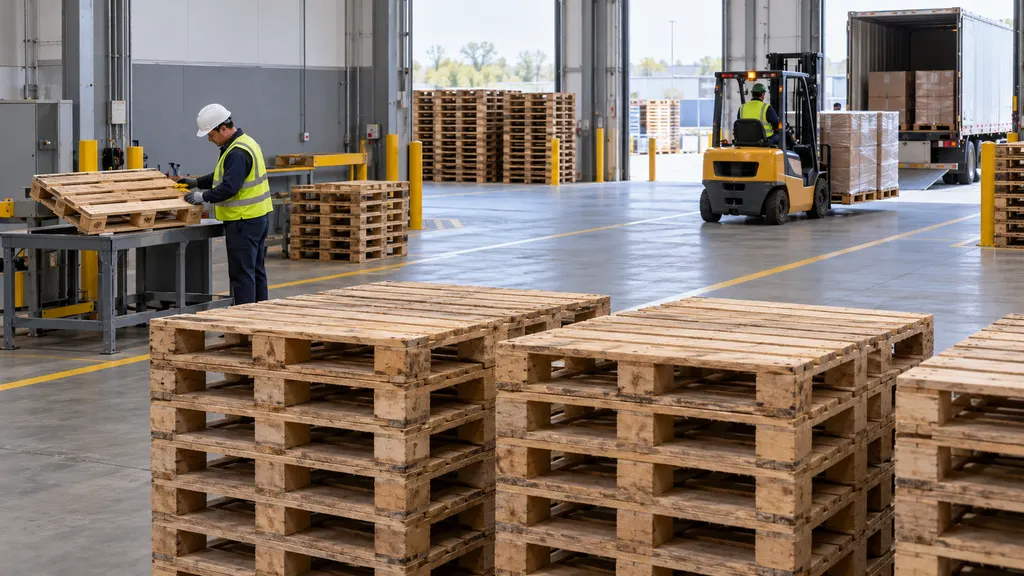
A pool may be managed by a service provider, operated within a business network, or maintained through an exchange arrangement for pallets that meet agreed specifications. Ownership and payment arrangements vary: some pallets remain the property of a pool operator, while others are exchanged between participants. The defining feature is organized reuse across multiple handling cycles, not a particular ownership model, pallet material, or tracking technology.
How a Pallet Pool System Works
Pallet pooling combines physical circulation with administrative control. A pallet carries goods through the supply chain, while records identify who supplied it, where responsibility transferred, and what must happen after unloading. The following sequence describes a possible operating cycle; individual systems may combine stages or allocate responsibilities differently.
- Supply: A participating manufacturer, distributor, or fulfillment operation obtains pallets that meet the pool's specifications.
- Loading: Goods are assembled into a unit load. The pallet, packaging, and load-securing method must be suitable for the intended handling and transport.
- Dispatch: The shipment leaves the site. Relevant pallet quantities and any required identifiers are recorded alongside the goods movement.
- Receipt and transfer: The receiving site checks quantities and condition. Responsibility may transfer under the pooling agreement, or an exchange obligation may arise.
- Unloading and recovery: Empty pallets are segregated for collection, exchange, or further authorized use rather than treated as disposable packaging.
- Inspection and repair: Pallets are checked against the applicable acceptance criteria. Damaged units are repaired where permitted or removed from circulation.
- Reissue: Suitable pallets return to use, completing another circulation cycle.
Not every pallet returns to its original sender. A network may collect empties from one location and supply another location with different serviceable pallets. This distinction separates pooling from a simple return arrangement in which a business expects its own identifiable pallets back.
Operating Arrangements and Ownership
Several arrangements can support pallet reuse. The distinctions below describe how responsibility is organized; they are not a universal legal classification, and a particular network may combine elements.
| Arrangement | Ownership and control | How circulation is maintained |
|---|---|---|
| Operator-managed pool | An operator supplies pallets under agreed service terms and may retain ownership. | Participants report movements or arrange collection, allowing pallets to be recovered and reissued. |
| Exchange-based pool | Participants use pallets meeting an accepted specification; ownership need not remain with one central operator. | Transfers create an exchange or accounting obligation for acceptable equivalent pallets. |
| Restricted circulation network | One organization or a defined group controls pallet use within an agreed network. | Pallets circulate between designated sites and return through specified collection or backhaul routes. |
An open exchange network does not mean that every pallet can be exchanged. Acceptance depends on the applicable design, identification, condition, and repair requirements. Likewise, a pallet's appearance or dimensions alone do not establish ownership or permission to use it.
Role in Logistics and Ecommerce
Pallet pools support the movement of unit loads between factories, distribution centers, warehouses, wholesalers, and receiving facilities. They concern the handling platform beneath the goods, rather than the commercial ownership of the goods themselves.
In ecommerce, pooling is relevant to inbound replenishment and transfers between fulfillment facilities. For example, a merchant may send cartons of products on pooled pallets to a fulfillment warehouse. The warehouse receives the products into inventory and handles the empty pallets under a separate pallet procedure. Later customer orders may leave as individual parcels, without the pooled pallets accompanying them.
Businesses may encounter the term in warehouse receiving requirements, transport instructions, pallet account statements, supplier agreements, and packaging specifications. A receiving facility's willingness to accept the goods does not automatically mean it accepts the pallet type or agrees to a pallet exchange.
Operational Requirements
Compatibility and condition
Pool participation requires more than matching a nominal footprint. Pallets must be suitable for the handling equipment, storage arrangement, load, and receiving requirements involved. Forklift access, conveyor interfaces, rack support, and damage condition can all affect suitability. Pallets with similar dimensions are not necessarily interchangeable.
Acceptance criteria should distinguish serviceable pallets from units requiring repair or removal. For example, the EPAL Euro pallet specification includes exchangeability criteria and repair requirements. Those rules apply to that system and should not be treated as universal requirements for every pallet pool.
Records and reconciliation
A pallet account records movements and obligations under the relevant agreement. Depending on the system, records may concern quantities, individual identifiers, dispatch locations, receiving locations, or transfer dates. Individual electronic identification is not essential to the definition of pooling; a system can also operate through quantity-based records.
Reconciliation compares dispatch records, receiving confirmations, physical counts, and account entries. Differences can arise when a transfer is unrecorded, quantities are disputed, unsuitable pallets are rejected, or empties are sent to the wrong location. The agreement should establish how discrepancies are reported and resolved.
Recovery and costs
Empty pallets still occupy space and require handling. A workable arrangement therefore needs designated storage areas, collection procedures, and responsibility for loading and transport. Returning pallets on an available backhaul may be practical in some networks, but it is not guaranteed.
Commercial terms may allocate costs for supply, use, transport, repair, loss, or administration. There is no universal pooling tariff. Any comparison with purchasing pallets should consider the relevant handling, recovery, storage, loss, and administration costs, rather than only an initial purchase or service charge.
Cross-Border Use and Wood Packaging Requirements
A pallet accepted within one network is not automatically accepted at every overseas destination. Cross-border use requires checking both the pool's authorized service arrangements and the importing country's packaging requirements. A destination outside an agreed collection network may create a recovery problem even when the goods can legally enter.
Wood packaging material can also be subject to phytosanitary controls. ISPM 15 establishes international measures for regulated wood packaging material used in international trade, including treatment and marking requirements. Its application depends on the material and the importing jurisdiction's rules; processed wood materials such as plywood are outside its scope.
Participation in a pallet pool does not itself demonstrate phytosanitary compliance. Conversely, an ISPM 15 mark does not establish pool membership, ownership, or exchangeability. A shipper must assess these as separate questions. Requirements for repaired or remanufactured wood packaging also need attention when evaluating previously used pallets.
Related Terms and Important Distinctions
| Term | Meaning | Relationship to pooling |
|---|---|---|
| Pallet exchange | An arrangement for providing acceptable equivalent pallets or recording an obligation to do so. | It can maintain a pool, but it is not the only pooling mechanism. |
| Pallet rental | Access to pallets under a commercial hire arrangement. | It may form part of an operator-managed pool; the contract determines the obligations. |
| One-way pallet | A pallet supplied without an organized return or exchange obligation for that shipment. | It is not necessarily physically incapable of reuse, but it is outside a planned pooling cycle for that movement. |
| Returnable transport packaging | Transport packaging intended for repeated use, including pallets and other reusable load carriers. | Pooled pallets are one application of this broader concept. |
| Pallet recycling | Recovery of pallet materials or processing of pallets at the end of useful service. | It differs from keeping serviceable pallets circulating through reuse and repair. |
Benefits, Constraints, and Practical Checks
Pooling can reduce the need to procure a new pallet for each shipment and can support consistent handling specifications. However, reuse alone does not establish that a particular system has lower total costs or environmental impacts. Results depend on service life, losses, repair, collection distances, transport utilization, and the alternative being compared.
Before using a pallet pool for a shipment, the parties should clarify:
- Acceptance: Does the receiving site accept the exact pallet specification and condition?
- Authorization: Are the sender, receiver, and destination covered by the arrangement?
- Transfer: When does pallet responsibility change, and what confirms that change?
- Recovery: Who stores, collects, or exchanges the empty pallets?
- Disputes: How are shortages, damage, rejected units, and account differences handled?
- Border compliance: Does any regulated wood packaging meet the destination's requirements?
These checks address a central limitation of pooling: a reusable pallet is useful to the network only if it remains suitable, recoverable, and correctly accounted for.
QA
Is pallet pooling the same as pallet exchange?
No. Pallet exchange is one method of maintaining circulation. Pooling can also operate through managed supply and collection without an immediate exchange at delivery.
Must the same pallet return to the sender?
Not necessarily. Some arrangements accept equivalent serviceable pallets, while others recover pallets into a wider network. The applicable agreement determines the requirement.
Can pooled pallets be used for international shipments?
They can, provided the destination and participants are authorized under the arrangement and the pallets meet applicable import requirements. Pool acceptance and phytosanitary compliance are separate checks.
Does a pallet pool system require individual pallet tracking?
No. Individual identification can support control, but pooling can also use quantity-based accounts and transfer records.
Sources
- Wikipedia: Pallet — General reference for pallet pooling, ownership arrangements, reuse, and handling context.
- European Pallet Association: EPAL Euro Pallet — Official specification, exchangeability criteria, and repair requirements for a specific exchangeable pallet system.
- International Plant Protection Convention: International Standards for Phytosanitary Measures — Official standards collection, including ISPM 15 on wood packaging material in international trade.
- USDA APHIS: Wood Packaging Material — Official example of national import requirements for regulated wood packaging material.