Drive-In Rack
What Is a Drive-In Rack?
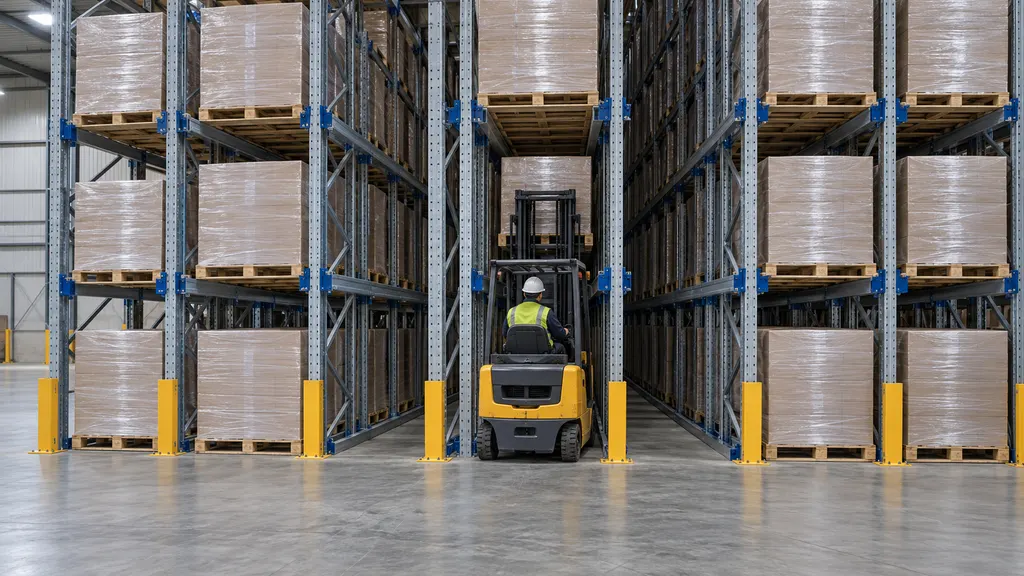
A drive-in rack is a high-density warehouse storage structure in which a forklift enters a storage lane to place or retrieve pallets supported on rails. Pallets are stored several positions deep, reducing the number of access aisles needed compared with conventional selective pallet racking. In a standard drive-in arrangement, loading and unloading take place from the same end of the lane, so access normally follows a last-in, first-out (LIFO) sequence.
The term usually refers to a complete pallet-racking system rather than an individual shelf. Drive-in racking is used for palletized inventory where storing multiple pallets of the same product together is more important than having immediate access to every pallet. Its defining trade-off is greater storage density in exchange for reduced pallet selectivity.
Structure and Operating Principle
A drive-in rack consists of upright frames, supporting rails, connections, and structural bracing arranged to create internal storage lanes. Pallets rest on rails running along the sides of each lane rather than on conventional front-to-back pairs of horizontal shelf beams. The forklift travels into the rack structure, carrying the pallet at the height needed to place it on the appropriate rails.
The rack must be designed for the actual pallet, load, and handling equipment. Pallet dimensions alone do not establish suitability: pallet construction, condition, load distribution, and the way the pallet bears on its supports also matter. A pallet that works in one storage system is not automatically suitable for another.
- Storage lane: The channel into which the forklift enters and pallets are placed in depth.
- Support rails: Components that carry the pallets along the sides of the lane.
- Upright frames and bracing: Structural components that transfer loads and maintain rack stability.
- Entry protection and guidance: Protective or guiding features that may be incorporated into the design to help manage vehicle movement and impact exposure.
Lane dimensions, clearances, load limits, and protective features are design-specific. They should come from the rack designer or supplier rather than from generic rules applied to every installation.
How Loading and Retrieval Work
For a standard single-entry lane, pallets placed farther inside become inaccessible while pallets remain between them and the entrance. The loading sequence therefore determines the retrieval sequence. Warehouse procedures must coordinate physical access with the inventory records used to allocate stock.
- Assign the inventory. Select a lane and storage level suitable for the product, pallet type, and required stock rotation. Keeping compatible inventory together reduces the need to move unrelated pallets.
- Check the pallet and load. Confirm that the pallet is sound, the load is stable, and the combined load is within the approved capacity for that storage position.
- Approach and enter. The trained operator aligns the truck with the lane and follows the approved travel and handling procedure, maintaining the required clearances.
- Position the pallet. The operator places the pallet on the designated support rails at an available position. Loading generally progresses from the rear toward the entrance, following the installation's operating instructions.
- Record the movement. The warehouse records the product, quantity, and location, including lot or date information where required.
- Retrieve accessible inventory. Pallets nearest the entrance must normally be removed before those behind them at the same level. The inventory system should not treat every stored pallet as independently accessible.
The exact loading order across levels and lanes must follow the system's operating instructions. A general description of drive-in storage is not a substitute for a site-specific handling procedure.
Storage Density, Selectivity, and Inventory Rotation
Storage density describes how effectively a layout uses space for inventory. Selectivity describes the ability to access a particular pallet without moving other pallets. Drive-in racking reduces the aisle space associated with individual pallet access, but it also creates dependencies between pallets stored in the same lane.
This makes inventory grouping important. A deep lane can be useful when a business holds enough compatible pallets to fill it. If each lane contains only a few pallets because products, batches, or dates must remain separated, some of the theoretical space advantage may be lost. This unused capacity is sometimes described as honeycombing.
LIFO describes the physical access pattern, not a financial inventory valuation method. A warehouse using drive-in racks does not automatically use LIFO accounting. Equally, recording stock on a first-in, first-out (FIFO) basis does not make an older pallet physically accessible when newer pallets block it.
Products controlled by expiry dates require particular attention. First-expired, first-out (FEFO) allocation may conflict with the access sequence if pallets with different expiry dates share a lane. Dedicated lanes, disciplined allocation, or a different storage system may be necessary where strict rotation is essential.
Drive-In Racking Compared with Related Systems
The following systems differ primarily in how pallets are supported, accessed, and moved. The comparison describes common arrangements; the actual installation and operating rules remain decisive.
| System | Access and movement | Usual rotation characteristics | Main operational distinction |
|---|---|---|---|
| Drive-in racking | A forklift enters the lane; loading and unloading use the same end. | Normally LIFO within a lane and level. | Deep storage with restricted access to individual pallets. |
| Drive-through racking | A forklift can access the storage lanes from opposite ends. | Can support FIFO when one end is used for loading and the other for unloading. | Two-ended access changes material flow and aisle requirements. |
| Selective pallet racking | A forklift handles pallets from access aisles without entering storage lanes. | Allows individual pallet selection rather than imposing one lane sequence. | Greater direct access, with more space allocated to aisles. |
| Pallet flow racking | Pallets move along inclined roller tracks between loading and retrieval faces. | Commonly arranged for FIFO. | Pallet movement uses gravity rather than forklift entry into the lane. |
| Push-back racking | Pallets are handled from one face on a system of carts or rollers. | Normally LIFO within a lane. | The forklift stays outside the storage lane. |
Drive-in and drive-through are sometimes discussed together as closely related high-density systems. They should not be treated as operationally identical: access from one end versus two ends affects stock rotation, traffic planning, and the surrounding layout.
Use in Logistics and Ecommerce Warehousing
Drive-in racking belongs to the storage stage of warehouse operations. It can hold palletized goods after receiving and before replenishment, order preparation, or dispatch. It is more directly associated with bulk pallet storage than with picking individual items for customer orders.
For example, an ecommerce retailer may receive several pallets of the same packaged product and place them in a designated drive-in lane. Workers can later retrieve accessible pallets to replenish a separate picking area. The customer order is fulfilled from that picking area; the drive-in rack serves as reserve storage rather than as the main piece-picking location.
In cross-border operations, imported goods may enter drive-in storage after receiving checks and any applicable release requirements have been satisfied. The rack itself does not determine customs status, ownership, or whether goods may be sold. Those matters depend on the relevant procedures and inventory controls.
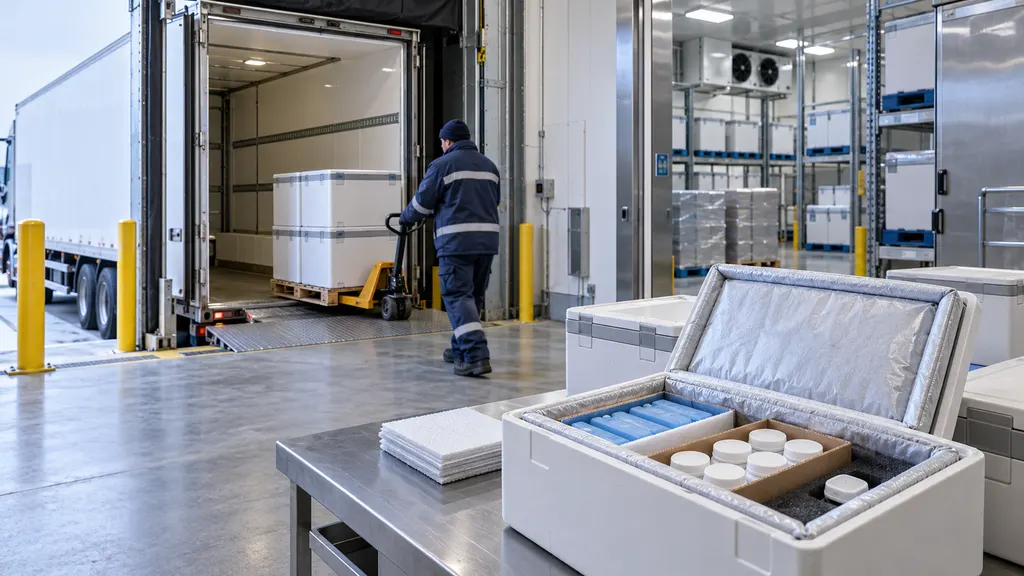
Cold-storage facilities are another application because space utilization can be especially important in temperature-controlled buildings. However, suitability still depends on pallet compatibility, vehicle operation, product rotation, and the conditions for which the equipment is designed. High density alone does not establish that a particular layout is appropriate.
Suitability and Operating Checks
Choosing drive-in racking requires more than comparing the number of nominal pallet positions. The useful capacity depends on the inventory profile and whether operators can store and retrieve goods without excessive relocation or blocked access.
- Inventory concentration: Are there enough pallets of each compatible product or batch to use the planned lane depth effectively?
- Rotation requirements: Can the products tolerate the physical LIFO sequence, or do expiry and quality rules require another arrangement?
- Pallet compatibility: Are pallet size, construction, condition, and load support suitable for the rail arrangement?
- Handling equipment: Does the forklift have the required capacity, lift height, and physical clearances for the approved design?
- Movement frequency: Can the layout accommodate the expected receiving, replenishment, and retrieval activity without unacceptable congestion?
- Traceability: Can warehouse records distinguish lanes, levels, products, and lots accurately enough to prevent allocation of inaccessible stock?
- Building constraints: Have floor conditions, rack anchoring, emergency access, and relevant fire-protection requirements been considered by competent personnel?
No universal capacity gain or cost saving follows from the term alone. Results depend on the building, storage depth, product mix, occupancy, and handling process.
Safety and Maintenance
Because a forklift enters the rack structure, vehicle clearance and impact prevention are central operating concerns. Operators need training appropriate to the equipment and installation. Pallets should not be forced into positions, and damaged pallets or unstable loads should not be placed in storage.
Warehouse guidance from the UK Health and Safety Executive emphasizes suitable storage equipment, load information, damage reporting, and inspection arrangements. In practice, a drive-in installation needs clear procedures for reporting impacts, assessing damage, and restricting use where safety is uncertain. Operators should not straighten, modify, or repair structural components without an approved technical procedure.
Changes to pallet dimensions, load weights, truck types, rail positions, or rack configuration can affect the original design assumptions. Such changes require review by the supplier or another competent specialist. A previously acceptable installation should not be assumed suitable for a different duty merely because the new pallets fit inside it.
QA
Is drive-in racking FIFO or LIFO?
A standard drive-in lane normally operates on a LIFO basis because pallets enter and leave through the same end. FIFO requires a layout and operating sequence that make older stock accessible, such as an appropriately managed drive-through arrangement.
Can different products share a drive-in lane?
They can sometimes share a lane, but mixing products can block access to the required inventory. Product, batch, and expiry-date grouping should match the physical retrieval sequence.
Is a drive-in rack suitable for ecommerce order picking?
It can support ecommerce fulfillment as bulk reserve storage. It does not provide the same direct access to individual products or pallets as a dedicated picking layout or selective pallet racking.
Does higher storage density always mean better space utilization?
No. Partly filled lanes, product separation, blocked stock, and movement requirements can reduce usable capacity. Suitability should be assessed against the actual inventory profile and operating process.
Sources
- Wikipedia: Pallet racking — Reference overview of pallet-racking systems, including drive-in and drive-through arrangements and related storage methods.
- Mecalux: Drive-in pallet racking — Manufacturer documentation supporting the description of rail-supported storage lanes, forklift entry, and single-ended versus two-ended operation.
- Health and Safety Executive: Warehousing and storage—A guide to health and safety — Official guidance supporting storage-equipment safety, pallet suitability, rack loading, inspection, and damage-management principles.