Ocean Freight Tracking API: Container Events, Eta Data, and Selection Criteria
An ocean freight tracking API should connect container movements, transport milestones, and ETA updates to the shipment your team manages. For freight forwarders, importers, and integration teams, the selection test is whether it can reliably identify the right container journey, distinguish actual events from forecasts, and expose enough context to support operational decisions. A generic shipment status or an unexplained arrival date is not sufficient for managing ocean freight.
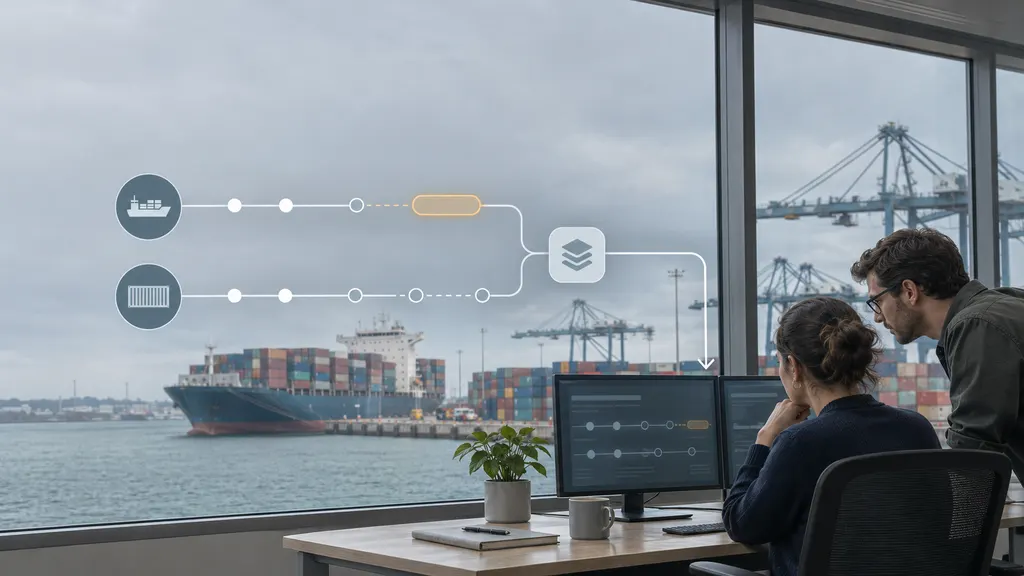
This guide explains the data to request, how to interpret container events and arrival estimates, and how to evaluate an integration before committing production traffic or procurement budget.
Start with the shipment model, not the tracking screen
Ocean freight tracking involves several related objects: a commercial shipment, its transport documents, one or more containers, and the transport legs carrying them. These relationships matter because a single booking can involve multiple containers, while a container can move through several vessels, terminals, and inland legs.
A useful integration must preserve those relationships rather than flattening everything into one status. If two containers under the same shipment move differently, the system should let an operator see the difference instead of presenting an apparently complete shipment-level milestone.
Before evaluating an API, identify the references your business actually receives:
- Container number: Identifies the equipment, but should be associated with the relevant shipment or journey because containers are reused.
- Carrier booking reference: Can connect the tracking request to a booking, subject to the source system's lookup requirements.
- Transport document reference: May identify the shipment at the ocean carrier level. Confirm whether the API accepts the document references your team holds.
- Internal shipment ID: Connects external tracking records to your transportation management system, ERP, or forwarding software.
Do not assume that a house bill reference issued by a forwarder can be used wherever an ocean carrier document reference is required. Test the exact identifiers available in your booking and document workflows.
Which container events should an API expose?
The Digital Container Shipping Association's Track & Trace standards provide a useful reference for discussing ocean shipment data. DCSA distinguishes shipment, transport, and equipment events. These categories help separate administrative progress, movement of the transport, and handling of the physical container.
A vendor does not have to use your preferred field names to be useful, but it should explain how its event model maps to the operational milestones you need.
Equipment events: what happened to the container
Relevant equipment milestones can include gate-in, loading, discharge, gate-out, and empty-container movements. Availability depends on the journey, source, and product. Require sample records rather than assuming that every event is available at every terminal.
These distinctions have practical consequences. Vessel arrival does not prove that a specific container has been discharged. Discharge does not prove that the container is released or ready for collection. A gate-out record also needs location and context: gate-out from a transshipment facility is not the same business outcome as collection from the final import terminal.
Transport events: where the vessel or transport leg stands
Arrival and departure events describe transport activity. To interpret them, your system needs the associated location, transport mode, and leg. Where available, vessel and voyage identifiers help distinguish the intended sailing from another movement serving the same ports.
For transshipment cargo, preserve intermediate stops. Reducing the itinerary to origin and destination can conceal a missed connection or a change in routing. An operational timeline should make it possible to see which leg has completed and which remains estimated.
Shipment events: administrative progress is not physical movement
Document and shipment-processing events can be useful for forwarding workflows, but they should remain distinguishable from container movement. A documentation milestone does not establish that cargo has physically moved, and a movement event does not establish that all commercial or regulatory requirements have been satisfied.
For each event, request the event type, relevant object, location, event timestamp, time-zone information, source, and an indication of whether the event is planned, estimated, or actual. Also ask for a stable event identifier and correction behavior so repeated updates do not create duplicate milestones.
ETA data needs a destination, a meaning, and a history
An ETA is an estimated time of arrival at a specified point. It is not inherently a promise that cargo will be available to collect. An ocean freight tracking API should make the destination milestone explicit rather than returning an ambiguous field labeled only eta.
For example, an arrival estimate could refer to a port call, a terminal, an inland facility, or another defined destination. Before using it to schedule trucks or promise inventory availability, establish exactly what that timestamp represents.
Separate the source of the estimate from its status
A carrier-provided estimate and a provider-generated prediction are different data products. Neither should be presented as an actual arrival. Ask whether the response identifies the estimate's origin, its calculation or publication time, and the location or event it predicts.
If a provider offers predictive ETA, request its methodology and validation approach. Useful questions include which milestone is predicted, how far before arrival performance is measured, and whether results differ across the lanes you use. A broad accuracy claim is difficult to apply when its target event and measurement window are unspecified.
Keep ETA revisions instead of overwriting them
The latest ETA supports today's planning; the revision history explains what changed. Store the previous estimate, new estimate, associated milestone, source, and the time your system received the change.
This history lets an operations team distinguish a material delay from a formatting correction or a change to an unrelated port call. It also supports retrospective evaluation without pretending that a final estimate was known earlier in the journey.
Time zones deserve explicit testing. Preserve the source timestamp and its offset where supplied, normalize timestamps for computation, and display local operational time when appropriate. If the source provides only a date, do not silently convert it into a precise midnight arrival promise.
Evaluate coverage at the event level
A carrier appearing on a coverage list does not, by itself, establish that every container milestone is available. Coverage should be tested against the carriers, lanes, shipment references, and operational events that matter to your business.
Build an evaluation matrix with your actual requirements. For each representative shipment, check whether the API can resolve the reference, return the correct itinerary, expose the milestones you require, and maintain updates through the part of the journey you manage.
- Direct ocean movements: Can you identify origin departure, destination arrival, and relevant container handling events?
- Transshipment movements: Are intermediate legs visible, and can containers moving separately remain distinguishable?
- Inland legs: If your service includes them, does the API provide relevant rail, barge, or truck milestones, or does visibility end at the port?
- Exceptions: How are missing events, changed routings, unmatched references, and source interruptions represented?
- Completed shipments: Can your team retrieve enough historical data to investigate a customer dispute or reconcile an operational record?
Keep unavailable data separate from negative events. No discharge record does not prove that discharge has not occurred. A useful integration distinguishes an explicit operational status from a gap in visibility.
API behavior matters as much as the event list
Even a rich event feed can become difficult to operate if delivery behavior is unclear. Evaluate how your application receives updates, handles corrections, and recovers after an outage.
Polling, webhooks, and recovery
Polling lets your application request updates on its schedule. Webhooks let a provider send updates to an endpoint you operate. Neither mechanism alone establishes freshness: an immediately delivered webhook can still contain a source event received late.
Ask for separate definitions of source-event time, provider receipt time, and notification time where available. For webhooks, confirm authentication or signature verification, retries, duplicate delivery behavior, and whether failed notifications can be replayed. For polling, check pagination, rate limits, incremental retrieval, and the treatment of historical corrections.
Normalization without losing evidence
Normalized statuses make cross-carrier workflows easier, but excessive simplification removes useful context. Prefer a model that lets you retain the normalized event alongside the original source description or code when available.
Store raw incoming records separately from the business rules that turn them into dashboard statuses. This allows you to revise a mapping without losing the original evidence. It also makes a customer-facing status easier to investigate when it differs from an operational team's interpretation.
Commercial and governance checks
Request a written explanation of the billing unit. A subscription, tracked shipment, container, API request, and notification are not interchangeable measures. Clarify how retries, duplicate registrations, historical lookups, and reactivated shipments affect charges rather than assuming a particular pricing model.
Also review data retention, access controls, credential rotation, permitted downstream use, support escalation, and service commitments. Treat contractual guarantees separately from product demonstrations and marketing statements.
Do not assume a general tracking API meets ocean freight requirements
A tracking API should be selected for its verified data model, not its category label. Parcel delivery updates and ocean container visibility can serve different workflows, even when both are described as shipment tracking.
If 17TRACK is already on your integration shortlist, use its official Tracking API page and API documentation as starting points for a requirements check. Confirm the exact ocean references, container events, transport legs, and ETA fields required by your application before treating any general tracking integration as an ocean freight solution. This guide does not establish those ocean-specific capabilities for 17TRACK.
The same acceptance standard should apply to any candidate: demonstrate the required data with representative shipments and explain its limitations. A broader carrier tracking workflow may be useful elsewhere in your supply chain without replacing a specialized container-event feed.
Run a proof of concept around operational decisions
The strongest proof of concept starts with decisions your team needs to make, not a dashboard demonstration. Select representative shipments from your own operation, including straightforward voyages and the difficult cases that create manual work.
- Define acceptance criteria. Specify required references, events, locations, timestamp semantics, and acceptable handling of missing data before testing.
- Validate identity. Confirm that every result belongs to the intended shipment and container journey. Include reused equipment and multi-container bookings where relevant.
- Compare with source records. Check returned milestones against accessible carrier or terminal records, accounting for differences in update timing.
- Test revisions and failures. Exercise duplicate notifications, out-of-order events, corrected timestamps, unavailable sources, and endpoint outages.
- Replay a business workflow. Verify whether the data supports the intended action, such as reviewing a delayed connection or updating an inbound inventory estimate.
- Review unresolved gaps. Record whether each gap comes from the underlying source, the provider's processing, or your integration. Agree on remediation before expanding usage.
For ETA testing, preserve each forecast as it arrives and compare it with the eventual actual event for the same milestone. Do not evaluate a port-arrival forecast against warehouse receipt, or combine forecasts made at very different lead times into one unexplained score.
The selection rule is straightforward: choose the integration that demonstrably supports your required decisions with traceable events, understandable estimates, and recoverable delivery behavior. If collection planning also requires terminal availability, release status, or appointments, verify those inputs separately rather than inferring them from vessel arrival.
FAQ
Can I track an ocean shipment using only a container number?
That depends on the data source and API. Some workflows may require a carrier identifier, booking reference, or transport document reference as well. Because equipment is reused, confirm that the returned events belong to your intended journey rather than relying on the container number alone.
Does an actual vessel arrival mean my container is ready for pickup?
No. Vessel arrival, container discharge, cargo availability, and permission to collect are separate operational facts. Depending on the shipment, collection may also require release information and a terminal appointment. Verify the relevant conditions with the parties responsible for them.
Does AIS vessel tracking replace container tracking?
No. AIS concerns vessel identification and movement information; it does not itself establish an individual container's loading, discharge, release, or gate-out status. Vessel movement can contribute context, but the container's association with the voyage still needs confirmation.
How frequently should an ocean tracking API update?
There is no single useful interval for every workflow. Set requirements around how quickly your team needs to act after relevant source information becomes available. Measure source latency separately from API delivery latency, and confirm what happens when the source does not publish a new event.
Can tracking events calculate demurrage or detention charges?
Events can support the timeline, but they do not establish a complete charge calculation. You also need the applicable contractual terms, free-time rules, calendar treatment, and authoritative start and end conditions. Do not derive payable amounts from generic milestones alone.
Sources
- DCSA: Track & Trace standards — Reference framework for shipment, transport, and equipment events in container shipping.
- DCSA: OpenAPI specifications repository — Technical reference for DCSA API definitions and event structures. Check the applicable specification version when designing an integration.
- International Maritime Organization: Automatic Identification Systems — Background on AIS and the vessel information it provides.
- 17TRACK: Tracking API and official API documentation — Starting points for validating product fit; not evidence here of ocean-container event or predictive ETA support.