Mobile Rack
What Is a Mobile Rack?
A mobile rack is a storage rack designed to move rather than remain permanently fixed in one position. In warehouse storage design, the term commonly refers to racking mounted on movable bases that travel along floor rails, allowing an access aisle to open between selected rows. It can also describe a smaller rack fitted with wheels or casters. These arrangements serve different purposes, so equipment specifications should identify which meaning is intended.
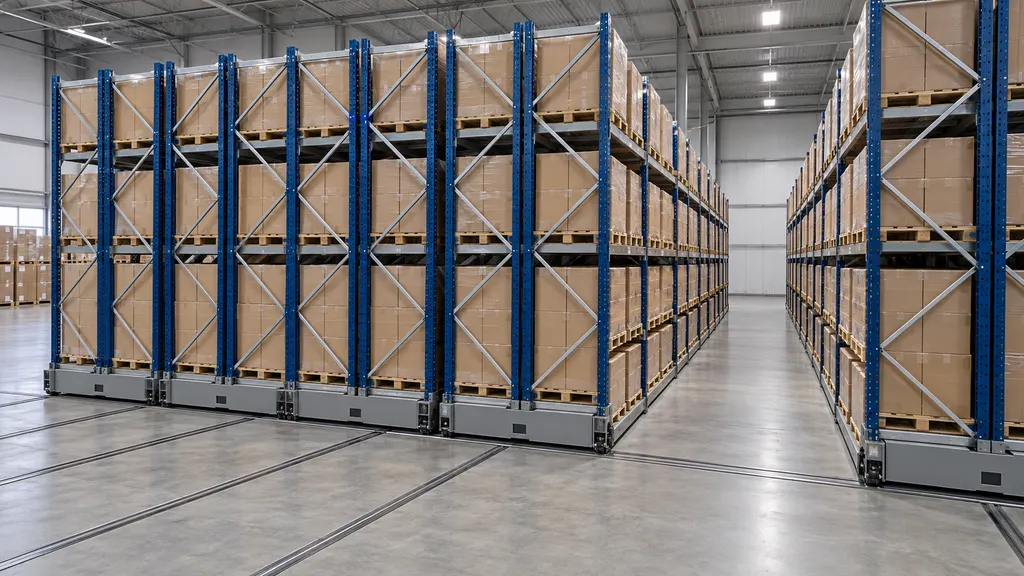
Rail-mounted mobile racking is principally a storage arrangement: the racks move to provide access to stored goods. A wheeled rack may instead support the movement of goods between work areas. Neither meaning implies that the rack is an autonomous vehicle, a conveyor, or equipment suitable for transporting goods on public roads.
How Rail-Mounted Mobile Racking Works
In a conventional static racking layout, access aisles remain open between designated rows. In a mobile arrangement, several rows can stand close together when access is not required. Moving the bases creates a working aisle at the selected storage location. This reduces the floor area devoted to permanently open aisles, although the actual storage benefit depends on the building, rack dimensions, handling equipment, and required access pattern.
The bases may be moved manually, through mechanically assisted controls, or by powered drives, depending on the equipment. Pallet-storage installations can use electrically driven bases, while lighter mobile shelving may use hand-operated mechanisms. The drive method does not by itself establish the rack's load capacity or suitability for a particular operation.
A simplified retrieval sequence is:
- Identify the location. The operator determines the rack, bay, and level holding the required inventory.
- Request access. The relevant control is used to select or open the aisle.
- Check the movement area. The system's operating procedure and protective devices must address people, equipment, and obstructions within the affected area.
- Move the rack rows. The bases reposition to provide the required working aisle.
- Retrieve or replenish stock. Authorized personnel use handling equipment appropriate to the load and installation.
- Record the inventory movement. The stock record is updated through the warehouse's established process.
This sequence is illustrative rather than a substitute for operating instructions. The permitted interaction between rack movement, pedestrians, and lift trucks must follow the installation's design and safety procedures.
Mobile Racks in Warehouse and Ecommerce Operations
Mobile racking sits within the storage stage of warehouse operations. It holds inventory between receiving and a later activity such as replenishment, order picking, production supply, or dispatch. It does not itself create an order, arrange carriage, clear customs, or confirm delivery.
An ecommerce warehouse may use mobile pallet racking for reserve inventory that feeds a separate picking area. For example, a retailer may store unopened cartons on pallets in mobile racks and replenish fixed picking shelves when their available stock falls below a planned level. This separates bulk storage from frequent individual-item retrieval without implying that every ecommerce operation needs this arrangement.
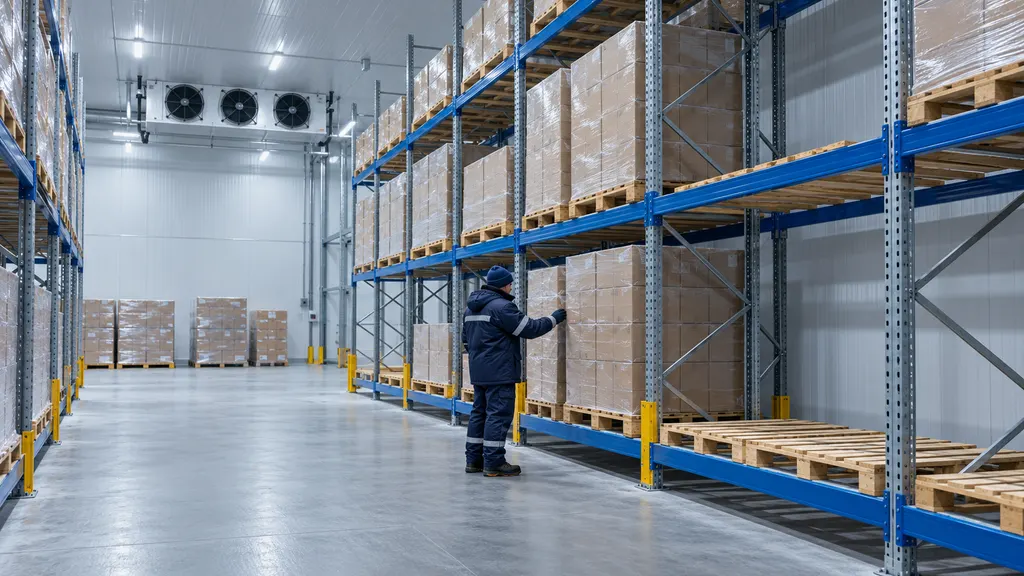
Mobile racking can also be considered where storage space is constrained or where maintaining additional building volume carries a substantial operating cost, such as temperature-controlled storage. Suitability still depends on access frequency, simultaneous handling requirements, equipment compatibility, and the conditions for which the system was designed.
For cross-border ecommerce, the rack's role remains physical inventory storage. Imported and domestic stock can be assigned warehouse locations according to operational needs, but a mobile rack does not determine customs status. Any requirement to segregate, identify, or control particular goods comes from the applicable inventory procedures, contractual obligations, or regulatory framework—not from the fact that the racking moves.
Related Equipment and Terminology
The following distinctions concern equipment function and movement. They are not a formal classification covering every product sold as a mobile rack.
| Term | Meaning | Main distinction |
|---|---|---|
| Rail-mounted mobile rack | Storage racking installed on bases that move along a defined rail path. | Movement opens access to storage positions. |
| Wheeled mobile rack | A rack fitted with wheels or casters for repositioning. | It may move between work areas rather than merely open an aisle. |
| Mobile shelving | Shelving arranged on movable bases, often for smaller items, documents, or supplies. | It shares the movable-aisle principle but is not necessarily designed for pallet loads. |
| Static pallet racking | Pallet-storage racking that remains fixed during normal access. | Handling equipment travels through established aisles; rack rows do not reposition to provide access. |
| Picking cart | A wheeled device used to carry items during order picking. | Its main function is transport during a task, not the provision of storage aisles. |
Commercial terminology can overlap. A supplier may use mobile rack, mobile shelving, or mobile storage system for related equipment. Procurement documents should therefore describe the load, movement mechanism, dimensions, and intended use rather than rely on the product name alone.
Storage Density and Access Trade-Offs
The central design trade-off is between space allocated to storage and space available for immediate access. Moving rack rows can consolidate aisle space, but it also makes access dependent on the position of those rows. An operator may need to wait for an aisle to open before reaching a location.
This matters when several workers or trucks need different storage positions at the same time. A design that works for intermittent pallet retrieval may be less suitable for a task requiring many simultaneous picks across separate rows. Some installations can provide more than one access opening, but the number and arrangement are design-specific.
Storage density should not be confused with throughput. More inventory positions within an area do not automatically mean more orders processed per hour. Retrieval time, travel distance, load handling, replenishment, and access conflicts all affect operational performance. Without a defined layout and workload, a universal capacity gain or productivity improvement would be misleading.
Inventory accessibility also requires clear location identification. The rack's position can change while its bays and levels still need stable references. A warehouse should establish how location labels, scanning procedures, and inventory records correspond to the movable structure.
Planning and Safety Considerations
Mobile racking combines storage loads with moving equipment. Its suitability should therefore be assessed as an installed system rather than as a collection of interchangeable racks and wheels. Relevant checks include:
- Load characteristics: Confirm the permitted pallet or shelf loads, load distribution, dimensions, and stability. A rating for one configuration should not be assumed to apply after alterations.
- Floor and rail design: Establish whether the supporting floor, rails, and installation details meet the system's requirements. Movement introduces considerations beyond the rack's visible footprint.
- Handling clearances: Check the working aisle against the truck, load, turning requirements, and placement task. An aisle that opens is not automatically wide enough for every vehicle.
- Access protection: Review how the system detects or controls access to areas where movement could trap or crush a person. The required protective arrangement depends on the installation.
- Emergency arrangements: Identify emergency stops, isolation procedures, escape provisions, and the response to an interrupted movement or power loss.
- Inspection and maintenance: Include rack structure, bases, rails, controls, and protective devices in an appropriate inspection and maintenance program.
- Change management: Seek competent assessment before changing loads, structural components, operating conditions, or the intended use.
The UK Health and Safety Executive's warehousing guidance provides a general reference for storage-system safety, workplace transport, inspection, and risk assessment. It is not a universal approval for a particular mobile-racking installation. Applicable legal duties and technical requirements depend on the jurisdiction and equipment.
How to Interpret a Mobile Rack Specification
When the term appears in a warehouse proposal, equipment list, or purchasing document, the first question is whether it means rail-mounted storage or a freely movable wheeled rack. A photograph alone may not resolve the equipment's permitted use or loading limits.
For rail-mounted equipment, useful specification details include the stored load, rack dimensions, number of accessible aisles, drive method, control arrangement, required floor works, and compatible handling equipment. The document should also explain operating restrictions and the responsibilities for installation, inspection, maintenance, and training.
For a wheeled rack, relevant details include total rated load, shelf loading, wheel and brake arrangements, stability, permitted floor conditions, and whether movement while loaded is allowed. A rack that can be repositioned when empty should not be assumed safe to push when fully loaded.
These checks establish what the equipment actually does. They also prevent a common misunderstanding: mobile describes an ability to move, not a guarantee of automated operation, unrestricted movement, or suitability for goods transport.
QA
What does mobile rack mean in logistics?
It means storage racking designed to move. In warehouse layout discussions, it commonly means rail-mounted racking that repositions to open an access aisle. In other equipment descriptions, it may mean a rack on wheels.
Is a mobile rack the same as mobile shelving?
The terms overlap, particularly when both use movable bases to consolidate aisle space. Mobile shelving does not necessarily have the structure or load rating required for pallet storage, so the equipment specification matters more than the label.
Does mobile racking increase picking speed?
Not necessarily. It can reduce space devoted to permanent aisles, but picking performance also depends on access demand, aisle-opening time, travel, and handling. Storage density and picking speed are separate measures.
Can an existing pallet rack simply be fitted with wheels?
That should not be assumed safe. A mobile installation requires compatible structural components, bases, floor support, movement controls, and protective arrangements. Any conversion needs competent assessment and approval appropriate to the equipment.
Sources
- Health and Safety Executive: Warehousing and storage—A guide to health and safety — General warehouse safety guidance supporting the discussion of storage systems, load limits, inspection, handling equipment, and risk assessment.
- Wikipedia: Mobile shelving — Reference background on movable-base storage, aisle consolidation, and manual and powered movement mechanisms.