Joint Distribution
What Is Joint Distribution?
In logistics, joint distribution is an arrangement in which two or more businesses coordinate the distribution of their goods by sharing transport capacity, delivery routes, facilities, or related logistics activities. Instead of organizing every delivery independently, participating businesses combine selected operations while retaining responsibility for their own commercial relationships. The purpose is to use distribution resources more efficiently, although the outcome depends on shipment compatibility, operating rules, and the costs of coordination.
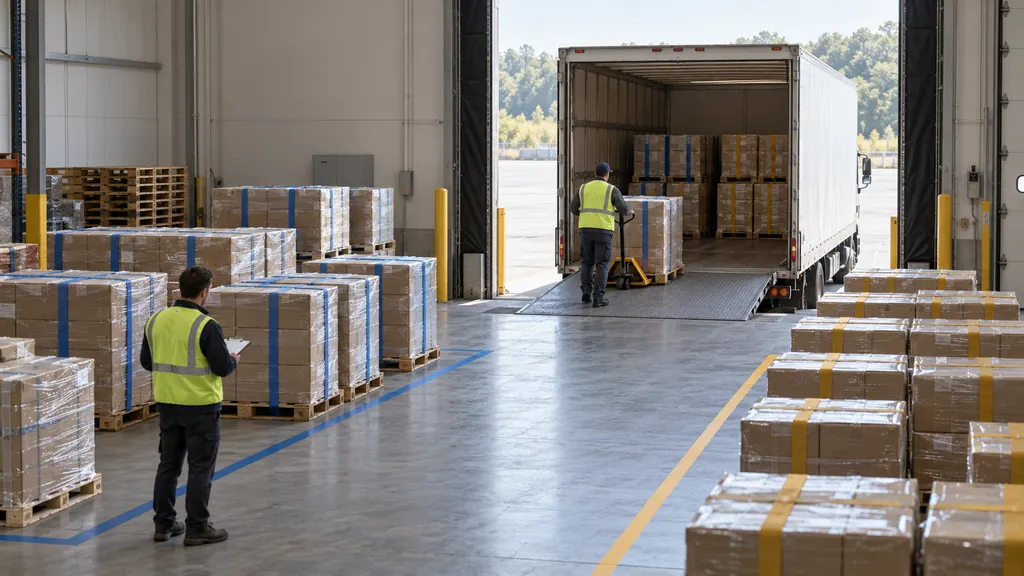
The term belongs to the broader field of collaborative logistics and is closely associated with horizontal cooperation between businesses operating at a similar level of the supply chain. Its precise scope varies: an arrangement may cover only a shared delivery route, or it may include consolidation, sorting, temporary storage, and delivery planning. In probability and statistics, joint distribution has a separate meaning: the probability distribution of two or more random variables considered together.
How Joint Distribution Works in Logistics
Joint distribution connects goods flows that would otherwise be managed separately. Participating shippers may organize the arrangement themselves or appoint a logistics service provider to coordinate it. The provider can remain operationally independent from the businesses whose goods it handles.
A shared operation does not require common ownership of the goods or a merger between the participating businesses. The essential feature is deliberate coordination of distribution resources across their shipments. The following sequence illustrates how such an arrangement may operate; it is not a prescribed industry standard.
- Identify compatible demand. Participants compare delivery areas, shipment sizes, collection schedules, and service requirements to determine whether their goods flows can be combined.
- Agree on operating responsibilities. The parties specify who receives goods, plans routes, handles exceptions, communicates with recipients, and pays the distribution charges.
- Provide shipment information. Each participant supplies the information needed for execution, such as destination, dimensions, handling restrictions, delivery window, and shipment identifier.
- Combine selected activities. Goods may be collected on a shared route, brought to a consolidation facility, or assigned directly to a common delivery vehicle.
- Deliver and record outcomes. The operator completes deliveries while maintaining shipment-level records, including delivery confirmation and exceptions.
- Allocate costs and review performance. Participants apply their agreed charging method and assess whether the arrangement meets its operational and commercial objectives.
Physical consolidation is one possible mechanism, but joint distribution is not limited to placing goods in the same vehicle. Shared route planning or coordinated use of a distribution facility may also form part of the arrangement. Its boundaries should therefore be established from the operating agreement rather than inferred from the label alone.
Where It Fits in the Supply Chain
Joint distribution concerns the movement and handling of goods between supply-chain locations or toward recipients. It may connect warehouses with retail outlets, regional depots with delivery areas, or fulfillment facilities with customers. It does not, by itself, determine how products are purchased, who owns inventory, or which business has contracted with the customer.
In ecommerce, separate sellers may retain their own order-management and inventory records while using a coordinated distribution operation. An order remains a commercial instruction from a customer; a shipment is the physical movement arranged to fulfill all or part of that order. Sharing a vehicle does not turn several sellers' orders into a single order or eliminate the need to identify individual shipments.
For cross-border ecommerce, joint distribution may be used for a domestic collection leg, a shared transport movement, or delivery after importation. It is not a customs procedure. Combining goods operationally does not, by itself, change the applicable declaration requirements, tax treatment, importer responsibilities, or restrictions on particular goods. Those matters depend on the relevant jurisdiction and shipment circumstances.
Operational Conditions and Decision Criteria
Geographic overlap alone is not enough to establish that joint distribution is suitable. Participants must also examine whether their service promises and handling requirements can coexist. The following are practical assessment dimensions, not formal categories of joint distribution.
| Dimension | What to examine | Why it matters |
|---|---|---|
| Delivery geography | Destination overlap, route density, and access restrictions | Widely separated destinations may require additional travel rather than create useful sharing. |
| Timing | Collection readiness, delivery windows, and dispatch deadlines | Waiting for one participant's goods may delay other shipments. |
| Goods compatibility | Temperature, contamination risks, security, and handling restrictions | Some goods require separation or dedicated equipment. |
| Capacity | Weight, volume, pallet positions, and loading sequence | Available space does not necessarily mean usable capacity for every shipment. |
| Information quality | Accurate addresses, shipment identifiers, dimensions, and status events | Shared operations still require reliable shipment-level execution and records. |
| Commercial rules | Charging, liability, confidentiality, and exit provisions | Operational savings may not translate into an acceptable outcome for every participant. |
Delivery frequency also matters. Combining departures may improve vehicle utilization, but less frequent dispatch can increase waiting time. Conversely, maintaining every participant's existing schedule may leave limited scope for consolidation. The relevant question is whether the proposed arrangement meets agreed service requirements at an acceptable total cost.
Potential Benefits and Limitations
Research on horizontal logistics cooperation identifies opportunities to improve resource use alongside organizational and commercial impediments. Joint distribution may reduce duplicated journeys, improve vehicle loading, or spread selected operating costs across more shipments. These are potential outcomes, not defining characteristics or guaranteed results.
Any assessment should include the resources added by cooperation. These may include transfer movements, sorting, facility handling, coordination work, information-system integration, and time spent resolving exceptions. A reduction in delivery-route distance does not necessarily establish a reduction in total logistics cost.
Environmental claims require similar care. Fewer vehicle trips on one part of a network may be offset by additional collection movements, detours, or facility activity elsewhere. A defensible comparison needs a clear baseline and consistent boundaries, rather than assuming that shared distribution is automatically lower-emission.
Governance can be as important as route design. Participants may disagree over how savings are measured, how scarce capacity is assigned, or who bears the cost of a failed delivery. Businesses that compete commercially also need appropriate controls over sensitive information. Competition-law requirements depend on jurisdiction; describing an arrangement as logistics cooperation does not establish that every form of information sharing is permissible.
Joint Distribution and Related Terms
| Term | Relationship to joint distribution | Important distinction |
|---|---|---|
| Shipment consolidation | Combines smaller shipments into a larger transport movement. | It is a handling or transport mechanism and does not necessarily involve a broader cooperative arrangement between shippers. |
| Horizontal logistics cooperation | Describes cooperation between businesses at a similar supply-chain level. | It is broader than distribution and may include purchasing, warehousing, or other logistics activities. |
| Shared warehousing | Allows multiple businesses to use warehouse resources. | Sharing storage does not necessarily mean that outbound transport is coordinated. |
| Cross-docking | Transfers goods from inbound to outbound transport with limited storage. | It can support joint distribution, but it can also serve a single business. |
| Third-party logistics | Places specified logistics activities with an external provider. | Outsourcing alone does not establish joint distribution; the provider may manage each customer's operation separately. |
Illustrative Example
Two retailers may supply stores in the same urban district from separate warehouses. Under independent arrangements, each retailer schedules its own delivery vehicle. Under a joint arrangement, a coordinating operator may collect both retailers' goods, sort them by destination, and plan shared delivery routes.
The retailers can retain separate inventory ownership, sales records, and shipment references. The operator needs instructions that distinguish each retailer's goods and record the outcome of each delivery. If one shipment is refused, the agreement should identify who authorizes its return and how the additional handling is charged.
This hypothetical arrangement is useful only if the combined operation satisfies the retailers' requirements. Incompatible delivery windows, extra transfer handling, or long collection detours could outweigh the value of sharing the final route. The example illustrates the mechanism rather than demonstrating a guaranteed saving.
Operational Controls
A joint distribution agreement should make the shared operation understandable at shipment level. Useful controls include the following:
- Defined scope: identify the facilities, transport legs, goods, and services included.
- Responsibility allocation: establish who handles loading, damage reports, delivery failures, claims, and returns.
- Shipment traceability: retain identifiers that connect each physical movement to the relevant participant's records.
- Service measurement: define delivery performance, exception reporting, and the treatment of missing information.
- Cost allocation: document the charging basis and how additional handling or unused reserved capacity is treated.
- Data governance: limit access to information according to operational need and applicable obligations.
- Change and exit procedures: explain how participants adjust volumes, revise schedules, or leave the arrangement.
Returns require particular attention because a shared outbound route does not automatically include reverse logistics. Collection authorization, identification, inspection, and return destinations need their own instructions if they fall within the operation.
QA
Is joint distribution the same as shipment consolidation?
No. Consolidation combines shipments for transport. Joint distribution is a cooperative operating arrangement that may use consolidation alongside shared planning, facilities, or delivery resources.
Do participants have to share a warehouse?
No. They may retain separate warehouses while coordinating collection or delivery. A shared facility is one possible component, not a requirement.
Does joint distribution always reduce costs?
No. Potential savings must be compared with additional handling, transfers, coordination, and service-related costs. Results depend on the specific network and agreement.
What does joint distribution mean in statistics?
In statistics, it describes the probabilities associated with two or more random variables considered together. That mathematical meaning is separate from the logistics arrangement described here.
Sources
- Cruijssen, F., Cools, M., and Dullaert, W. — Horizontal cooperation in logistics: Opportunities and impediments. Academic foundation for the discussion of logistics cooperation, potential operational benefits, and barriers to implementation.
- Wikipedia — Joint probability distribution. Reference for distinguishing the statistical meaning from the logistics meaning.